At 36, Hannemann-Gago still enjoys the game of basketball
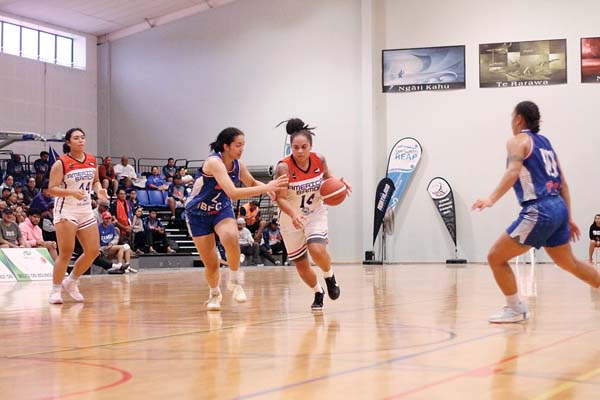
Mahina Hannemann-Gago, an associate athletic director for Kamehameha Schools Maui, dribbles the ball down the court last month during the Polynesia Basketball Cup in New Zealand. Bryan Montuya photo
After returning from the 2022 FIBA Polynesia Basketball Cup, Mahina Hannemann-Gago shows that it’s never too late to pursue or continue competing in sports.
Hannemann-Gago, an associate athletic director for Kamehameha Schools Maui, hasn’t played competitive basketball since graduating from Brigham Young University-Hawaii in 2010, but that didn’t stop her from leading the American Samoa women’s national basketball team to a gold medal in 2019 at the Pacific Games in Apia, Samoa.
Then, following the COVID-19 pandemic, she played point guard for American Samoa again last month at the Polynesia Basketball Cup in New Zealand on two-weeks’ notice.
“It’s never too late to compete at that level,” the 36-year-old said last week. “So even, too, when we talk about those Maui athletes who think that ‘Oh, I graduated and I didn’t go to college, so I’m pau’ — no, there are so many opportunities to compete internationally and get exposure.”
She’ll continue to play basketball until “I can’t walk anymore.”
“That’s my goal and we joke about it every time I go back to Samoa because, no joke, I’m the oldest one, but I always tell them that as long as I don’t look old and I’m not playing like I’m old, I’ll always play,” she said. “And when I can’t, I’ll just go into a coaching capacity.”
During her 10-year hiatus from competitive sports, she spent time in South Dakota earning her masters degree and doctorate, coaching college basketball, becoming a high school administrator, and finally, associate athletic director for the Warriors.
Also a master athletic administrator under the National Interscholastic Athletic Administrators Association as of 2019, one the few women in Hawaii with that certification, Hannemann-Gago is passionate about exposing Maui student-athletes to sports opportunities beyond the island and beyond high school.
“Any chance I get to represent American Samoa and Hawaii — because I am Hawaiian, too — but any opportunity I get is so humbling because I think sometimes growing up in the states, I sometimes take for granted what kind of life we live out here and what kind of access we have to resources back in the islands,” she said. “It was such a good experience outside of basketball itself. For me, at this point in my life, that’s what it’s all about–networking, making connections, continuing to evolve my identity and representing the place that my family came from in order to even give me the opportunity to experience these things.”
American Samoa won one of its four group phase games, against Tonga (98-88) on the third day of competition. Hannemann-Gago led the team with 11 rebounds and added nine points.
Throughout the tournament, she averaged 10.5 points, 8.3 rebounds and 3.5 assists per game.
One of the main requirements to play for American Samoa is to have the respective ancestral ties. The National Olympic Committee then whittles down the recruits based on who is playing or have recently played collegiate basketball. Evaluating game footage and contacting coaches are also part of the recruiting process.
Athletes must also be cleared through FIBA, the International Basketball Federation that governs and organizes the sport of basketball.
Though Hannemann-Gago doesn’t train and compete like she once did, she still has the competitive attitude.
“I wouldn’t miss a lot of them, but I would joke with the girls, like, ‘Oh my gosh, 10 years ago, I would have gotten that pass or two years ago I would have been able to jump for that rebound.’ So, I would just make it fun because if you’re not having fun, then what’s the point,” she said.
The KSM administrator wasn’t planning on playing as many minutes as she did, too, but there were only eight players and one teammate got injured early on in the tournament.
“I ended up playing every minute of every game,” she said with a laugh.
Representing her heritage, having and sharing new experiences, and learning more about the different Polynesian cultures is what’s most important.
“Every time, I meet such good people. It’s the people that make such good experiences,” she noted. “On the professional side of things, I’m always looking for opportunities to expose our athletes here in Hawaii to international things.”
* Dakota Grossman is at dgrossman@mauinews.com.
-
- Mahina Hannemann-Gago, an associate athletic director for Kamehameha Schools Maui, dribbles the ball down the court last month during the Polynesia Basketball Cup in New Zealand. Bryan Montuya photo
Local Sports
Joshua Walker named Rainbow Wahine volleyball coach
Aloha Volleyball Association wins back-to-back championships
Lilinoe Peterson: Sports Spotlight June 4
Jona Dudoit: Sports Spotlight June 4

Sentry to take over as title sponsor of PGA Tour event at Torrey Pines