
Maui squadron of Civil Air Patrol celebrates its 75th anniversary
Commander of Hawaii wing addresses Maui questions, disputes
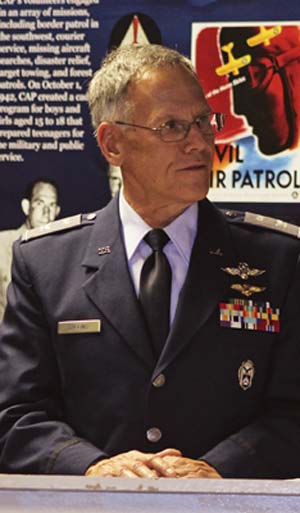
Col. Patrick Collins, commander of the Civil Air Patrol Hawaii Wing, addresses the audience during the celebration of CAP’s 75th anniversary. The organization is the civilian auxiliary of the U.S. Air Force. The Maui News / COLLEEN UECHI photo
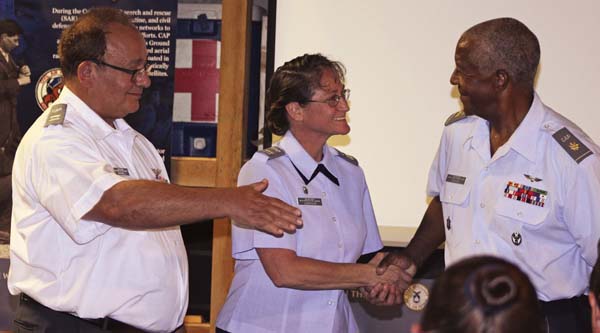
Civil Air Patrol Capt. Joseph Bardwell (from left), Capt. Chantal Lonergan and Maj. Charles Dryden Jr. shake hands after being announced as the new leadership of the Maui County Composite Squadron Tuesday at the group’s headquarters at Kahului Airport. The Maui News / COLLEEN UECHI photo
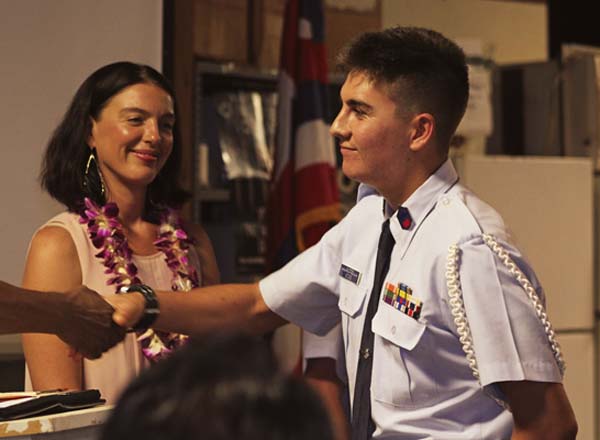
Chief Master Sgt. Harlie Stone, who earned his private pilot certification in August, was among several cadets to receive a promotion during the 75th anniversary celebration. The Maui News / COLLEEN UECHI photo
Col. Patrick Collins, commander of the Civil Air Patrol Hawaii Wing, addresses the audience during the celebration of CAP’s 75th anniversary. The organization is the civilian auxiliary of the U.S. Air Force. The Maui News / COLLEEN UECHI photo
Civil Air Patrol Capt. Joseph Bardwell (from left), Capt. Chantal Lonergan and Maj. Charles Dryden Jr. shake hands after being announced as the new leadership of the Maui County Composite Squadron Tuesday at the group’s headquarters at Kahului Airport. The Maui News / COLLEEN UECHI photo
Chief Master Sgt. Harlie Stone, who earned his private pilot certification in August, was among several cadets to receive a promotion during the 75th anniversary celebration. The Maui News / COLLEEN UECHI photo
Trending
KAHULUI -- Col. Patrick Collins, commander of the Civil Air Patrol Hawaii Wing, said last week that the incident in which Maui County's squadron was without its mission airplane for almost a year "would never happen" . . . "not under my command."
Collins came to Maui Tuesday to celebrate the 75th anniversary of Civil Air Patrol, and he addressed questions about the Maui squadron, with its history of internal disputes intensifying when its plane was kept on Oahu for maintenance from March 2014 to March 2015, save for one 12-day period.
"Put it in large block letters," Collins emphasized. "That would never happen. The mission's too important."
On Tuesday, Collins also recognized the new leadership of the Maui County Composite Squadron, a merging of two local crews under the formerly disbanded 57th squadron's number. Capt. Chantal Lonergan will head up the new squadron, with Capt. Joseph Bardwell leading the senior, or active, members and Maj. Charles Dryden Jr. in charge of cadets.
Collins said Lonergan was the unanimous choice of Hawaii Wing staff. A 10-year Air National Guard veteran, Lonergan has five years of experience with CAP and was formerly the commander of the 76th squadron. She said she's focusing on "achieving the unification of the two squadrons."
"I think issues arose in the past because the vision for the unification may not have been communicated as clearly as it could have been to members that were less active," Lonergan said. "Questions arose that weren't being answered. That builds anxiety, fear."
Maui previously had two squadrons -- the 57th, which was chartered in Kahului in 1974, and the 76th, which was chartered in Kihei in 2008. In August 2014, the two squadrons merged under the 76th due to a decline in active members in the 57th, according to then-wing Cmdr. Col. Jeff Wong. The 57th was disbanded on the day that Hurricane Iselle hit the islands.
Kahului members said they were pushed out of the new squadron and forced to give up their longtime headquarters at the Kahului Airport. They accused then-Vice Cmdr. Maj. Eduardo Zayas of abusing his power. An independent review panel convened by the national CAP organization found that "more likely than not" the removal of former squadron Cmdr. Bobby Hill was "motivated by retaliation" after he filed complaints against Wong and Zayas, according to a Jan. 7, 2015, Maui News story.
Tensions also arose over the airplane, which was taken off of Maui for a cracked engine and other maintenance. Collins said if Maui's plane had to undergo work again, he would station another on the island, instead of having the Kona squadron cover Maui as was the case in the past.
"Even if it was waiting for an engine, that's it. Put that (extra) airplane from Kauai on Maui," he said.
Wong was later transferred to CAP's Pacific Region headquarters. Zayas was found guilty of forging a document to give himself credentials to fly young cadets, and is no longer a part of CAP.
With a change in command and attempts at more "open, clear communication," Lonergan said the current transition to one unit is "absolutely" going smoother than the first.
"Different leadership always brings a different dynamic," Lonergan said. "Currently the wing leadership is highly supportive and has come out in person to meet with the membership, explain the vision and allow them to ask questions. And I've seen really positive response from most members. The active membership that you see here tonight is a blend of both squadrons."
Lonergan said Bardwell is from the 57th and Dryden is from the 76th.
Collins agreed that the transition is moving along well.
"I won't tolerate anything else," he said.
Collins, a veteran pilot who spent 31 years with United Airlines, 15 years with the U.S. Navy and six years with CAP, took over for interim Cmdr. Col. John Henry Felix in February. He said he hoped to "incorporate all islands" moving forward, through regular joint meetings and joint training.
The U.S. Civil Air Patrol is the official civilian auxiliary of the U.S. Air Force. The volunteer organization performs three primary missions: emergency services, aerospace education and cadet programs for youth.
CAP was formed in 1941, a week before the Japanese attack on Pearl Harbor, according to its website. Concerned with the growing threat of war, Gill Robb Wilson, a World War I aviator and New Jersey director of aeronautics, launched an organization of volunteer aviators eager to assist in defense efforts. In 1942, armed CAP aircraft patrolled the Atlantic and Gulf Coasts to help stop German submarines from attacking shipping vessels. CAP pilots also patrolled the southwest border and helped with missing aircraft searches, disaster relief and forest patrols.
After the war in 1946, President Harry Truman signed a law officially making CAP a nonprofit, and in 1948, Congress established the CAP as the auxiliary of the U.S. Air Force.
CAP now has a wing in every state, the District of Columbia and Puerto Rico. The Hawaii Wing has 10 Cessna mission planes, 34 pilots, more than 300 cadets and a little under 300 senior members statewide, Collins said. The whole organization gets about $94,000 a year from the state, Collins said.
Maui has one plane along with five pilots and two in training, Lonergan said. Squadron members have participated in several missions throughout the year, including three statewide tsunami response exercises, three county emergency response missions, more than a dozen transport missions and 47 cadet orientation rides.
* Colleen Uechi can be reached at cuechi@mauinews.com.