
Molokai robotics soars high at VEX IQ World Championships
Molokai’s Kualapuu School and Middle School joined with Pukalani Elementary to represent Maui County
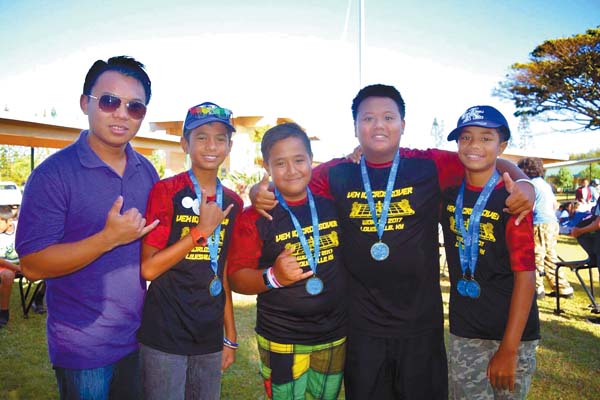
Kualapuu robotics coach Edwin Mendija (from left), Naiwa Pescaia, Jaryn Kaholoaa, Aron Corpuz and John Quintua-Salavea pose with their medals back home on Molokai. The Kualapuu School 6th-graders qualified for the 2017 VEX IQ World Championship in Louisville, Ky., last month. Pescaia and Quintua-Salavea paired up with a Canadian team to take second place in the world finals. Photo courtesy of Edwin Mendija
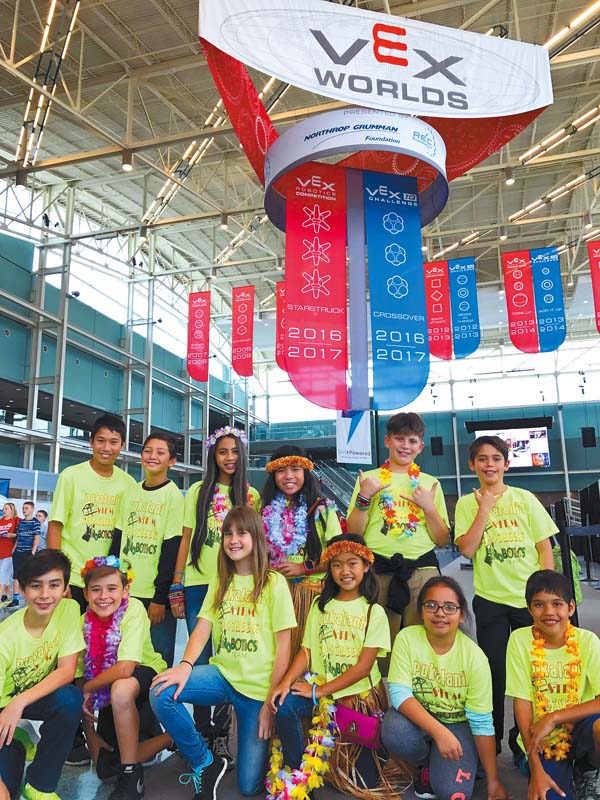
Fourth- and 5th-graders with Pukalani Elementary’s robotics team are all smiles at the VEX IQ World Championship in Louisville, Ky. One of Pukalani’s two teams qualified, but coaches Jasmine Domingo and Debbie Hisashina wanted all the students to experience top-level competition. Photo courtesy of Jasmine Domingo
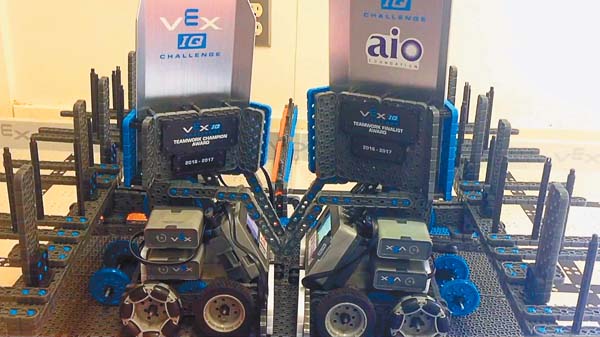
Kualapuu’s robots sit with the team’s awards from the world championship competition. Coach Edwin Mendija said he’ll have to buy a new robot for the team because the winning one is going on display. Photo courtesy of Edwin Mendija
Kualapuu robotics coach Edwin Mendija (from left), Naiwa Pescaia, Jaryn Kaholoaa, Aron Corpuz and John Quintua-Salavea pose with their medals back home on Molokai. The Kualapuu School 6th-graders qualified for the 2017 VEX IQ World Championship in Louisville, Ky., last month. Pescaia and Quintua-Salavea paired up with a Canadian team to take second place in the world finals. Photo courtesy of Edwin Mendija
Fourth- and 5th-graders with Pukalani Elementary’s robotics team are all smiles at the VEX IQ World Championship in Louisville, Ky. One of Pukalani’s two teams qualified, but coaches Jasmine Domingo and Debbie Hisashina wanted all the students to experience top-level competition. Photo courtesy of Jasmine Domingo
Kualapuu’s robots sit with the team’s awards from the world championship competition. Coach Edwin Mendija said he’ll have to buy a new robot for the team because the winning one is going on display. Photo courtesy of Edwin Mendija
Trending
Up against stiff international competition, Molokai's Kualapuu School captured second place at the 2017 VEX IQ World Championship last month, the highest-ever finish for a Hawaii elementary school at that event, Kualapuu coach Edwin Mendija said.
From April 20 to 25, teams from elementary to college brought their best robots and brightest minds to Louisville, Ky. At the elementary level, 272 teams from more than 30 countries competed. Kualapuu, which was paired with Canada's Brampton Robotics Education, finished second with 94 points, right behind two Chinese teams that combined for 99 points.
It was Kualapuu's first trip to the world robotics stage and another success story for an island where robotics talent continues to bloom.
"I never thought this would happen within two years of doing a program," said Mendija, who's also the school's technology coordinator. "I don't want it to be a one-time thing. I want it to be something we strive to hit every time."
Pukalani Elementary and Molokai Middle School, which competed at the middle-school level, also represented Maui County in Kentucky. Pukalani came in fifth, and Molokai Middle School finished third in the Teamwork Division that took place before the final rounds.
"We had all these obstacles," said Jasmine Domingo, Pukalani's coach and curriculum and STEM (science, technology, engineering and math) coordinator. "They never gave up. They never shed a tear. They never grumbled. They kept plugging away and just doing what they had to do."
Kualapuu took four students to the competition, all 6th-graders. Aron Corpuz and Jaryn Kaholoaa formed Team 1037A, while John Quintua-Salavea and Naiwa Pescaia competed as Team 1037B, which took second place.
The competition kicked off with a Robot Skills Challenge, in which teams tried to score as many points as possible in a 1-minute driver skill challenge and 1-minute programming challenge, which requires teams to program their robot instead of using a remote to control it.
Programming was the hardest part of competition, Quintua-Salavea said. But from there on, he and his teammates ran into few problems.
The next stage was the Teamwork Challenge, which divided competitors into four different divisions. Teams were randomly paired and had to work together to get the highest possible score in a game called "crossover." Drivers had one minute to send their robots to pick up balls and carry them to different scoring zones. They finished by balancing their robots on a seesawlike bridge.
The top-seeded Kualapuu Comets and second-seeded Brampton Discobots, the defending world champs, won their division together with 93 points and advanced to the finals.
"They ended up being the perfect complementary alliance," Mendija said. Each team's "robots could do something the other robots couldn't do."
The final matches can intimidate many teams -- thousands are watching, the sound system is booming and "all the lights are on you," said Mendija, who was so nervous he kept his distance from the team.
In the finals, teams took on the same "crossover" challenge. Kualapuu and Brampton did even better with 94 points, bested only by the Chinese.
Coming on stage to get their awards, "it was kind of like a rock concert," Quintua-Salavea said. "I just felt awesome."
"I think if I held both (trophies) I would've dropped to the ground," he added.
Teammate Pescaia said robotics has taught him "that not everything is easy," but he said he wasn't nervous during the world finals and didn't have trouble with the competition.
"That was the crazy thing," Mendija said. "They had almost a flawless tournament. They missed maybe a few points here and there. I think only once was it their own fault. . . . They carried a lot of their partners."
What really set Kualapuu apart was "their ability to work with other teams," Mendija said. Before competition started, Mendija took his students to find their teammates and strategize together. Kaholoaa said the hardest part was the Teamwork Challenge, but that he picked up new skills and lessons about "working together and teamwork."
Mendija hopes Kualapuu's performance will draw in more sponsors. The island is full of robotic talent, he said. On Molokai, every public and private school is involved in robotics, and Molokai Middle School has gone to the world championship three times.
"We're just trying to maintain the Maui County and Molokai presence at worlds, and at the same time trying to support and encourage our elementaries," said Kaeo Kawaa, who coaches the middle school team with his wife Kahoiwai. "This past year, we also at the high school made it to the national level. For Molokai, we're represented at all levels, which is kind of cool."
At the world competition, Pukalani students also presented their STEM project, which took first place in the state. Students chose the problem of bullying and researched ways that robotics could solve it. They suggested a robot that could befriend a bully, sense when the child was feeling agitated (similar to the way a mood ring senses temperature changes) and help the child calm down.
Domingo said the Maui community helped Pukalani raise more than $25,000 to attend.
"When we went up, I told the kids, 'Look how many people believe in you, and this is like your job, so you have to do your best and give back to the community that gave you this opportunity,' " she said.
* Colleen Uechi can be reached at cuechi@mauinews.com.