
Wildfire lessons learned
Better brush management in fire-prone areas can reduce risks
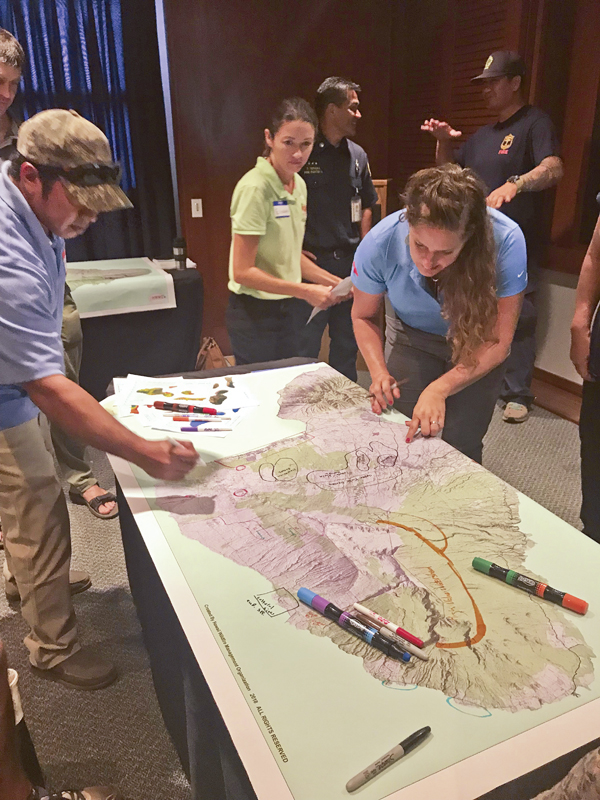
Auwahi Wind project biologist George Akau (from left), Hawaii Wildfire Management Organization Executive Director Elizabeth Pickett and Vares Contracting General Manager Lisa Vares look over a map of Maui to determine priorities for wildfire protection at a “Maui Vegetative Fuels Management Collaborative Action Planning Workshop” on Thursday at the Maui Arts & Cultural Center. -- The Maui News / MELISSA TANJI photo
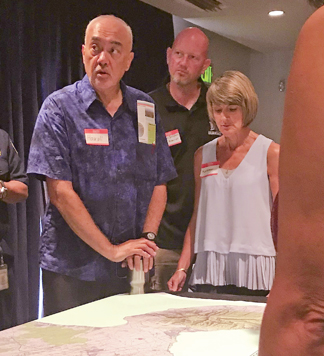
John Hau‘oli Tomoso (from left), executive director of the Tri-Isle Resource Conservation and Development Council; Tim Griffith Jr., Maui County arborist; and Kathleen Aoki, plan implementation division administrator at the Maui County Planning Department, listen before they determine wildfire protection priorities for West Maui at the “Maui Vegetative Fuels Management Collaborative Action Planning Workshop” on Thursday at the Maui Arts & Cultural Center. -- The Maui News / MELISSA TANJI photo
Auwahi Wind project biologist George Akau (from left), Hawaii Wildfire Management Organization Executive Director Elizabeth Pickett and Vares Contracting General Manager Lisa Vares look over a map of Maui to determine priorities for wildfire protection at a “Maui Vegetative Fuels Management Collaborative Action Planning Workshop” on Thursday at the Maui Arts & Cultural Center. -- The Maui News / MELISSA TANJI photo
John Hau‘oli Tomoso (from left), executive director of the Tri-Isle Resource Conservation and Development Council; Tim Griffith Jr., Maui County arborist; and Kathleen Aoki, plan implementation division administrator at the Maui County Planning Department, listen before they determine wildfire protection priorities for West Maui at the “Maui Vegetative Fuels Management Collaborative Action Planning Workshop” on Thursday at the Maui Arts & Cultural Center. -- The Maui News / MELISSA TANJI photo
Trending
KAHULUI -- Unmanaged grass, brush, high winds from approaching Hurricane Lane and dry summer weather were a perfect recipe for the Lahaina wildfires that torched more than 2,000 acres last month, a wildland fire management specialist said.
"All the conditions were aligned for those fires to happen," said Clay Trauernicht, an assistant specialist with the University of Hawaii at Manoa's Department of Natural Resources and Environmental Management. His research includes fire ecology.
Trauernicht was a speaker at last week's Hawaii Wildfire Management Organization workshop at the Maui Arts & Cultural Center.
Following his talk, he said the West Maui fires came as no surprise because wildfires were breaking out across the state in August. This included the nearly 9,000-acre brush fire on Oahu's Leeward Coast and the wind-whipped fire in Waikoloa on Hawaii island that burned around 18,000 acres.
"We were trying to get the word out. It was not unpredictable."
But the Lahaina fires occurred at "the worse timing imaginable."
"People weren't thinking about it. Everyone was trying to get ready for the storm" Trauernicht later said.
Three brush fires broke out from Maalaea to Kaanapali in a nearly 10-hour span from Aug. 23 to 24 as then-Hurricane Lane made its approach to the islands. Later, it fizzled into a tropical storm. With the fires, hundreds of people were evacuated. At least 21 homes were damaged or destroyed. The second of three fires, which broke out around 12:45 a.m. Aug. 24, was the most widespread with around 1,500 acres scorched. It was first reported at Kauaula Valley and Punakea Loop, then spread to Lahainaluna Road.
There were no updated cost figures or damage estimates from the county last week.
Addressing whether the fires could have been prevented or less widespread, Trauernicht said some things could have been prevented, but other conditions could not be controlled.
Grass and brush, or the "fuels" in the wildfires, could have been managed better to try to help prevent fires, he pointed out. But he added that Maui firefighters "did as much as they could" to combat the blaze that broke out in the middle of the night amid high winds. Because of darkness and wind gusts in excess of 50 mph, helicopters were unable to provide water drops in the early hours of the fire.
"When it sparked, (there was) nothing really in place, not much in place to help firefighters put that thing out," he said.
Trauernicht said what could have helped was better management of vegetation such as haole koa and guinea grass, which are often found on vacant lands and tend to burn quickly, especially when it's windy.
Last winter's heavy rains built up the vegetative fuel for the fires, he said.
Residents can help reduce wildfire risks by ensuring flammable material is not near structures and that gutters and roofs are clear of debris, he said.
People believe that homes burn when flames reach them, but actually the structures burn after embers fall upon them, Trauernicht said.
The Hawaii Wildfire Management Organization says that wildfire embers can ignite a home up to a mile away.
"What did we learn at the end of the day?" Trauernicht asked, summing up what happened with the Lahaina fires. "It just shows how vulnerable we are."
For now, it looks like recent rainy weather has reduced the risk of wildfires.
The nonprofit Hawaii Wildfire Management Organization hosted a "Vegetative Fuels Management Collaborative Action Planning Workshop" Thursday at the Maui Arts & Cultural Center.
Based on Hawaii island, the organization serves as a hub for wildfire prevention, mitigation and planning activities in the Pacific region. It is gathering information from the community about priorities for wildfire protection as well as suggestions for potential action plans to manage fire-susceptible vegetation, said Pablo Beimler, community outreach coordinator for the organization.
The organization was working on the project prior to this year's wildfires, and it met with owners of large amounts of land at the beginning of this year to identify priorities and prevention strategies, Beimler said.
People cannot control the weather that may lead to wildfires, but they can control brush that fuels wildfires, Beimler said.
Some examples of vegetative fuels management include weed control, mowing, grazing, brush abatement, roadside and firebreak maintenance.
This year, wildfires have burned 34,000 acres statewide, which is twice the annual average, according to the organization.
The wildfire management organization works with 35 agency partners, including fire departments on all islands and the state Department of Land and Natural Resources, including its Division of Forestry and Wildlife.
Around 50 people participated in last week's workshop, including Maui firefighters, property owners and community members. They worked to identify priority areas to protect from wildfires in West, East and Central Maui. Important areas included those with larger populations and critical infrastructure and areas prone or susceptible to wildfires.
Some of the most critical areas of protection the attendees identified included Lahaina and nearby Launiupoko, where the wildfires broke out during Hurricane Lane. Other areas were highly populated Kahului and Wailuku, Kahikinui and the Kula Forest Reserve.
Workshop attendees came up with ways to reduce wildfire risks, including clearing brush and vegetation around transformers and utilities in Lahaina; creating "fuel breaks," or altering vegetation, to control fires that could break out in Kahului; and creating access areas and firebreaks for residents and first responders in Kahikinui.
In several months, the priorities and potential action plans to manage vegetation on the island will be summarized and mapped, and informational fact sheets will be created for public information, Beimler said.
Community groups can use the information to seek help and funding from agencies or the government to manage vegetation, he added.
At the workshop event, Trauernicht said that 99 percent of wildfires in Hawaii are started by people, and 75 percent of that is by accident.
So, if people change their behaviors, that could prevent many fires, he pointed out.
He advised being careful when using machinery that could spark and start a fire. Such equipment includes weed whackers, chain saws, grinders, welding equipment and all-terrain vehicles, according to information from the Hawaii Wildfire Management Organization.
For more information, see Hawaiiwildfire.org.
* Melissa Tanji can be reached at mtanji@mauinews.com.