
Commission takes DOE official to task
Members reaffirm support for under- or overpass to Kihei high school
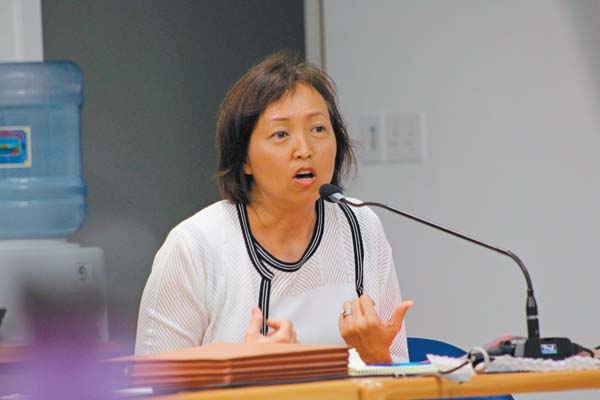
Gaylyn Nakatsuka, planning coordinator with the state Department of Education, explains plans to put in a signal at the intersection of Piilani Highway and Kulanihakoi Street. The Maui News / COLLEEN UECHI photos
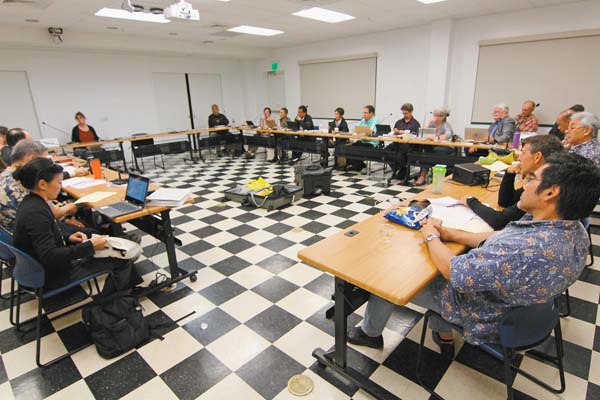
The state Land Use Commission discusses pedestrian crossing options to Kihei high school during a meeting at the Malcolm Center in Kihei on Wednesday. The commission took the state Department of Education to task, wanting to know who made the decision to not build an overpass or underpass to the school, a condition the commission placed on the project.
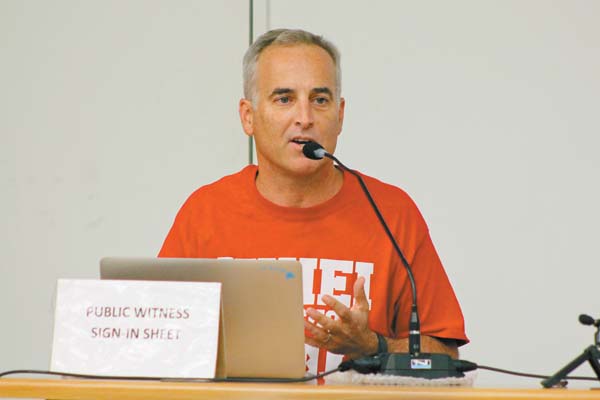
Andrew Beerer, chairman of the Kihei High School Action Team, advocates for an underpass during testimony at the meeting.
Gaylyn Nakatsuka, planning coordinator with the state Department of Education, explains plans to put in a signal at the intersection of Piilani Highway and Kulanihakoi Street. The Maui News / COLLEEN UECHI photos
The state Land Use Commission discusses pedestrian crossing options to Kihei high school during a meeting at the Malcolm Center in Kihei on Wednesday. The commission took the state Department of Education to task, wanting to know who made the decision to not build an overpass or underpass to the school, a condition the commission placed on the project.
Andrew Beerer, chairman of the Kihei High School Action Team, advocates for an underpass during testimony at the meeting.
Trending
KIHEI -- The state Land Use Commission grilled a state education official about the Kihei high school on Wednesday night, wanting to know who made the call to do away with plans for an overpass or underpass to the school.
The commission, which had made it a condition of the project that the state build one or the other, was upset that the department planned only a traffic signal at the intersection.
"This is a classic case of unacceptable bureaucrats working behind the scenes without consulting with the community, without consulting with legal authorities about exactly what was meant," Commission Chairman Jonathan Scheuer said.
The commission was reviewing the issue because the Maui County Council passed a resolution earlier this month asking the commission to reaffirm the requirement for a pedestrian overpass or underpass.
Based on precedent from the Bridge Aina Lea case on the Big Island, the commission can’t enforce the condition with work on the site already underway. That means it falls to the county.
"This is an extremely important condition, and if it holds up the high school for one year or two years, and it even saves one life, it will be worth it," Council Chairwoman Kelly King told the commission. "I don’t accept the fact that it’s OK for the first 800 students to walk across that highway, and we can wait for the next phase."
The safe crossing debate has been an issue for a community that’s eager to see the school built but not at any cost.
Andrew Beerer, chairman of the Kihei High School Action Team, said that after years of disappointments, "we became desperate again and considered even waiving these important conditions so we could open the school."
But Beerer said the conditions are the only way for the community to hold the department accountable.
"We have been threatened with fear of them not opening the school on time, fear that we’d somehow be to blame for slowing it down, fear that flooding would sweep innocent people through the underpass, fear that it would be a haven to homeless and criminal activity," Beerer said. "That’s all baloney. We endorse the study done by Dan Burden."
Burden is the co-founder of the Walkable and Livable Communities Institute, which did a pedestrian route study for the department in 2014. The study recommended a crossing at street level to the school, as well as an underpass.
An overpass or underpass "is most appropriate over high-volume, high-speed highways," but it can be costly and difficult to build in compliance with ADA requirements, the report said. Studies also show that "many pedestrians will not use an overpass or underpass if they can cross at street level in about the same amount of time or less." Lighting, drainage and security are also concerns.
But South Maui residents said it was hard to imagine students and teachers crossing the busy four lanes of high-speed traffic on Piilani Highway. Dezireen Austin recalled how her son, a former student at Kihei Charter School, was biking across the highway about two years ago when a car nearly clipped him and knocked his shoe off.
"That has always stuck in the back of my mind," Austin said. "So when I heard there was the possibility that there would not be an under- or an overpass, I became concerned."
Mike Moran, president of the Kihei Community Association, said that he’s seen Kihei Charter students walk through a drainage culvert under the highway to get to school every day.
"If that was a common practice, imagine how many more would use a true, safe accessway when they can ride those bicycles and walk upright," Moran said.
But Gaylyn Nakatsuka, planning coordinator with the Education Department, said that a traffic report and pedestrian study approved by the state Department of Transportation in 2017 "show current conditions warrant a signalized intersection at Piilani Highway and Kulanihakoi Street, and that a grade-separation pedestrian crossing (e.g. an underpass or overpass) is not warranted at this time."
She said work on the signalized intersection will start in May and will eventually be converted to a four-way intersection before the school opens in 2021.
Several commissioners asked Nakatsuka who made the decision to not do an overpass or underpass.
"There was a study that was done," she said. "DOT reviewed it, and it agreed that there was no need for a grade-separated crossing."
When pressed further on whether the education or transportation department made the final call, Nakatsuka did not single out either.
"A study was done, it was identified that based on the warrant system and with the review of the study by Fehr & Peers that a grade-separated crossing was not required," she said. "There was no decision of ‘let’s decide whether we should put one in or not.’ It was just looking at what was warranted based on the study."
Frustrated commissioners criticized Nakatsuka’s "double talk" and said they had been very clear when they made the condition in the first place.
"This commission, at least speaking for myself, is incredibly clear at what that condition meant, and it is for a grade-separated bypass prior to the opening of the first phase," Scheuer said. "Now, our hands are tied because of the Bridge Aina Lea case. . . . All we can do is clarify what our intentions were and have a little bit of moral indignation.
“And let me say, I have a lot of moral indignation."
The commission didn’t plan to take any action Wednesday. Executive Officer Daniel Orodenker said it will schedule another hearing and issue a decision on the county’s request for a declaratory order before the end of April.
Acting Planning Director Michele McLean said Thursday that "it seems quite clear that the LUC meant for the over/underpass to be a requirement -- and not an option or something that could be deferred if a study says it’s not warranted."
"Given that, the county can administer and enforce accordingly," McLean said. "I doubt that the DOE will proceed with new major work without figuring out how to provide the over/underpass. But if they do, our options would be to not sign off on building permits or other permits, certificates of occupancy and other needed approvals."
McLean said the department also could enforce through notices of warning and notices of violation for noncompliance with LUC and zoning conditions, "if it appears that they are in violation."
West and South Maui Sen. Roz Baker, who’s long been involved in the project, said Thursday that "the school needs to continue to go forward," and that ongoing work gives the community time to discuss more modern safety measures than an underpass.
"Things have changed since some of this stuff was talked about," she said. "I just think we need to be looking at some of the more creative and interesting options to provide for the safety of students and others in the area."
Baker echoed concerns about the underpass being costly, creating a flooding hazard or going unused.
"I’ve been talking with DOT on some other traffic-calming kinds of things," Baker said. "Part of the problem is people are speeding on Piilani Highway, and that needs to stop anyway, irregardless of whether there was a school there or not."
* Colleen Uechi can be reached at cuechi@mauinews.com.