
Remembering the sacrifices of ‘The Forgotten War’
Ceremony pays special tribute to Korean War veterans
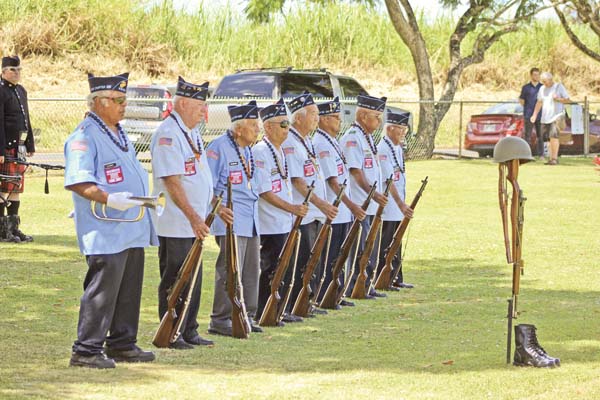
Maui County veterans of the Korean War stand ready for the 21-gun salute near the close of the annual Memorial Day ceremony at the Maui Veterans Cemetery in Makawao on Monday morning. The ceremony, sponsored by the county and the Maui County Veterans Council, honored the service members who gave the ultimate sacrifice, with a special tribute this year to Korean War veterans. The Maui News / COLLEEN UECHI photos
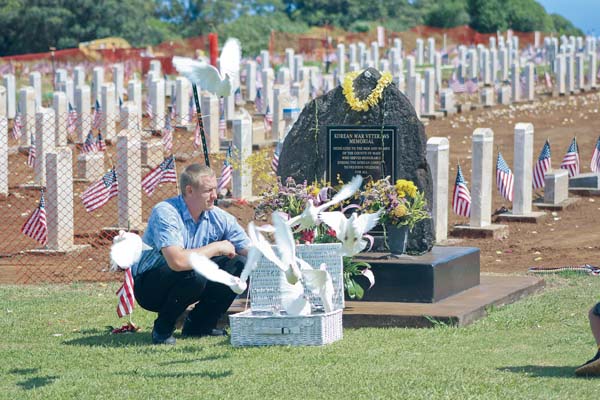
Chris Harris, an auxiliary member of Na Koa Kahiko Wahine, releases doves from Maui Wedding Cakes in front of the Korean War Veterans Memorial.
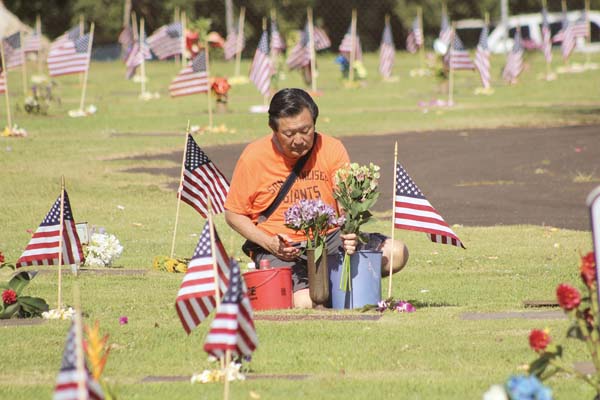
Homer Shishido of Folsom, Calif., cuts flowers to place on the grave of his father, World War II veteran Akira Shishido, and his mother, Winifred Shishido. Homer Shishido, who grew up in Pukalani and graduated from Maui High School, said he and his siblings wouldn’t be here if not for Sadao Munemori, who jumped on a grenade to save Akira Shishido and another soldier during combat in Italy in April 1945. Munemori became the first Japanese American to be awarded the Medal of Honor.
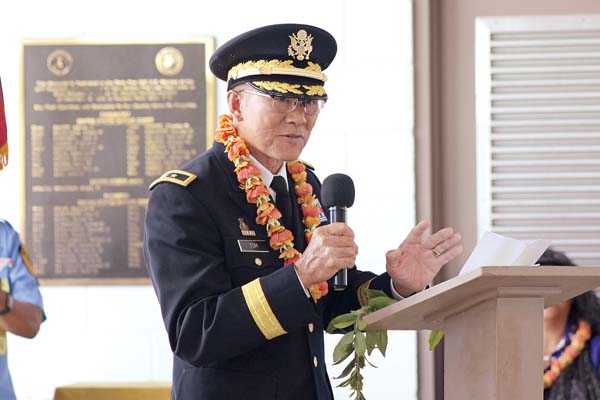
Maj. Gen. Stephen D. Tom spotlights Korean War veterans during his keynote speech on Monday.
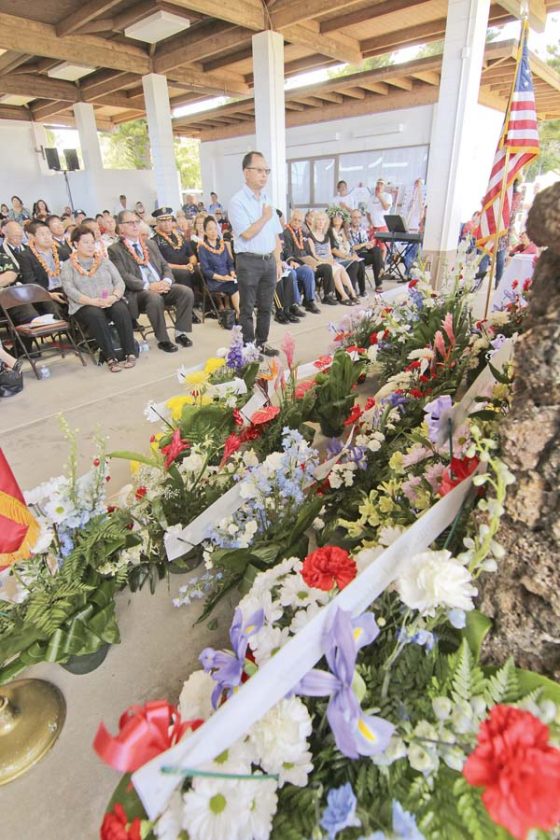
Brian Moto, president of the Nisei Veterans Memorial Center Board of Directors, pays his respects during the floral tribute.
Maui County veterans of the Korean War stand ready for the 21-gun salute near the close of the annual Memorial Day ceremony at the Maui Veterans Cemetery in Makawao on Monday morning. The ceremony, sponsored by the county and the Maui County Veterans Council, honored the service members who gave the ultimate sacrifice, with a special tribute this year to Korean War veterans. The Maui News / COLLEEN UECHI photos
Chris Harris, an auxiliary member of Na Koa Kahiko Wahine, releases doves from Maui Wedding Cakes in front of the Korean War Veterans Memorial.
Homer Shishido of Folsom, Calif., cuts flowers to place on the grave of his father, World War II veteran Akira Shishido, and his mother, Winifred Shishido. Homer Shishido, who grew up in Pukalani and graduated from Maui High School, said he and his siblings wouldn’t be here if not for Sadao Munemori, who jumped on a grenade to save Akira Shishido and another soldier during combat in Italy in April 1945. Munemori became the first Japanese American to be awarded the Medal of Honor.
Maj. Gen. Stephen D. Tom spotlights Korean War veterans during his keynote speech on Monday.
Brian Moto, president of the Nisei Veterans Memorial Center Board of Directors, pays his respects during the floral tribute.
Trending
MAKAWAO -- The Korean War may have taken on the moniker of "The Forgotten War," but the families and friends of veterans who fought will always remember.
George Matsunaga remembers the 24-hour battle that took out more than half his company.
Joyce Kawakami remembers the day a family member came to pick her up from school to tell her that her brother had been killed in the war.
And Maui County veterans remember Pfc. Anthony T. Kaho'ohanohano, who earned the Medal of Honor for his heroism in protecting fellow troops.
"All war is hell," said Matsunaga, who served in Korea 1952-53. "I hate to see anybody go to war."
On Monday morning, residents gathered at the Maui Veterans Cemetery in Makawao to honor the service members who made it home and those who didn't. The annual event, sponsored by the county and the Maui County Veterans Council, paid special tribute this year to Korean War veterans.
The Korean War began on June 25, 1950, when thousands of troops from Soviet-backed North Korea invaded the U.S.-backed South Korea after years of bloody conflicts along the 38th parallel dividing the peninsula. It came to an end on July 27, 1953, after military commanders signed an armistice, but because no formal treaty was ever drawn up, the war technically never ended.
It became known as "The Forgotten War" because of the military's censorship of press coverage of the war, and because it was sandwiched between World War II and the Vietnam War. As of December, there were still 7,675 Americans unaccounted for from the Korean War, according to the Department of Defense POW/MIA Accounting Agency.
Matsunaga, who was born and raised in Haiku, was 20 years old when he was sent to Korea as an Army infantryman. He remembered being stationed in a "hot spot" where American troops suffered many casualties, and recalled two local boys he knew going missing in action within a few weeks of arriving.
"If you talk to me, you gotta get a helmet and an armored vest, because a lot of bullets flying," said Matsunaga, now 87.
One of the worst battles Matsunaga was involved in started after American troops "took a hill from the Chinese, and they attacked." The battle lasted about 24 hours and killed about 65 of the 100 soldiers in Matsunaga's company.
"I was in combat for 11 months," said Matsunaga, who rose to become the squad leader and later the assistant platoon sergeant. "But I didn't get injured. I was lucky."
When Matsunaga came home to Maui, he joined the Maui Police Department, retiring on May 1, 1980, after 25 years of service.
Meanwhile, Korean War veteran Richard Ouchi will never forget two dates -- Dec. 1, 1951, when he was drafted into the military at the age of 19, and Oct. 16, 1952, when his brother-in-law Sueo Koyanagi was killed in combat. Koyanagi's sister, Kawakami, was just 8 years old at the time. She recalled how a family member came to pick her up from Waihee School and break the news about her brother. At the time, it was hard for Kawakami to comprehend.
"It's young kid time; you don't think anything," she said when asked what was going through her mind.
For 60 years, Kawakami and her family have been coming to the cemetery to pay their respects; her brother is anything but forgotten.
On Monday morning, key-note speaker Maj. Gen. Stephen Tom chose to spotlight two Hawaii-born soldiers who earned the Congressional Medal of Honor for their heroics during the Korean War. There was Sgt. Leroy Mendonca of Honolulu, who was killed protecting his retreating platoon on July 4, 1951; and Pfc. Herbert Pililaau of Waianae, who also stayed behind to fight the enemy on Sept. 17, 1951, so his fellow soldiers could protect key terrain on "Heartbreak Ridge."
Maui's own Kaho'ohano-hano also earned the Medal of Honor for his heroics during a retreat. Kaho'ohanohano was in charge of a machine gun squad supporting another company when enemy forces launched a fierce attack near Chupa-ri, Korea, on Sept. 1, 1951, according to the Congressional Medal of Honor Foundation. Kaho'ohanohano ordered his squad to take up more defensible positions and provide cover fire for the withdrawing troops. He injured his shoulder but managed to gather up grenades and ammunition to take on the enemy, shooting until he was out and resorting to hand-to-hand combat until he was killed -- inspiring his fellow troops to launch a counterattack "that completely repulsed the enemy."
"It's only fitting that we give those veterans who served our country so bravely our gratitude for providing us the blessing of freedom," Tom said.
* Colleen Uechi can be reached at cuechi@mauinews.com.