
Hawaii island, Maui telescopes can offer asteroid early warning system
Atlas, PanSTARRS track near-Earth object that burns up off Puerto Rico
Trending
The Atlas telescope on Mauna Loa with an assist from the new PanSTARRS 2 telescope atop Haleakala demonstrated the ability to provide advance warning and evacuation of asteroid impact areas while tracking the 13-foot diameter asteroid 2019 MO on June 22, the UH Institute of Astronomy has reported.
The Hawaii island-based Atlas, with a sister telescope atop Haleakala, located 2019 MO after midnight June 22 about a half-day before its impact near Puerto Rico, the UH news release said.
With the help of PanSTARRS and other astrometric resources, "a precise orbit could be computed that confirmed the impact time and location," said an International Asteroid Warning Network news release.
"For the first time, astronomers at the University of Hawaii have demonstrated that their Atlas and Pan-STARRS survey telescopes can provide sufficient warning to move people away from the impact site of an incoming asteroid," the UH news release said.
Developing an early warning system for asteroids is the goal of Atlas, developed by UH and funded by NASA, the Atlas website said. The two telescopes, 100 miles apart, automatically scan the whole sky every two nights looking for moving objects. It currently discovers about 100 asteroids with diameters larger than about 100 feet, the UH news release said.
"Atlas will provide one day's warning for a 30-kiloton 'town killer,' a week for a 5-megaton 'city killer,' and three weeks for a 100-megaton 'county killer,' '' the Atlas website said.
Larry Denneau, UH Atlas project scientist, said Thursday that for smaller objects the size of 2019 MO, Atlas can provide only a few hours' notice.
"Larger objects can be seen days or even weeks before impact, but they are much rarer," he said. "With this much notice, we will know the impact location very precisely."
The Atlas telescopes have identified 304 near-Earth objects and 33 potentially hazardous asteroids, its website said. The two Atlas telescopes came online in June 2017.
Denneau said astronomers "do not have a good estimate" of how many asteroids hit the Earth every year "but we think the number may be around 10 per year." An asteroid of 66 feet in diameter can impact the Earth, he said.
Denneau also noted that an asteroid does not have to hit the Earth to cause damage. The Chelyabinsk asteroid, which was about 66 feet in diameter, did not make it to the ground intact but the airburst caused major damage in the Russian region near the Ural Mountains in 2013. Even though that asteroid mostly burned up in the atmosphere, the airburst generated a shock wave, heat and scores of injuries.
"So an asteroid doesn't have to reach the ground to be destructive," Denneau said.
None of the asteroids the size of 2019 MO will make it to the ground intact, maybe small pieces, he said. They burn up in the atmosphere.
Denneau said little is known about 2019 MO's origin but it most likely came from the asteroid belt, roughly between Jupiter and Mars.
"Over millions of years, it probably had several gravitational encounters with Jupiter that changed its orbit from a circular one to one that comes into the inner solar system close to Earth," he said.
Atlas observed 2019 MO before it entered Earth's atmosphere, about 12 hours before impact, Denneau said. However, the definitive association with measurements showing the asteroid crashed into the ocean about 236 miles south of San Juan didn't occur until after the impact.
Atlas observed 2019 MO four times in a span of 30 minutes after detecting the asteroid just after midnight on June 22, the UH news release said. At that time, the asteroid was only 311,000 miles from Earth -- or 1.3 times the distance to the moon.
These initial observations were assessed by the NASA Jet Propulsion Laboratory's Scout impact analysis software, and the asteroid was given a modest impact rating of 2 (a rating of 4 is "likely"), the UH news release said. Scout takes telescope positional observations, creates thousands of hypothetical trajectories and computes which ones might strike Earth, Denneau said.
The fraction of asteroids that strike the Earth are then used to assign an impact rating. For example, if 1/10,000 of the hypothetical trajectories hit the Earth, that might be a "small" rating, but 1/10 would be "elevated," he explained.
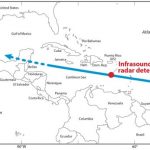
Davide Farnocchia with the Jet Propulsion Laboratory noted a possible match of Atlas' findings with an atmospheric infrasound detection near Puerto Rico about 12 hours later and asked if the community could search for additional observations.
Infrasound waves are sound waves with a frequency well below the human detection threshold, Denneau explained. Meteorites entering the atmosphere produce infrasound waves that are detectable from long distances away. There is a global network of infrasound detectors that were originally set up to monitor compliance with international nuclear test ban treaties.
Pan-STARRS 2 answered the call. It was operating at two hours before and at the same time as Atlas' initial observations and had imaged the part of the sky where 2019 MO should have been seen, the UH news release said. The asteroid was located on a part of the Pan-STARRS 2 camera that is not fully operational, but UH Institute of Astronomy scientists Robert Weryk and Mark Huber and Marco Micheli at the European Space Agency were able to analyze the images and find the asteroid.
With these additional Pan-STARRS 2 observations, the asteroid's entry path prediction improved significantly, and new calculations by the Scout software increased the impact rating to 4, or "likely," the UH news release said. The improved orbit calculation also matched the infrasound detection with very high likelihood.
The Nexrad weather radar in San Juan also detected 2019 MO as it burnt up in the atmosphere and pinpointed the entry location over the ocean that closely corresponded to the infrasound location.
"For the first time in history, astronomers can provide sufficient warning to move people away from the impact site," the UH news release said.
NASA and the U.S. government have been working for years on protocols regarding how to cooperate with international organizations in the event of a dangerous asteroid strike, Denneau said. The International Asteroid Warning Network was established in 2013 for a worldwide response to potential near-Earth object impact threats as well as to create an international group of organizations to detect, track and analyze objects. Members include Europe, Asia and South and North America, its website says.
There is more to be done in the detection of asteroids. Atlas or any ground-based survey currently cannot detect all incoming asteroids, Denneau said.
Atlas cannot see asteroids coming from the direction of the sun, and bad weather can stymie observations. The telescope cannot yet see asteroids in the far south of the sky that are visible only by a telescope in the southern hemisphere, he said.
"Improvement in warning time is complicated and happens in many different areas, but an important one is having more 'eyes' on the sky, in other words more telescopes in the southern hemisphere and on the opposite side of the Earth so that there is always something looking at the sky," he said.
Atlas and Pan-STARRS are funded by grants from NASA's Near-Earth Object Observation program. The Atlas website is atlas.fallingstar.com/home.php and PanSTARRS, panstarrs.stsci.edu.
The International Asteroid Warning Network website is iawn.net/ and the Jet Propulsion Laboratory's Scout page is cneos.jpl.nasa.gov/scout/#/.
* Lee Imada can be reached at leeimada@mauinews.com.