
Hiroshima mayor still dealing with the specter of atomic bombing
Kazumi Matsui tells mayors world nuclear status worsening
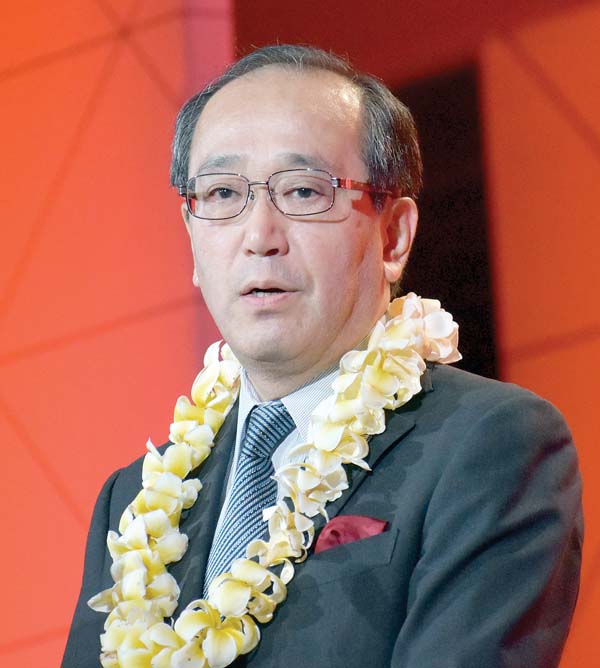
Kazumi Matsui, the mayor of Hiroshima, addressed a luncheon gathering of the U.S. Conference of Mayors on Sunday at the Hilton Hawaiian Village in Honolulu. He said that grassroots efforts toward peace and nuclear disarmament are improving but efforts on the international level are “regressing.” The Maui News / DEBRA BROWNING IMADA photos

Mayor of Hiroshima Kazumi Matsui makes a point during an interview Sunday at the U.S. Conference of Mayors in Honolulu. His mother survived the atomic bombing of Hiroshima but died at age 48. He said it’s not known if her death was related to radiation exposure from the bomb.
Kazumi Matsui, the mayor of Hiroshima, addressed a luncheon gathering of the U.S. Conference of Mayors on Sunday at the Hilton Hawaiian Village in Honolulu. He said that grassroots efforts toward peace and nuclear disarmament are improving but efforts on the international level are “regressing.” The Maui News / DEBRA BROWNING IMADA photos
Mayor of Hiroshima Kazumi Matsui makes a point during an interview Sunday at the U.S. Conference of Mayors in Honolulu. His mother survived the atomic bombing of Hiroshima but died at age 48. He said it’s not known if her death was related to radiation exposure from the bomb.
Trending
WAIKIKI -- Seventy-four years have passed since the world's first atomic bomb was dropped on Hiroshima, and city mayor Kazumi Matsui still receives personal reminders of that horrific day as he fights for the aging survivors and their call for the elimination of nuclear weapons.
He is the son of a hibakusha, or atomic bomb survivor. Matsui's mother was about 2 miles from the hypocenter on Aug. 6, 1945, and survived the blast. After Matsui's first election to the office in 2011, the wife of a supermarket owner came for a visit.
"Your mother helped save my life," the woman declared, then shared the story with him for the first time.
Trapped in a crumbled home, Matsui's mother helped free the woman and another person before it ignited in flames. His mother, who died at age 48, and the woman communicated in letters through the years.
"I heard my friend's son became the mayor so I came here to support you," the woman told the mayor, who recalled the encounter Sunday after addressing the U.S. Conference of Mayors in Waikiki.
Matsui talked about his uncle Hitoshi, who survived the nuclear blast but never told his daughter, lest she be discriminated against. In keeping the secret, he gave up special health benefits afforded by the government to hibakusha.
Only after his daughter got married recently did his uncle reveal his story to her and sign up for certification as a hibakusha. He attended his first -- and only -- Hiroshima memorial ceremony in August; his uncle died of cancer in January.
"When you lose your loved ones or friends, like in a natural disaster, you might say that that person was unlucky but I was saved. . . . You will carry that pain in your heart maybe the rest of your life," Matsui explained in an interview with The Maui News at the Hilton Hawaiian Village.
"But with this atomic bomb, what happens is even though you survive, you still have the effects of radiation. So it is like you are living but you are living in hell," he continued. "They don't know if the effects of radiation are passed down to their children or grandchildren.
"And on top of that they are discriminated against by society. So on top of their suffering they have to face that pain. There is just misery, it is hell."
The mayor spoke with The Maui News for about a half-hour in the 25th-floor suite of Honolulu Mayor Kirk Caldwell, the host of the 87th U.S. Conference of Mayors that ran from Friday through Monday. Matsui spoke in Japanese and was interpreted by Keiko Grant of Oahu.
Matsui, 66, was reelected for another four-year term as mayor in April. In the tradition of mayors of Hiroshima, Matsui advocates for nuclear disarmament worldwide on behalf of the hibakusha, whose average age is more than 82 years.
His family was touched by the bomb. He said that most of the men in his family were away as soldiers; his father was fighting in Manchuria. So many of his female relatives are hibakusha, including his grandmother. Two of his aunts, Tamie and Tokie, were killed in the blast.
The nuclear bomb dropped by an American B-29 bomber flattened the city and ignited infernos. About 140,000 people died due to the blast and radiation by the end of 1945.
His mother had evacuated the city with the family but was in Hiroshima that day doing community service work. Until he became the mayor, the day the bomb was dropped was not a subject talked about in the family.
"They were always feeling we don't need to talk about it," he said. "We just need to move forward. We need to overcome. So they never really discussed the bomb."
But as the years have passed, many hibakusha have come forward to tell and retell their stories, painfully depicting the horror and death as witnesses of the world's first nuclear attack.
The hibakusha "continue to passionately appeal for a world without nuclear weapons based on their conviction that 'no one shall ever again suffer as we have,' '' he told the mayor's luncheon, speaking in English.
Matsui said he has seen trends at the grassroots level moving "toward the realization of the hibakusha's wishes" but not so much on the international level.
"I feel the world is not making any progress and is even regressing," he said, citing the intentions of the U.S. and Russia to scrap the Intermediate-Range Nuclear Forces Treaty, the uncertain North Korean negotiations and the developments surrounding the crumbling Iran nuclear deal.
"As mayors, you are working every day for the well-being of your citizens," he told the conference. "I would also like to point out that, while every one of the nuclear-armed states is spending billions of dollars to modernize and upgrade their arsenals, that money could be much more productively spent to meet the needs of cities and people who live in them."
Matsui is the president of Mayors for Peace, an organization spawned in 1982 by Hiroshima and Nagasaki, the two cities destroyed by American nuclear bombs during World War II. The goal of the organization, which has grown to include 7,800 cities in 163 countries, is to push for lasting world peace and the elimination of nuclear weapons as well as to resolve problems such as starvation, poverty, refugees, human rights abuses and environmental degradation.
Maui County became a member in 2010; Honolulu, Kauai and Hawaii counties also are among the 215 U.S. member municipalities.
"To me, it is absolutely essential that we keep working for peace," said Mayor Denny Doyle of Beaverton, Ore., on Sunday while meeting with Matsui. "If we haven't learned the lessons of what happened in World War II, Vietnam, Korea, then we are not thinking as human beings."
He noted that Americans tend to "forget the past so fast" and that the history books often don't provide an adequate foundation. Doyle also said he believes that Mayors for Peace is critical because "mayors drive the countries now."
Nuclear disarmament can join concern for environmental change as global threats and "unite the world," Denny said.
"You don't have time for war when you gotta save the planet," he said. "I think if we can make that part of the message of Mayors for Peace, we want our grandchildren and great-grandchildren to have a world.
"I think we can tie the two together and signify how both can happen at the same time. So this may be the unity that we need that does not involve firearms and bombs."
On Monday, the U.S. Conference of Mayors passed for the 14th consecutive year a resolution calling for the prevention of nuclear war and the elimination of nuclear weapons. The resolution also calls for presidential candidates to pledge U.S. global leadership on the issue and to return to diplomacy.
Hiroshima and Hawaii have a historical connection. Many Hiroshima residents came to Hawaii to work in the sugar fields in the late 19th century.
Matsui explained that the workers came to Hawaii hoping for a better life. Many were second and third sons without hope of owning land of their own. But life was not as easy as they expected in Hawaii and they pined for the places of their homeland, or furusato, and the people they left behind.
In making a life in Hawaii, the immigrant workers kept the values and culture of Japan, some of which exist in Hawaii but not in Japan, he said.
"People in Hiroshima look at Hawaii as their second town, their second furusato because Hiroshima ben (dialect) still lives there, their relatives live in Hawaii," Matsui said.
This is Matsui's second visit to Hawaii, but he has not yet visited Maui.
"This may be the stereotype but Hawaii is always summer, always pleasant, always comfortable, not high humidity like Japan. It is kind of bright and sunny," he said. "While arriving (he thought) 'it's exactly what I heard.' ''
* Lee Imada can be reached at leeimada@mauinews.com.