
Wildfire charred 25 acres a minute
Harrowing firefight amid big flames, black smoke, tough terrain recounted by officials
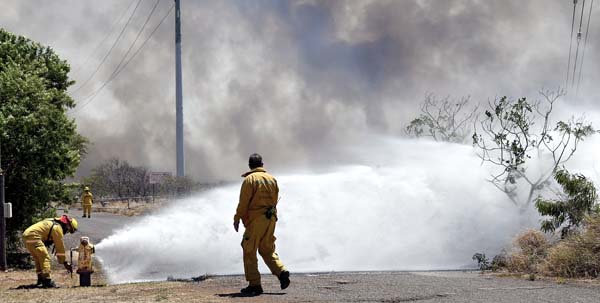
Maui firefighters clear and test a fire hydrant next to the Maui Humane Society on July 11 while waiting to make a stand against the fast-moving fire bearing down upon the facility. The Maui News/MATTHEW THAYER photo

RICHARD KAWASAKI Disheartened as fire spread

STEVEN THYNE Driving blind into the smoke
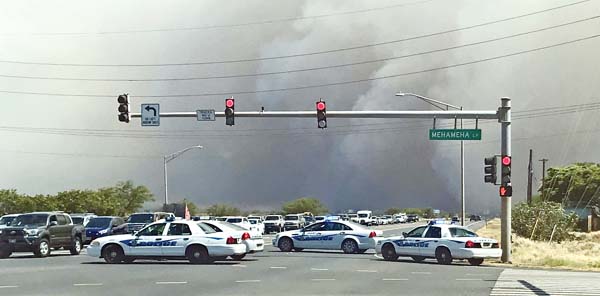
Firefighters recall black smoke eclipsing the sun, making “daytime look like nighttime,” in the 9,000-acre wildfire last week. This was the view of the fire headed to north Kihei July 11 along Maui Veterans Highway near the entrance to the Maui Humane Society, which was evacuated. The Maui News/ MELISSA TANJI photo
Maui firefighters clear and test a fire hydrant next to the Maui Humane Society on July 11 while waiting to make a stand against the fast-moving fire bearing down upon the facility. The Maui News/MATTHEW THAYER photo
RICHARD KAWASAKI Disheartened as fire spread
STEVEN THYNE Driving blind into the smoke
Firefighters recall black smoke eclipsing the sun, making “daytime look like nighttime,” in the 9,000-acre wildfire last week. This was the view of the fire headed to north Kihei July 11 along Maui Veterans Highway near the entrance to the Maui Humane Society, which was evacuated. The Maui News/ MELISSA TANJI photo
Trending
KAHULUI -- Some flames reached 50 feet high last week when a runaway fire roared through Maui's central plains, consuming an average of 25 acres a minute, officials said.
"Everywhere we turned, we had this monster we couldn't control," Maui Fire Department Battalion Chief Steven "Hapa" Thyne said Tuesday.
Kahului station-based Thyne and Assistant Chief Richard Kawasaki, who managed the fire from its start July 11 to its containment Monday morning, recalled the 9,000-acre blaze that threatened homes, closed roads and caused hundreds to evacuate.
The two, who have a combined total of nearly 60 years at the department, were among the first on scene at the morning Waikapu brush fire that appeared manageable due to light breezes. Within an hour, though, wind spiked and dry brush fed the fire, which began leveling 30-, 40-, 50-foot-tall trees lining a nearby drainage ditch.
Thyne said that's when he knew the wildfire turned menacing.
"Coming down that drainage the fire was spotting, and that's when I knew we were in deep, deep trouble. That fire behavior is very aggressive."
Spotting happens when a main body of fire collects so much energy and force that it hurls embers, branches, whatever it can, spawning additional fires, Thyne said. It's a sign the blaze is rapidly advancing.
After the wildfire shot south from Waikapu via the drainage ditch, it headed through fallow fields toward Kihei and ran parallel with Maui Veterans Highway, formerly Mokulele Highway, a main artery between Central and South Maui. Police closed the road by early afternoon.
Massive, billowing, black smoke eclipsed the sun and made "daytime look like nighttime," Thyne said. Dangerous air particles exceeded the highest breathing hazard threshold for Kihei air quality that day, according to the state Department of Health. A NASA satellite captured visuals of the smoke from space.
"We're going down Mokulele, driving in the (wrong) lane and you can't see the front of your truck," Thyne said. "I'm driving slowly, thinking please, please . . . if someone is driving out from Kihei on the highway, we're dead."
All of a sudden, "unpredictable" wind shifted again and the fire made a 90-degree turn to jump the highway. Once the wildfire cleared the highway, which is essentially a concrete firebreak, that's when Kawasaki felt disheartened.
"When it crossed Mokulele, I thought it was a down point," Kawasaki said. "It did cross Kuihelani (Highway) but it was still smaller. It crossed a couple cane roads. But once it crossed Mokulele, I was like, 'Now what? Now where are we going to catch it?' "
Once the fire moved into South Maui, it became a matter of steering it before stopping it, the two said.
Employing wildland training techniques often used in the nation's largest wildfires, local firefighters conducted controlled burns, removing fuel such as grass and brush. Also, bulldozers cut land down to dirt to create firebreaks. Torches were used to start flames back toward the main body, then both were extinguished.
Fire officials, along with private contractors, focused on creating firebreaks for residential developments in north Kihei, as well as the construction site of the new Kihei high school, the latter of which would prevent the fire from moving to vulnerable Maui Meadows. Also, firefighters were deployed to protect Maui Electric Co.'s Maalaea Power Plant.
"Whatever (the fire) does, it will move in the ranch (land)" Thyne said. "But our main objective was to protect the values at risk (homes, critical infrastructure). We basically had to steer the fire, we can't stop it."
Once the subdivisions were secured Thursday night, Thyne said, he could breathe a sigh of relief.
The fire came within 30 to 40 yards of north Kihei residences, 150 feet of the power plant and a little more than 4 miles from Waiohuli Hawaiian Homestead subdivision Upcountry, officials later reported.
Thyne and Kawasaki credited the collaboration of private contractors, state and county agencies, and the help of Maui Police Department, for protecting houses and infrastructure from damage.
"With a fire this big, it's not just the Maui Fire Department," Kawasaki said. "Many people play a part and work together."
Within the first six hours, the wildfire had consumed 9,000 acres. Thyne said that averages to 1,500 acres an hour and 25 acres a minute. The fire's reach didn't grow much after the first day, he added, as wind died down and firebreaks were implemented. No major damages or injuries occurred.
While the cause of the massive wildfire remains under investigation, 28-year-old Holden Bingham, who has no local address, was arrested Monday for first-degree arson and unauthorized control of a propelled motor vehicle in connection to the blaze, police said.
Battling the large blaze cost the county roughly $400,000, with most of the scorched acreage owned by Mahi Pono, said Maui Fire Department and Mahi Pono officials Tuesday.
"MFD firefighters are boots on the ground and the community who supports them are the ones who make the difference," Thyne said. "They all deserve the credit."
Still, one of the biggest challenges for Maui's firefighters is the unique island terrain, which is full of wildland-urban interface, where development juts up against rural areas. Firefighters must be diverse in their skills, Thyne said.
"For our firefighters, you have to have mountain rescues, ocean rescues, river rescues," he said. "Most places don't have to worry about all of that."
Maui Fire Department staffers have years of local knowledge and cutting-edge experience, the two said, and people will continue to learn from past, present and future fires.
"Knowledge gained from fighting these fires will benefit our future firefighters," Thyne said. "Future leadership will have experiences gained from fighting these fires to guide them in their strategic decision-making."
* Kehaulani Cerizo can be reached at kcerizo@mauinews.com.