
Mahi Pono unclear on needs from Na Wai ‘Eha streams
Company seeks to take place of HC&S on water use permit
Trending
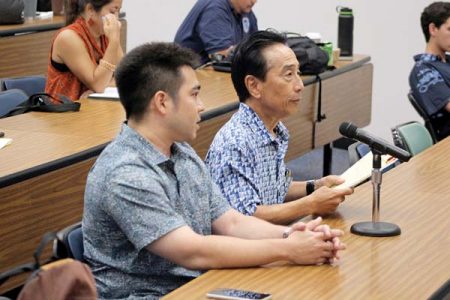
KAHULUI -- As the state water commission pressed for answers, Mahi Pono was unable to say Wednesday night how much water it would need from four Wailuku-area streams to supply its farming operations.
"We're still working on the farm plan, and of course a lot of the farm plan is driven by how much water we would be allocated," said Grant Nakama, operations manager for Mahi Pono.
"So I can't really say with utmost certainty what that number would be, and if I had to ballpark it right now," he said, pausing, "I'm not going to guess, actually."
The company's lack of specifics frustrated kalo farmers and kuleana landowners who have waited nearly two decades for a legal battle over the streams to come to an end -- and may now have to wait longer as Mahi Pono takes the place of its predecessor, Hawaiian Commercial & Sugar Co., in the drawn-out contested case.
"I think today gave you a very clear picture of how absolutely unorganized this multimillion-dollar company is," said Hokuao Pellgrino, president of Hui o Na Wai 'Eha, one of the groups involved in the case. "I think them not even having a farm plan ready that they can share about how much water that they need, I mean, you don't spend hundreds of millions of dollars on something and sound like you just bought it blindly."
The state Commission on Water Resource Management held a hearing on Wednesday night regarding Mahi Pono's request to take HC&S' place on the water use permit application that the sugar company filed in April 2009 to irrigate 4,400 acres in the Waihee-Hopoi area.
In December, Mahi Pono purchased 41,000 acres of former sugar cane land from HC&S' parent company, Alexander & Baldwin.
Mahi Pono's attorney, Benjamin Kudo, told the commission that of the 4,400 acres covered by the water use application, Mahi Pono planned to cultivate 3,700, including 800 acres of diversified agriculture and 2,900 acres of "tree orchard type crops," such as macadamia nut and lime.
"We don't want to unnecessarily delay the decision-making of this commission," Kudo said. "However, we feel that because our application is different -- that is, the types of plants, and the types of water needs, our water budget, our farm plan is different from the bioenergy grasses that were proposed by HC&S -- you may want to hear what we plan to do and our water needs. That may necessitate reopening of the contested case evidentiary portion before you render a decision."
Like many streams around Maui, Na Wai 'Eha, or "the Four Great Waters" of Waihee River, Waiehu Stream, Wailuku River and Waikapu Stream, were diverted for more than a century to feed sugar cane operations. The current battle to restore the streams stretches back to 2003, when the Hui and Maui Tomorrow petitioned the commission to amend their in-stream flow standards.
Since then, some stream flows have been restored through contested cases, but the closure of HC&S in 2016 prompted the commission to revisit the stream flows. The latest contested case was coming to an end when Mahi Pono submitted its request to take HC&S' place on the application.
Kudo said Wednesday that Mahi Pono hoped to settle the case with the other parties within two or three months; if not, they would request to reopen the contested case.
But Pam Bunn, attorney for the Office of Hawaiian Affairs, which is also a party in the case, said that "there is very little left to be done in this case," and that it was time to make a decision. She said if Mahi Pono doesn't like the permit it gets, it can apply to amend it.
"There are dozens and dozens of people waiting for their water use permits that filed for them 10 years ago," Bunn said. "I do understand Mahi Pono's argument that it now owns the land and it has the right to be a participant in these proceedings, but think about it. HC&S wouldn't be allowed to reopen the contested case at this point if it owned the land. Why would it be any different for Mahi Pono?"
The commission questioned Mahi Pono about its water needs, wondering if the company would ask for more than HC&S needed and whether it would want to amend it later on if it changed crops.
Kudo said that he didn't think Mahi Pono's needs "will be anywhere near the sugar cane level." He said the tree orchard crops planned for the Waihee-Hopoi fields would not be seasonal and would not rotate, while the diversified agriculture would be seasonal and rotate, leaving some fields fallow at times.
He added that crops in the future would depend on a "balance between the water budget, economics, marketing, field conditions." But he said that Mahi Pono would try to stay within the water amount granted to it by the commission.
HC&S had originally applied in 2009 for 36.29 million gallons per day of Na Wai 'Eha surface water to irrigate the 4,400 acres; after announcing its closure in 2016, it lowered that request to 19.48 mgd for bioenergy crops. The hearing officer's proposed decision and order in November 2017 allocated 15.65 mgd.
"For us, I think we're somewhere in the middle of those two numbers, in the middle of 15 and 30-something," Nakama said.
Afterwards, Pellegrino was critical of what he called Mahi Pono's "guessing games at their water allocation."
"HC&S always used to threaten us with sharing the water, and Mahi Pono seems to be asking to share the water," he said. "Yet for over 120-plus years, Native Hawaiians have suffered at the hand of plantations. And I often wonder if Mahi Pono is HC&S 2.0, because tonight they showed their cards, and they don't seem to be serious about really engaging with the Native Hawaiian community and traditional farmers within the Na Wai 'Eha area, as well as protecting water resources."
Pellegrino added that "while we are open to settlement, we need them to be really serious about the numbers and serious about their gallons per acre per day."
When asked about Pellegrino's concerns, Nakama said that "a lot of the farm plan is driven by the water allocation that CWRM decides to give us, so until that's decided, nothing really will be solidified.
"We have an idea of what kind of crops we want to plant, how many acres we want to plant, so there is a farm plan in place, but it's always subject to change given market conditions, water availability, and that's why we're here right now," he said.
"In other words," Kudo added, "there's an ideal plan of what we really want to do, and then it has to come down to reality based on how much water we get."
Kudo said Mahi Pono preferred to get the water allocation hashed out now rather than have to come back later to amend the permit.
The commission must first decide on Mahi Pono's request to put its name on the application; then it will mull the proposed decision and order on the contested case and stream flows. On Wednesday, the commission did not have a timeline for either decision.
* Colleen Uechi can be reached at cuechi@mauinews.com.