
Wildfire and hurricane season keep MECO busy
Utility would have left generators running even if it had to abandon power plant due to fire
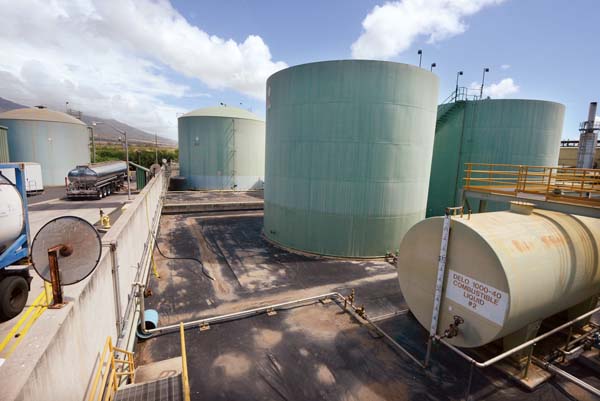
Maui Electric Co. is preparing the Maalaea Power Plant, shown in a photo taken Wednesday, and other equipment for Hurricane Erick and Tropical Storm Flossie, which are headed this way. The plant, which can provide up to 80 percent of the island’s power, was threatened by a wildfire last month. Shown is the plant’s fuel storage area designed to contain spills and leaks. The Maui News / MATTHEW THAYER photos
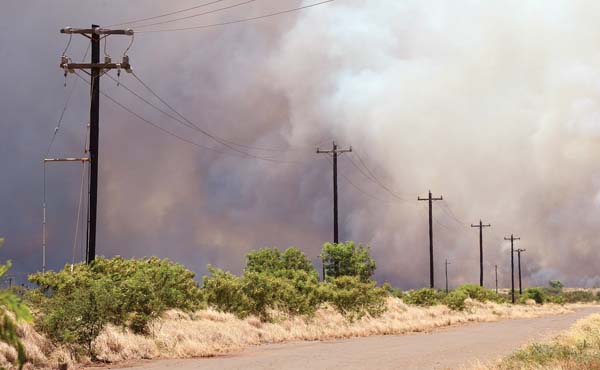
A wildfire July 11 burned MECO power lines and cut power from Maalaea to Kihei. This forced the utility to route power up through Pukalani and Kula and all the way back down to Wailea and Kihei.
Maui Electric Co. is preparing the Maalaea Power Plant, shown in a photo taken Wednesday, and other equipment for Hurricane Erick and Tropical Storm Flossie, which are headed this way. The plant, which can provide up to 80 percent of the island’s power, was threatened by a wildfire last month. Shown is the plant’s fuel storage area designed to contain spills and leaks. The Maui News / MATTHEW THAYER photos
A wildfire July 11 burned MECO power lines and cut power from Maalaea to Kihei. This forced the utility to route power up through Pukalani and Kula and all the way back down to Wailea and Kihei.
Trending
Just past the fence line of the Maalaea Power Plant is a cluster of torched brush and kiawe trees that serves as a reminder of how close the 9,000-acre fire last month in Central Maui and north Kihei got to the plant.
Maui Electric Co. didn't have to resort to its worst-case scenario that day, but between the major wildfire, the highest energy demand in a decade and two storms approaching the island chain, the utility is keeping busy this summer.
"We do storm prep year round, and we do a little more before the storm comes," said Mat McNeff, director of Maui County for MECO, Wednesday during a media tour of the Maalaea Power Plant and other MECO facilities. "It seems like it's either hurricane season, rainy season, or it's always some season."
With Hurricane Erick set to pass south of the islands over the weekend and Tropical Storm Flossie -- which has been fluctuating between tropical storm and hurricane -- projected to pass straight over in the days after, MECO is going through the usual preparations. It's wrapping up work wherever it can, postponing jobs that can wait a little longer and making sure generators in places like Hana are topped off with fuel and ready as backup.
"We're actively tracking Erick and Flossie, not only from the Pacific Disaster Center, but we also get weather reports from a private weather forecasting company, StormGeo," said Chris Reynolds, MECO's director of operational technology. "Basically, they give a very definitive track, and they tell us specific locations and what the anticipated wind speeds are going to be there, how much rainfall we expect."
As far as the grid goes, the lines and poles are the equipment most vulnerable to major storms or fires. They're scattered across the island and not always quickly accessible; crews usually have to wait until the storm has passed to go and fix the lines. That's why crews try to trim out-of-control brush year-round, as well as tree branches that could pose a threat to wires in high winds.
Plants and substations are usually a little better protected, McNeff said. The plants are manned 24/7 by staff who can quickly fix a problem, and they're generally solid facilities that can withstand strong winds. Substations -- which are crucial in reducing voltage so electricity can be safely transmitted to homes -- aren't usually impacted either, though the circuit breakers are usually most susceptible explained Emily Smith, engineering project manager for MECO.
"They're one of the first pieces of equipment that comes in from the line," Smith said. "If you have a lightning strike hit a line, then what happens is the current will just shoot down the line. So then it'll hit the first protection equipment (the circuit breakers)."
In the wake of a big storm or fire, it can actually take weeks for the utility to recover, even if power has been restored to customers, Reynolds explained. During the recent fire, MECO lost power from Maalaea to Kihei and had to route power up through Pukalani and Kula and all the way back down to Wailea and Kihei.
"Not the way you want to do it," Reynolds said. "So after we got everybody restored, they got the fire out, we will send crews in there and restore that transmission line. So even though everyone has their power on, they think everything's good now. No. It usually takes us quite awhile to bring everything back."
McNeff said there's not a certain wind speed threshold at which MECO would shut off power. Homes, businesses and "critical infrastructure" like water and sewer systems, hospitals and airports, depend on that electricity, and so MECO won't shut off the power unless it has to.
They would, for example, if a line falls to the ground and makes it hazardous for first responders to cross, MECO spokeswoman Shayna Decker said. Or, if there are high winds, MECO will avoid certain activities like automatically re-energizing lines when they trip off, McNeff said.
Even if MECO staff had to abandon the Maalaea Power Plant during the fire, they wouldn't have shut off electricity, Decker said.
"We can't just turn off a generating unit. That would result in outages or people not having service," she said. "The thought is we're going to keep the lights on as much as we can, 24/7, even ride it out through different storms or issues."
When the fire began threatening the Maalaea plant, firefighters took up a defensive position and prepared to protect the plant. MECO crews, who are trained to use hoses and firefighting equipment that they keep on site, also were working to water the firebreaks around the perimeter, McNeff said.
MECO reduced its power plant staff to essential personnel only, about 50 workers. If they had had to evacuate the plant completely, Decker said they would have left the operations on and controlled them remotely from somewhere like MECO's dispatch office in Kahului or its substation in Wailuku.
McNeff said he doesn't know what MECO would have done if it had lost the Maalaea plant, which is capable of providing up to 80 percent of the island's generating needs. (The percentage it actually provides varies depending on other plants and the amount of wind and solar available.)
MECO would have had to "look to other generating sources," like the Kahului Power Plant, as well as solar and wind farms, Decker said. That's why MECO's future plans -- including the draft request for proposals it filed with the Public Utilities Commission earlier this month -- are seeking out additional resources that can aid in generation.
* Colleen Uechi can be reached at cuechi@mauinews.com.