
Another pygmy killer whale stranding hits Sugar Beach
Two whales are euthanized; another four mill offshore

National Oceanic and Atmospheric Administration Fisheries, along with veterinarians and volunteers, responded to two adult pygmy killer whales stranded onshore at Sugar Beach in Kihei on Tuesday morning. After blood work determined a grave chance of survival, the two whales were euthanized. National Oceanic and Atmospheric Administration / AIMEE LEMIEUX photo

David Schofield, National Oceanic and Atmospheric Administration regional stranding coordinator, said further studies will determine whether Tuesday’s stranding is an isolated case or a more serious population problem. The Maui News / KEHAULANI CERIZO photo
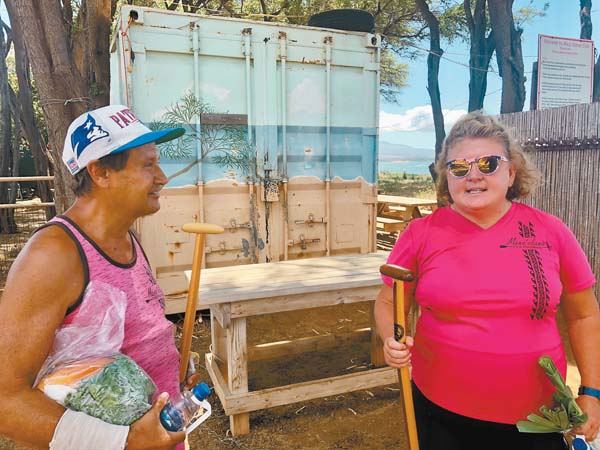
Mana‘olana paddlers Marvin and Kim White, who reside at a condo overlooking Sugar Beach, discussed helping National Oceanic and Atmospheric Administration monitor an at-risk pod of six pygmy killer whales over the last 10 days. The couple roped off the area where two of the six whales beached themselves Tuesday morning and helped keep passersby away from the whales. The Maui News / KEHAULANI CERIZO photo

Shown is one of two pygmy killer whales that beached itself at Sugar Beach in Kihei on Tuesday morning. Four other whales in their pod milled offshore. The two beached whales were euthanized. MARVIN WHITE photo
National Oceanic and Atmospheric Administration Fisheries, along with veterinarians and volunteers, responded to two adult pygmy killer whales stranded onshore at Sugar Beach in Kihei on Tuesday morning. After blood work determined a grave chance of survival, the two whales were euthanized. National Oceanic and Atmospheric Administration / AIMEE LEMIEUX photo
David Schofield, National Oceanic and Atmospheric Administration regional stranding coordinator, said further studies will determine whether Tuesday’s stranding is an isolated case or a more serious population problem. The Maui News / KEHAULANI CERIZO photo
Mana‘olana paddlers Marvin and Kim White, who reside at a condo overlooking Sugar Beach, discussed helping National Oceanic and Atmospheric Administration monitor an at-risk pod of six pygmy killer whales over the last 10 days. The couple roped off the area where two of the six whales beached themselves Tuesday morning and helped keep passersby away from the whales. The Maui News / KEHAULANI CERIZO photo
Shown is one of two pygmy killer whales that beached itself at Sugar Beach in Kihei on Tuesday morning. Four other whales in their pod milled offshore. The two beached whales were euthanized. MARVIN WHITE photo
Trending
KIHEI -- Called a "rare" occurrence that hasn't happened in 40 to 50 years, the second mass stranding of pygmy killer whales at the same South Maui beach in nearly a month raises questions about whether these are individual or population-wide problems.
Meanwhile, authorities and area volunteers were encouraging people to report whales stranded or swimming close to shore, which is an indication that something may be wrong.
National Oceanic and Atmospheric Administration Fisheries, along with veterinarians and volunteers, responded Tuesday to Sugar Beach after the stranding of two pygmy killer whales was reported to NOAA's hotline at 5:55 a.m.
David Schofield, NOAA regional stranding coordinator, said the two whales were part of a pod of six in the area being monitored due to unusual behavior since Sept. 13. After visual and blood tests confirming a "grave prognosis" for survival at sea, the two adult pygmy whales were euthanized Tuesday, he said.
While some may want the whales refloated in the water, Schofield said that Tuesday's blood tests showed "critically low" alkaline phosphatase enzyme levels. Also, both whales had signs of emaciation, abnormal heart rates and labored breathing.
"It would have been inhumane for us to put them back out into the wild," he said.
Although the stranding occurred at the same beach as another stranding of 10 pygmy killer whales on Aug. 29, the Tuesday morning incident involved a different pod from the mass stranding about 3 1/2 weeks ago, NOAA officials said. Identifications were made by their fins, which are like fingerprints for humans.
On Aug. 29, four of 10 live adult and sub-adult stranded whales were euthanized due to health reasons; a calf of the same species was found dead later in the day. A necropsy report recently released by NOAA showed that the four euthanized whales, along with the dead calf, had signs of lung abnormalities and possible infection.
Mass strandings, defined by two or more mammals not including a female and her calf, are rare for Hawaii, Schofield said. A mass stranding of pilot whales happened on Kauai in 2017. Before then, it had been 40 to 50 years since a mass stranding.
"It's alarming we would see mass strandings in a two- or three-year period," he said.
The last individual stranding was a pygmy whale in 2009 near Maalaea Bay, Schofield said.
"We usually just see individual strandings, maybe one every two to three years," he added.
The whales will be flown to Oahu for postmortem examination by the University of Hawaii Stranding Lab. Results will not be known for weeks or months.
"The concern is that we've now had two different episodes that have involved pygmy killer whales," he said at the Kihei beach. "Is this two isolated incidents or are we starting to see a population-level problem?
"We are kind of sitting up and scratching our heads right now, going, 'Is this going to be a continuous thing?' We hope not."
Officials are continuing to monitor four other pygmy killer whales in the same pod that are "milling close to shore in the same area" from Kihei Canoe Club to Maalaea.
Hawaiian pygmy killer whales live at depths of 250 to 300 feet. When they are in 11 to 15 feet, "they are out of habitat," Schofield said.
The pod has been demonstrating abnormal nearshore behavior at the surface of the water, such as bottling, when animals are in a near-vertical position bobbing up and down "like a half-filled Coke bottle," he said.
Schofield said the behavior signals the animals are low on energy and very lethargic.
Recently, he met with South Maui paddlers at Kihei Canoe Club and Mana'olana Pink Paddlers at Maui Canoe Club to discuss abnormal behavior for the animals. He said paddlers have been helpful in volunteering to monitor the at-risk pod.
Mana'olana paddlers Marvin and Kim White, who reside at a condo overlooking Sugar Beach, helped rope off the early-morning incident Tuesday and responded to passersby.
"I was shocked even today when we tried to keep the people back, they were saying, 'Well why can't I come on the beach?' '' Kim White said. "If it was a dead human, the police wouldn't want you right up on it either. Why is a dead animal any different? I was amazed at the rebuttal I was getting."
She added that they recently watched the state Department of Land and Natural Resources take two people out of the ocean who were paddleboarding "right up to the (distressed whales)."
"They're not there because they're healthy," she said.
The group of Mana'olana paddlers had seen the whales about 50 yards from shore regularly for the last 10 days and had been reporting behavior and movement to NOAA and other officials.
"We never had this," said paddler Jon Peterson. "I never seen a pod like this, and I dive up and down here."
Schofield said that when in the water, keep a distance of at least 50 yards. "These particular animals may be stressed, and we don't want to add to the stress," he said.
If a stranding occurs, do not try to push animals back into the ocean, since "it's the cruel thing to do," and maintain distance on the shore, he said.
NOAA urged members of the public to call its hotline at (888) 256-9840 if they see strandings or unusual near-shore behavior.
* Kehaulani Cerizo can be reached at kcerizo@mauinews.com.