
For ‘houseless people’. . . A shower, laundry services not taken for granted
Maui Rescue Mission brings mobile unit to Kanaha and Hope Chapel
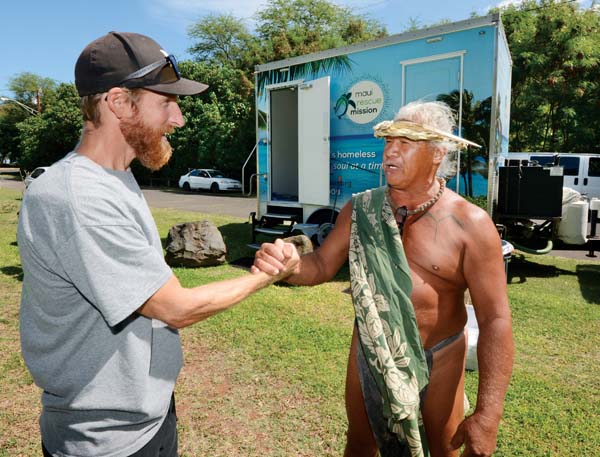
Scott Hansen (left) shakes hands with Molokai’s Leimana Naki. Naki said he would love to see a mobile hygiene trailer on his home island. -- The Maui News / MATTHEW THAYER photo
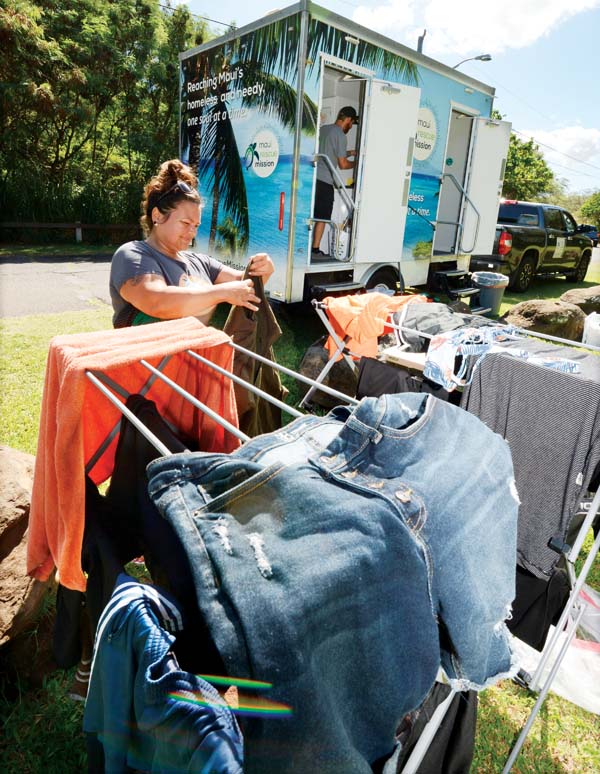
Maui Rescue Mission volunteer Tania Hansen hangs clothes to dry outside the mobile hygiene trailer that includes a hot shower and laundry room Thursday morning at Kanaha Beach Park. -- The Maui News / MATTHEW THAYER photo
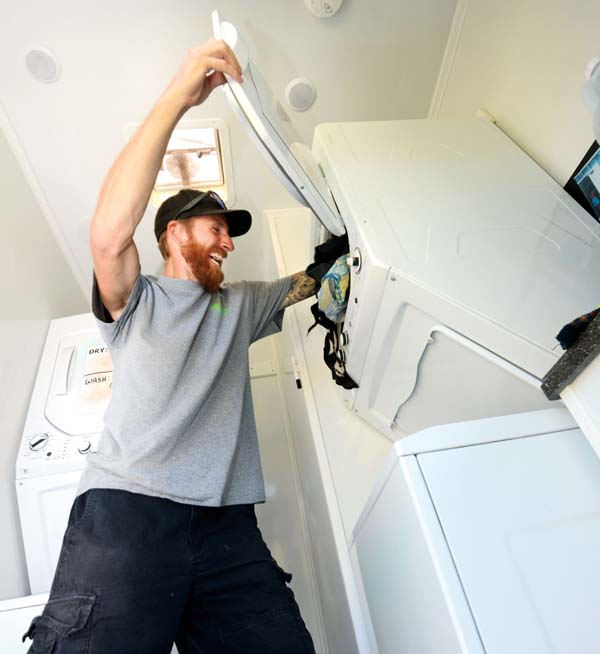
Maui Rescue Mission Executive Director Scott Hansen transfers a load of laundry into a dryer Thursday. -- The Maui News / MATTHEW THAYER photo
Scott Hansen (left) shakes hands with Molokai’s Leimana Naki. Naki said he would love to see a mobile hygiene trailer on his home island. -- The Maui News / MATTHEW THAYER photo
Maui Rescue Mission volunteer Tania Hansen hangs clothes to dry outside the mobile hygiene trailer that includes a hot shower and laundry room Thursday morning at Kanaha Beach Park. -- The Maui News / MATTHEW THAYER photo
Maui Rescue Mission Executive Director Scott Hansen transfers a load of laundry into a dryer Thursday. -- The Maui News / MATTHEW THAYER photo
Trending
KANAHA -- Not having access to a regular supply of hot water, food, hygiene supplies and internet -- things most people take for granted -- is just a small part to what homeless people experience every day.
The executive director of Maui Rescue Mission hopes to make the lives of homeless people they encounter a little better by not only offering the unsheltered a place to freshen up and wash their clothes, but also "dignity and respect."
Maui Rescue Mission operates a mobile bathroom with shower and toilet and laundry facility that it takes out into the community to homeless people.
"The main purpose of the unit and the outreach is not just to provide showers and laundry, it's a way for us to connect with them and know what's going on personally with them, what got them on the street, what are some of their obstacles to getting back into a working environment in society," Scott Hansen said of the Christian nonprofit mobile shelter.
"The laundry takes a while, sometimes there's a waiting list," he said. "So during that time, we are able to speak with them, get to know them, build relationships and connect them to resources around the island to help them with whatever their needs are."
Currently, there is only one Maui Rescue Mission trailer, which includes two laundry units and one full shower that is cleaned after each use. An open outreach is available from 10 a.m. to 3 p.m. at Kanaha Beach Park on Thursdays and at Hope Chapel in Kihei on Saturdays. Services are offered on a first-come, first-served basis, limited to one shower and one load of laundry.
Maui Rescue Mission also tries to coordinate with the Salvation Army or Feed My Sheep to provide lunches during visits at around 11:45 a.m.
"It's great to have something like this, something that's private, because I'm living in my car as a single woman," said Misty Frazier, who has used the facility on about 10 different occasions. "To me, I don't like to just go anywhere, just to be safe. So this is perfect because it's private and safe.
"I don't know what I would do without them.''
A few people waiting in line, who wished to remain anonymous, agreed.
Each person is on-site for about an hour, Hansen said. They have access to a hot shower and soap, haircuts, Wi-Fi, email, phone charging stations, eye care and glasses, transportation referrals, hygiene kits, medical referrals, washing and drying laundry facilities and Bibles.
"One thing I learned, and I'm not a doctor or nurse, but especially when you're homeless living on the beach or bushes, hygiene is so important and many of our friends have infections on their legs, their feet," he said. "It's just terrible. . . . Hygiene is so vital. We take it for granted."
Hansen and Abel Garcia, who is director of operations and outreach, are the only Maui Rescue Mission paid staff members, meaning the organization relies mostly on volunteers, as well as partnerships with rehabilitation centers, churches and food banks, to assist with services.
While Maui Rescue Mission has been around for less than a year, Hansen is "amazed" at how quickly the community responded to join the cause.
"Volunteers are a crucial part of this whole thing, but unfortunately, it's been a little challenging to find people who are available, such as on our Thursday outreach, because people are at work," Hansen said. "But volunteering, it gives people awareness of what's going on. Maybe then, when you're not with us, you'll be helping the homeless or serving the community on your own.
"We want everyone to join in, we want to connect with other people and be a vehicle in which people can serve and help,'' he added.
Being referred to as "houseless" rather than "homeless" was a common preference among the people utilizing the Maui Rescue Mission mobile shelter on Thursday afternoon at Kanaha Beach Park.
"When people ask me, I tell them I'm houseless. There's a big difference, I'm looking for a house," said Larry, who gave only his first name while waiting for his laundry. "No one can afford to live here. Who's going to afford that kind of money with $1,200 to $1,600 a month without utilities?"
Larry, who has been houseless on Maui for about 30 years after a job fell through, said that more needs to be accomplished with affordable housing to help local families and children.
"The county said they're going to do this, do that, so do it," he added. "It's sad to see us treated like rubbish. It's not fair."
Origins of Maui Rescue Mission
Maui Rescue Mission was founded by Brian Nelson and John Savage, who became aware of the high rates of unsheltered and low-income populations on Maui.
According to the 2019 Homeless Point-in-Time Count, Maui County homelessness is down 1 percent (873 to 862) since last year, but more than half the people are considered unsheltered, as opposed to living in an emergency or transitional home.
The largest percentage of the unsheltered population resides in Central Maui at 43.4 percent, followed by Kihei (21 percent) and Lahaina (20.8 percent).
Nelson and Savage discovered that many unsheltered people feel reluctant to go inside homeless shelters and facilities or do not have the means to travel to a shelter. This is why they decided that a mobile unit might be the best way to bring services to those in need, Hansen recalled.
"Several people on the island were saying that something needs to be done," he said. "After asking several homeless people around the island, they realized that hot showers and laundry service were two of the main things they needed and were interested in having. So (the founders) had a trailer, through fundraising, designed and built with two laundry units and one full bathroom."
The trailer unit cost about $30,000 to build and ship. A volunteer drove the trailer unit from the Midwest, where it was built, to the West Coast for shipping, Hansen said. The trailer was shipped to Maui in early January to begin connecting with the homeless population.
Hansen said it took Nelson and Savage about three years from coming up with the idea to the first outreach visit to raise the funds and have the trailer unit built and shipped.
Other help offered
Hansen said that there is "no limit" to the services they provide, explaining that there have been special occasions when the Maui Rescue Mission helped one individual pay for an electric bill. On another occasion, Hansen connected a woman to a rehabilitation facility on the Mainland until she was ready to return to Maui and her family.
"We don't necessarily have the funding to do that for every person, and there is a vetting process we give here on island through a counseling center to make sure that they're a good candidate," he said. "If someone needs something to get off the street, we want to do whatever we can to make that happen."
There currently isn't funding for larger expenses, such as rent, though there could be in the future, Hansen said. So in the meantime, they try to connect individuals with possible supporters through networking on Instagram or Facebook and do what they can.
At the end of the day, the goal of Maui Rescue Mission is to help those in need with whatever they need as best the organization can. The program relies on donations for its outreach, he said.
One shower or one load of laundry costs about $6.92 in donations, meaning a donation of $48.44 can provide showers and laundry for seven people, he said. Maui Rescue Mission also accepts donations of clothes and hygiene supplies.
Depending on the day and location, between six to 15 people take advantage of the facilities. The majority of the people live in their cars and work full time, Hansen said.
"We serve a lot of people who want to wash their clothes before work or shower before work," he added. "The drawback is that we can't always serve everyone because we run out of water or we run out of space for the wastewater."
The trailer holds about 160 gallons of water, which can provide six to eight loads of laundry and about eight to 10 showers, limited to 10 minutes per person.
The trailer and appliances, including a gas generator, also require fuel and propane, as well as maintenance and cleaning fees, which cost an estimated $1,000 per month, Hansen said. Operationally, the monthly costs have been mostly covered by donations.
Kahului Baptist Church has donated fresh water for every outreach and a parking space for the trailer to reduce some financial burden.
"We're still building out our donor base, so hopefully we can receive enough monthly revenue to work full time, and there's still other things we're trying to work out as we open up more sites," he said.
In the future, Maui Rescue Mission hopes to add an outreach location in Lahaina, possibly get a second trailer, and operate five days a week. Hansen added that they have received requests to bring their services to Paia and Wailuku.
Molokai cultural practitioner Leimana Naki came by the trailer Thursday to discuss how he wants to get a similar mobile shelter on Molokai to help "his people and all others" who are "houseless."
Naki leads Kua, a community-based program that teaches people how to protect, restore and care for the island, its people and culture.
"I need to talk to the boss and see how we can get one on Molokai, and the reason for that is that most of these people I see here, I know all of them from Molokai," said Naki, who is visiting Maui for the week to see family and friends at Kanaha. "This is our home, but we don't have homes, and the reason for that is housing is incredibly high all around."
In addition to the high cost of living -- which Hansen is familiar with having to take a part-time job to supplement his income as executive director -- there are various reasons why someone becomes homeless, he said. They include substance abuse, mental illness, health issues, broken relationships and other stresses of life.
There are those who refuse or don't seek help, Hansen said.
"We're going to help them because we believe that, at some point, they will decide that they've had enough and need help," he said. "We'll also be there for them whenever they're ready, even if they feel like they don't need it at the time. There's really nobody that we wouldn't help.
"Every person that comes to the trailer and tells us their story about what happened, we believe their story until we find a reason not to believe it."
For more information about the program or how to donate and volunteer, visit MauiRes
cueMission.org or call 727-9008. Donations also may be sent by mail to P.O. Box 330381, Kahului 96733.
"We just try to work together with the community," Hansen said. "That's the heart of it, is to connect them to things that will ultimately change their life."
* Dakota Grossman can be reached at dgrossman@mauinews.com.