
Solutions to homeless woes in Kahului area in works
Kama leads meeting of businesses and agencies
Trending
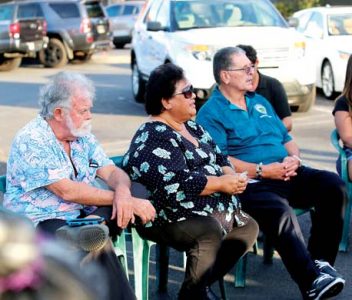
Educating businesses on how to best report incidents involving homeless people to police, mapping where issues arise and providing funds and programs to assist people living on the streets were some of the actions floated during a gathering of Kahului businesses, county department officials, the mayor and County Council members on Wednesday in the old Safeway parking lot.
The meeting was convened by Council Member Tasha Kama in the parking lot, where there was a traffic fatality last month. The next morning, there was a nonfatal shooting involving two homeless men on a nearby street.
After the incidents, Kama, whose residency district is Kahului, called for the community to come together to deal with the problem in the area, where homeless people congregate.
The presence of homeless people has grown in the parking lot since the supermarket's closure in July. However, since the traffic fatality and shooting, the lot has been cleared, though homeless people still occupy nearby sidewalks.
Area business owners said homeless people have been camping, loitering and committing crimes in the area for more than a decade.
Kama said Friday that her office was sending the county administration a synopsis of information gathered at the meeting with copies to be sent to businesses and others. The next step will be to come up with solutions.
"The momentum will keep on" to assist homeless people and businesses in the area, she said.
A possible first step could be to educate businesses on how to best report criminal or nuisance incidents to police, she acknowledged.
The suggestion came from retired police officer Lawrence Kauha'aha'a, who leads Wailuku Clean & Safe, a program that hires homeless people and those suffering from mental health issues to sweep, clean and maintain Wailuku town. Through the program run as a project of the Maui Redevelopment Agency, homeless issues in Wailuku town have gone down.
Kauha'aha'a, who attended Wednesday's meeting, said thorough reporting of crimes could lead to better outcomes. For example, an offender may be committing a crime when someone calls police, but the offender may not be doing anything wrong when police arrive.
So police would need to follow up with the caller to identify the problem and possible crimes, he said.
Another action could be mapping the Kahului business area for homeless gathering spots and identifying property owners, Kauha'aha'a said. If there is a cluster of homeless people on private property, the owner can be notified and act to remedy the problem.
He acknowledged that Kahului's situation is different from Wailuku's. In Kahului, the homeless population could span miles, while his program is centered in the heart of Wailuku. He also works with Mental Health Kokua, which has its offices on Market Street; this makes it easy for program clients to access Kauha'aha'a's program.
Kauha'aha'a said having a mental health and/or homeless program for the homeless people in the Kahului area, even at the old Safeway site, would also be ideal.
He does not see a job program like his in Wailuku emerging, but said there could be a business opportunity in Kahului gathering the shopping carts that homeless people take and returning them to the businesses.
Also attending Wednesday's meeting was Mayor Michael Victorino.
"We're going to have to sit down with our various service providers and county departments to formalize a strategy and plan for the area around the old Kahului Safeway," he said. "I plan to set aside some funding in the budget for programs and assistance, and we'll have to look at whether any changes to our ordinances are necessary."
Housing and Human Concerns Director Lori Tsuhako also attended the meeting and funneled questions about possible solutions to Kama.
"We will maintain and try our very best to enhance the social services network," Tsuhako said. "Leaving people on the street is not a good option for our community."
Social services agencies contracted by the county conduct "assertive" outreach, in which workers repeatedly visit with homeless people to offer help and shelter, she said. It may take a while for some people to accept help, but there are those who will not accept any assistance.
She cautioned to not perceive homeless people as criminals. They could be down on their luck, mentally ill or using substances.
Businesses and government agencies in the area were pleased with the meeting.
Joni McGinnis of Ameritone Maui said her family business has suffered from homeless people camping out along Alamaha Street and creating a nuisance for more than a decade. This includes derelict cars, syringes and feces.
She was happy that a meeting was called and action may be coming. Small business owners already are busy but dealing with homeless issues just makes things more difficult.
"I think it's a good start," she said Thursday. "There is no perfect answer. Hopefully, they use this as a foundation and keep moving and keep building on it."
Dr. Chisoo Choi, chief medical officer of the Maui Community Based Outpatient Clinic for the Veterans Affairs Pacific Islands Health Care System, also applauded the efforts.
"I think something good will come out of it," he said.
Choi noted that the homeless population around the VA clinic down the street from the old Safeway has lessened following the shooting in September. There also have been fewer homeless people parking their cars along the street near the clinic and less fighting and shouting.
He said his staff was concerned about having to walk by homeless people camping out. There also were times when homeless people would defecate at the VA property.
To stem criminal and nuisance activity, the VA is going to install security cameras at its clinic, he said.
* Melissa Tanji can be reached at mtanji@mauinews.com.