
Hospital could wait weeks for automated COVID-19 test
Maui Memorial official says it takes time for equipment to arrive, get validated
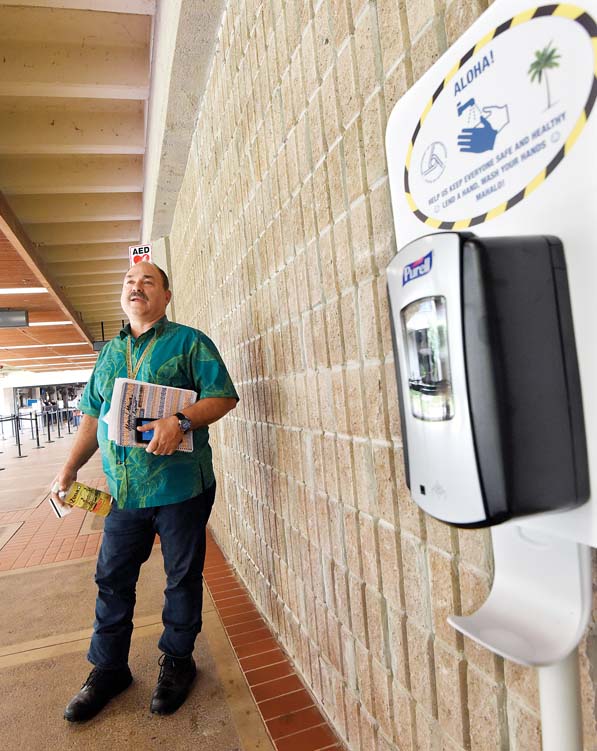
Maui Airports District Manager Marvin Moniz stands next to one of Kahului Airport’s automatic hand sanitizer dispensers Thursday afternoon. The Maui News / MATTHEW THAYER photo
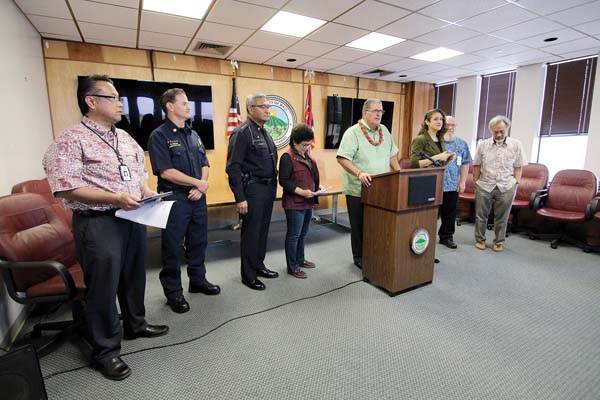
Maui County Mayor Michael Victorino announces during a news conference at the county building on Thursday that he’s requesting a $4 million budget amendment to help fund the county’s preparation and response to COVID-19. Victorino spoke alongside emergency, transportation, hospital and health officials. The Maui News / COLLEEN UECHI photo
Maui Airports District Manager Marvin Moniz stands next to one of Kahului Airport’s automatic hand sanitizer dispensers Thursday afternoon. The Maui News / MATTHEW THAYER photo
Maui County Mayor Michael Victorino announces during a news conference at the county building on Thursday that he’s requesting a $4 million budget amendment to help fund the county’s preparation and response to COVID-19. Victorino spoke alongside emergency, transportation, hospital and health officials. The Maui News / COLLEEN UECHI photo
Trending
WAILUKU -- It could take up to six weeks for Maui Memorial Medical Center to obtain automated testing for COVID-19, setting the island even more behind schedule in response to a virus that is likely already here, the hospital's medical director said Thursday afternoon.
"I am told that we will have the test automated and local in approximately six weeks, which I'm not happy about," said Dr. Lee Weiss.
Limited supplies of test kits locally and across the nation have handcuffed health care providers who are faced with patients who present symptoms but lack direct access to testing. After originally receiving defective kits from the Centers for Disease Control and Prevention, Hawaii obtained working kits near the beginning of March. However, testing still is being rolled out to private labs and local hospitals, forcing Neighbor Island physicians to send all samples to Oahu in the meantime.
Weiss and Maui District Health Officer Dr. Lorrin Pang spoke about the wait for Maui's testing capabilities following a news conference with Maui County Mayor Michael Victorino on Thursday afternoon.
"We've got to set this up," Pang said. "We're way behind the eight ball here."
Currently, Neighbor Island physicians can't order tests to be done on Maui; they must send all samples to Oahu, Weiss explained. And, any test that is confirmed positive on Oahu has to go to the CDC for further confirmation. Private labs are gaining the ability to do testing, but Weiss said that labs on Maui are sending samples to the Mainland for three-day turnaround testing.
He explained that the reason it will take so long for Maui Memorial to get automated testing is that the equipment, which is in high demand, will take three weeks to arrive. It will then take another three weeks to validate the testing.
"Why? Because all of the positive validations have to be confirmed in Oahu, and they're only doing 200 (a week) from everybody in the Hawaiian Islands," Weiss said.
When asked if the delays would put Maui behind, Weiss responded that "the whole country is behind."
"All you have to do is look at the South Korean model compared to the American model," Weiss said. "South Korea is a tiny country compared to the United States. Their model was successful right from the word 'go.' ''
"Maybe it was related to ethnocentrism, maybe it was related to a nationalistic spirit, related to our current politics, but we didn't use their test kit, even though they offered it to us. We had to develop our own. And when our own didn't work, we had no Plan B."
Weiss said he "absolutely" believes the virus is already on Maui, and that surveillance testing of patients with respiratory symptoms who test negative for the flu will likely reveal more cases while reducing the mortality rate. Up until this point, the rate is higher because only sick people are being tested; there could be a number of "asymptomatic walking well," he explained.
Weiss even expected to get the virus himself.
"I'm an emergency physician," he said. "I know I'm going to get it no matter how careful I am."
Lt. Gov. Josh Green said Thursday morning on Hawaii News Now that regional testing centers will be set up around the state at hospitals and urgent care centers, allowing people to be tested without having to sit in a doctor's office or an ER for several hours and possibly infecting others.
Attempts to reach Green's office Thursday for details on the regional centers were unsuccessful.
Weiss and Pang said that ideally, a testing center for "rapid turnaround" of about 90-100 minutes would be set up at Maui Memorial to help the hospital quickly sort out who needs immediate medical care and who can go home. Kaiser, the hospital affiliate, could do the automated testing quickly at Maui Memorial's laboratory.
Another testing center run by a commercial lab would be set up elsewhere for "the worried well," patients who may be sick but don't need to be in a hospital. Results would take a little longer, perhaps two days. Pang said he is trying to see if quick, "drive-thru" testing could take place at the National Guard armory in Puunene.
Pang said rapid turnaround testing at the hospital also would be useful for health care providers, who need to know quickly whether they have the flu or COVID-19, as well as for staff at institutions that care for the elderly. He added that he wasn't sure when the labs would be set up but that "we are working as fast as we can."
While it waits for testing capabilities, Maui Memorial continues to provide triage outside the Emergency Department, where a nurse takes patients' temperatures and asks for a history of travel and symptoms. If they fit the definition of either influenza or COVID-19, they'll be taken to a private room and given a mask and gown while awaiting further evaluation.
Weiss said taking the triage outside is the first step in keeping the virus from spreading through the hospital. If patients have to be hospitalized, staff would use a combination of negative pressure rooms for the sickest patients as well as portable HEPA filters to keep contaminated air from circulating through the hospital.
If there's a surge in the ER, "we can expand critical care beds right now by 20 percent," Weiss said, adding that there are enough ventilators for all of those critical care beds.
As for whether the hospital might clear a ward and isolate people there, Weiss said "it's dependent upon personnel."
"We will do that if we're presented with a situation where you have multiple patients requiring respiratory support with endotracheal intubation and respirator support," Weiss said. "We will open a closed ICU and staff it and segregate those patients to that area."
* Colleen Uechi can be reached at cuechi@mauinews.com.