
Ige extends travel quarantine through June 30
Churches, gyms and theaters could reopen potentially next month
Trending
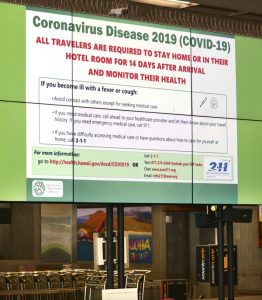
Gov. David Ige has extended the state's 14-day travel quarantine through June 30, though he added that more businesses, such as gyms, theaters and churches, could begin reopening next month.
Ige signed his 8th supplemental emergency proclamation Monday, extending the quarantine for both out-of-state and interisland arrivals. At a news conference, he outlined a reopening and recovery plan for the state, which he said is now entering the "act with care" phase.
Activities that may resume under the new phase include indoor gatherings, such as places of worship and indoor exercise facilities, along with museums and theaters. Businesses, however, must open with physical distancing and safe practices in place.
Restaurants, which have been allowed to offer takeout until now, may also open for dine-in options, though larger venues and bars and clubs cannot reopen yet, according to the state's plan.
Ige said the individual counties will decide how they will proceed under the new phase and that his plan allows the "framework" for the counties to decide what they want to reopen.
"We are looking at reopening first medium-risk businesses and operations, then high-risk businesses and operations beginning in June, so long as our health indicators remain manageable," Ige said at a news conference Monday afternoon.
When asked to define medium-risk businesses, Ige said these involve face-to-face interactions that may occur for 30 minutes or more.
From March 26 to May 6, the state was under strict "stay at home" orders as officials sought to tamp down the spread of COVID-19. As cases slowed, the state and counties began allowing the reopening of select businesses and beaches earlier this month under a "safer at home" model. Now, as new cases and/or clusters become manageable for local health systems and capacity for testing, hospitals and contact tracing improves, the state can move into the "act with care" phase.
Hawaii reported no new COVID-19 cases Monday and Maui County has now gone nine consecutive days without reporting a new case.
The state said its reopening strategy for businesses and operations is informed by the World Health Organization, the Centers for Disease Control and Prevention and the Johns Hopkins University Bloom-berg School of Public Health.
When asked why other states with higher case numbers have been quicker to reopen than Hawaii, Ige cited the state's isolation as a major factor. He agreed that others may choose to open up quicker, but in consultation with health experts and county mayors, local officials wanted to take a slower approach.
"We have limited health care resources here in the islands," Ige said.
Unlike other states, Hawaii residents cannot drive to another county to get more access to care or equipment, he added.
In response to questions about when the state might end the travel quarantine, Ige added that lifting it is not currently included in any of the phases and is being considered separately.
On Sunday, 1,073 passengers arrived by air to Hawaii, including 272 visitors and 400 returning residents, according to the Hawaii Tourism Authority. On Maui, there were 21 returning residents and 12 visitors, with two flights arriving from out of state.
In addition to the travel quarantine, Ige also extended through June 30 a moratorium that prevents evictions for failure to pay rent.
According to the governor's plan, the next phases after "act with care" will be:
• Recovery: This will take place when new cases indicate sporadic activity and the state optimizes capacity for testing, hospitals and contact tracing. Highest-risk businesses and operations would be allowed to reopen, though high-risk populations and kupuna would continue to stay home when possible.
• New Normal: This would take place when treatment and containment methods increase survival rates, when the population develops a natural "herd immunity" and/or when a vaccine is developed. Large social gatherings would be allowed without limitation. High-risk populations and kupuna would need to exercise caution when in public.
Under the strategy, Ige said counties may choose to relax stricter local orders at their own pace in coordination with the governor's office.
A minimum 14-day observation period between decisions will allow time to assess conditions before the state and counties move on to the next level.
If disease activity increases, the state will consider moving back to restrictions.
Case numbers statewide remained at 640 on Monday, including 415 on Oahu, 117 in Maui County, 77 on Hawaii island and 21 on Kauai. Ten residents have been diagnosed out of state.
On Monday, Hale Makua reported that an asymptomatic resident who tested positive for COVID-19 back in April has received two consecutive test results showing they are negative for the virus.
The other two home health clients who receive care outside of the facility and had tested positive for the virus have also been released from isolation. One of those clients recovered in April; the other recently received two negative COVID-19 tests.
Hale Makua has not had any further COVID-19 cases and does not have any tests pending. The facility has tested a total of 59 residents and 82 staff for COVID-19, and all have returned negative.
Hale Makua continues to conduct screening, restrict visitors and increase cleaning protocols as it has since early March. All new admissions since March 23 have been temporarily placed in isolation wing in Kahului.
For more information on Ige's reopening plan, visit governor.hawaii.gov.
* Melissa Tanji can be reached at mtanji@mauinews.com.