
Company flies hybrid-electric aircraft from Kahului to Hana
Ampaire is first to complete trial flight of hybrid plane on commercial route

An Ampaire Electric EEL aircraft flies past Maui on Nov. 22. The company became the first to complete a demonstration flight of a hybrid-electric aircraft along a commercial airline route, traveling from Kahului Airport to Hana and back on a single charge. Photos courtesy of Ampaire
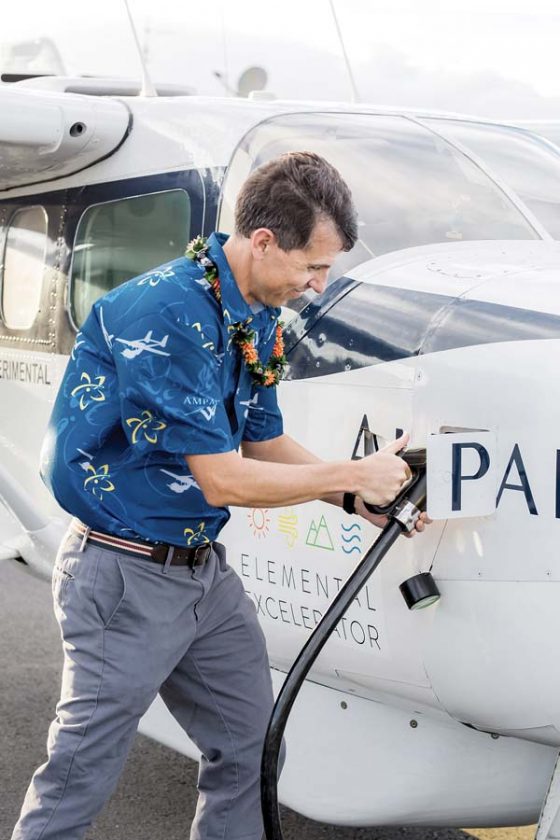
Ampaire test pilot Justin Gillen “fuels” the Electric EEL aircraft with electrons.
An Ampaire Electric EEL aircraft flies past Maui on Nov. 22. The company became the first to complete a demonstration flight of a hybrid-electric aircraft along a commercial airline route, traveling from Kahului Airport to Hana and back on a single charge. Photos courtesy of Ampaire
Ampaire test pilot Justin Gillen “fuels” the Electric EEL aircraft with electrons.
Trending
A hybrid-electric aircraft completed a series of test flights from Kahului Airport to Hana and back on a single charge, showcasing the cost-efficient and environmental benefits of electric aviation.
Product Manager Brice Nzeukou said Wednesday that Ampaire, a global leader in electric aviation, has been flying the 20-minute Kahului-to-Hana route twice a day since Nov. 22 as a pilot program with Mokulele Airlines, one of 15 airlines that signed a letter of interest with the company.
Ampaire is the first to complete trial flights of a hybrid plane along an actual airline route with the Electric EEL.
"The main purpose of this demonstration is to showcase the real benefits of electrical aviation," Nzeukou said. "It is possible to get the right infrastructure at the airport and we continue to work with Mokulele, the pilots and the community to communicate the changes they can expect."
Switching to an electric power unit is more cost effective, especially in a place like Hawaii where energy is generally more expensive than other areas, Nzeukou said. He estimated that an electric aircraft could reduce fuel costs for Mokulele by 30 to 50 percent.
Fuel consumption and carbon dioxide emissions are also reduced by about 40 to 50 percent, while overall maintenance costs of a hybrid aircraft may drop 20 percent.
Although the propeller on the Electric EEL may seem noisy when close by, the hybrid-electric aircraft is much quieter than a typical combustion engine.
"We're following the successful path of hybrid-electric automobiles in transforming ground transportation by taking that model to the sky," Ampaire CEO Kevin Noertker said in a news release Wednesday.
"By upgrading current aircraft with hybrid-electric propulsion, we can enter the market quickly and take advantage of existing infrastructure for fixed-wing aviation."
Nzeukou told The Maui News that "everything has been going great" with the demonstration as Mokulele pilots get acquainted with the aircraft, flight route and other operations.
Ampaire has also been working with the Hawaii Department of Transportation and Hawaiian Electric to research longer-term infrastructure changes to support a fleet of hybrid- or fully-electric aircraft, he said.
And, once the demonstration is complete next week, Nzeukou said the aircraft will be shipped back to California, but officials will continue working on how best to implement electric aviation at airports, since each facility is unique.
For the flight trials on Maui, the only change to ground equipment was the requirement to wire a Mokulele hangar with a 208-volt 3-phase outlet. Mokulele had previously offered Ampaire hangar space at the Kahului Airport, as well as parts, supplies, pilots and mechanics to help further the research.
"The future for regional airlines is electric," said Stan Little, CEO of Southern Airways, which operates one of the largest commuter airlines in the U.S. and owns Mokulele Airlines. "We expect to put hybrid- and all-electric designs into service as soon as possible, and we know other regionals are watching us with great interest."
The flight trials are supported by Elemental Excelerator, a Hawaii nonprofit that funds 15 to 20 startups each year with up to $1 million each to improve systems in energy, mobility, water and agriculture.
"We're excited to partner with Ampaire to pave a path to electric aviation that unlocks more accessibility to rural and island communities and increases green jobs while invigorating the aviation industry," Danielle J. Harris, director of mobility innovation at Elemental Excelerator, said in the news release.
Nzeukou later said that he's confident that the market for fully- and hybrid-electric aircraft will expand in the future as airlines understand how electric aviation is more environmentally friendly and cost effective. The focus will first be on modifying the smaller planes and then "it will scale up" to larger aircraft.
"We've already seen some of the largest developers who carry 100 seats, and others with a 30- to 50-passenger capacity leaning toward electric aviation and starting to make those modifications," he said.
UBS, the Swiss investment bank, forecasts a $178 billion market for hybrid-electric aircraft, according to the news release.
According to Ampaire, the Electric EEL technology demonstrator used in the Mokulele trials is an upgrade of the popular six-seat Cessna 337 twin-engine piston aircraft. The aircraft has a 300-horsepower piston engine in the rear and 160-kilowatt-capable electric power unit in front, as well as a battery pack carried in an under-fuselage aero-optimized shell.
"We've been taking two flights a day, flying to Hana and recharging in Kahului and then turning around and going back," pilot Justin Gillen said on Wednesday. "It's been going really well, and it's a pleasure to be able to fly it."
Gillen has been a pilot since 2008 and has flown electric aircraft in the past, but this is his first experience flying a hybrid. The learning process was simple, he said, because he had flown the Cessna 337 before the aircraft "got the upgrade."
"It's basically the same aircraft, and operating an electric engine is much simpler than gas," he said. "The cool thing about the hybrid is we can leverage the gas and increase our flight time."
Now when he flies the less-technical hybrid-electric planes, Gillen said with a laugh that "I always felt like I was missing something."
After having driven the infamous road to Hana with his family, seeing the same route from the air is a completely different experience.
"It's phenomenal," he said. "It was amazing on the ground and it's beautiful from the air. There was some rain these past couple days so all the waterfalls are just going crazy."
* Dakota Grossman can be reached at dgrossman@mauinews.com.