
Maui County bids not-so-fond farewell to 2020
Pandemic, mail-in voting, Supreme Court case headlined year

Army National Guard Spc. Zachary Cabingas checks the temperature of 8-month-old Emily King before she and her mom board an interisland flight at Kahului Airport on June 16. — The Maui News / MATTHEW THAYER photo
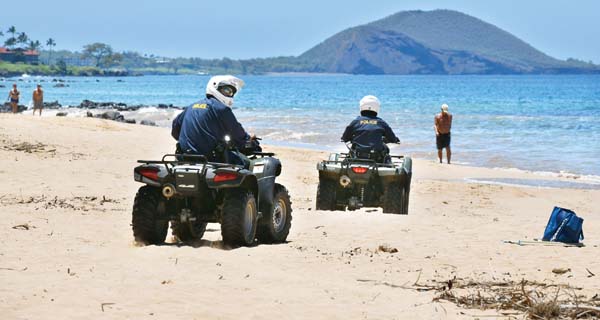
Maui Police Department officers patrol Keawakapu Beach on April 18. — The Maui News / MATTHEW THAYER photo
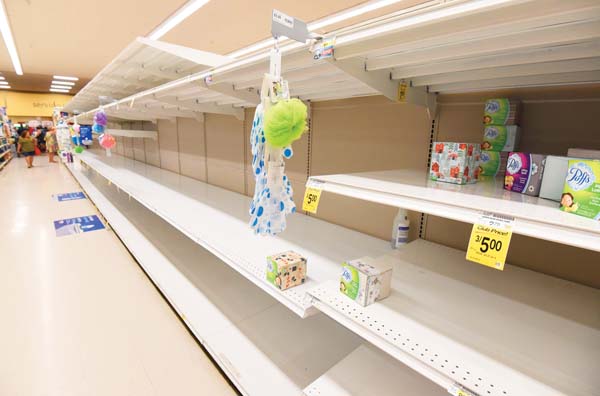
Grocery store shelves are empty March 13 after an islandwide run on toilet paper and other paper products. — The Maui News / MATTHEW THAYER photo
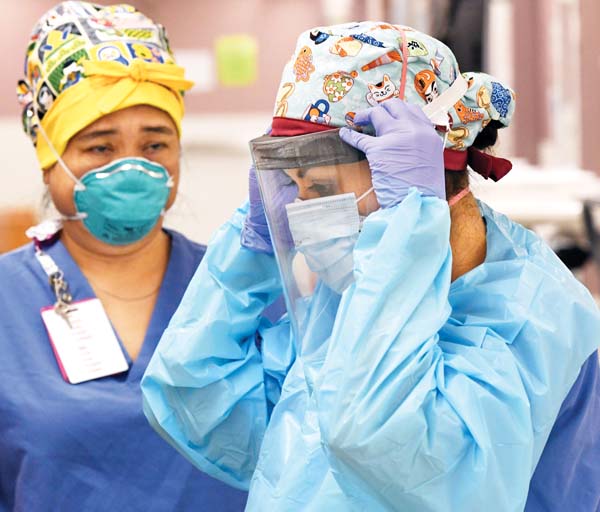
Maui Memorial Medical Center COVID-19 unit registered nurse Leigh Ringstad dons protective gear with help from hospital aide Reynita Franco before going into a patient’s room on May 14. — The Maui News / MATTHEW THAYER photo

Hospital workers are honored with a flower drop above Maui Memorial Medical Center on May 19. — The Maui News / MATTHEW THAYER photo
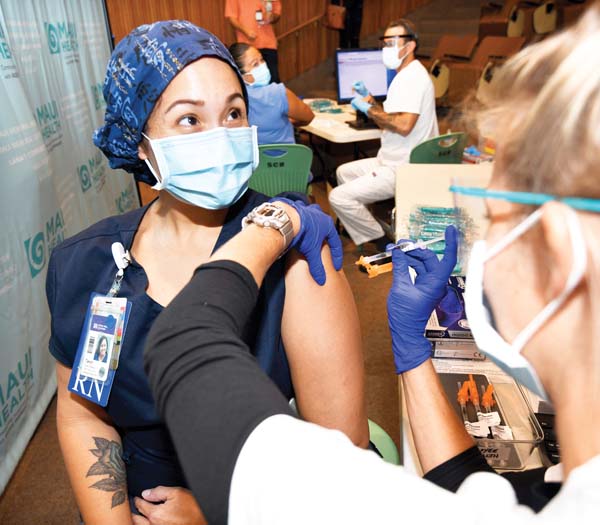
Maui Health System ICU RN Taryn Pacheco is vaccinated by graduate nurse Jodi Mormon at Maui Memorial Medical Center on Dec. 23. — The Maui News / MATTHEW THAYER photo
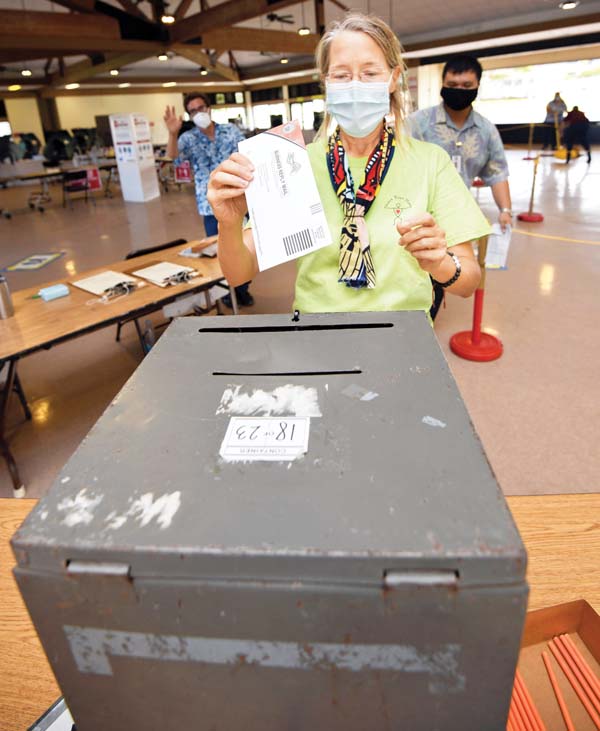
Share Your Mana founder Lisa Darcy puts a ballot into the ballot box at the Maui County voter service center at Velma McWayne Santos Community Center in Wailuku on Aug. 5. — The Maui News / MATTHEW THAYER photo
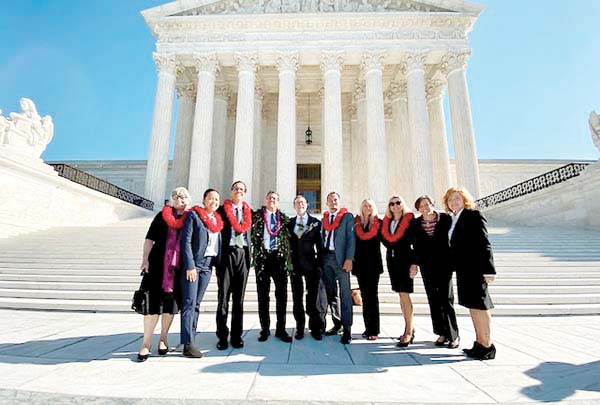
Earthjustice attorneys and plaintiffs who sued Maui County over its use of injection wells stand outside the U.S. Supreme Court in November 2019. The high court decided in the plaintiffs’ favor in April. — Photo courtesy Hannah Bernard
Army National Guard Spc. Zachary Cabingas checks the temperature of 8-month-old Emily King before she and her mom board an interisland flight at Kahului Airport on June 16. — The Maui News / MATTHEW THAYER photo
Maui Police Department officers patrol Keawakapu Beach on April 18. — The Maui News / MATTHEW THAYER photo
Grocery store shelves are empty March 13 after an islandwide run on toilet paper and other paper products. — The Maui News / MATTHEW THAYER photo
Maui Memorial Medical Center COVID-19 unit registered nurse Leigh Ringstad dons protective gear with help from hospital aide Reynita Franco before going into a patient’s room on May 14. — The Maui News / MATTHEW THAYER photo
Hospital workers are honored with a flower drop above Maui Memorial Medical Center on May 19. — The Maui News / MATTHEW THAYER photo
Maui Health System ICU RN Taryn Pacheco is vaccinated by graduate nurse Jodi Mormon at Maui Memorial Medical Center on Dec. 23. — The Maui News / MATTHEW THAYER photo
Share Your Mana founder Lisa Darcy puts a ballot into the ballot box at the Maui County voter service center at Velma McWayne Santos Community Center in Wailuku on Aug. 5. — The Maui News / MATTHEW THAYER photo
Earthjustice attorneys and plaintiffs who sued Maui County over its use of injection wells stand outside the U.S. Supreme Court in November 2019. The high court decided in the plaintiffs’ favor in April. — Photo courtesy Hannah Bernard
Trending
2020 is a year most people will want to forget.
The COVID-19 pandemic took over the world, infecting around 84 million, leaving more than 1.8 million dead and millions of others unemployed, keeping people cooped up at home and changing all aspects of normal life.
Maui County wasn’t spared, with at least 17 dying on Maui and more than 1,000 infected across all three county islands.
Thousands of residents lost their jobs as nonessential businesses and large resorts shut down in the spring after travel screeched to a halt. The trickle-down effects also closed the door on many other businesses that couldn’t deal with the harsh economic impact.
Public school students left their campuses in March for spring break and never returned for the rest of the school year. Some students have begun to filter back to school for the new term, while others have yet to set foot on a physical campus and continue to learn virtually.
Fear of the virus led to runs on hand sanitizer, disinfecting wipes, Lysol and toilet paper.
And, like it or not, "pivot," "bubble," "social distancing" and "flattening the curve" became buzzwords as people learned to adapt, stay with the same groups of people and keep six feet from others in public, all to flatten the rate of infection in their communities.
But even with the pandemic, an election went on with a new Maui County Council elected in November. Hurricane season also came and went with only a couple of major storms in the Pacific, including Hurricane Douglas in July, which came within "razor-thin" distance of the state but spared the islands from the worst of strong winds, storm surge and flooding.
Through it all, there were bright spots of neighbors helping neighbors, residents making masks and donating personal protective equipment, individuals and businesses donating food and delivering supplies to those in need. Essential workers continued to labor even with fears of the virus.
And, most of all, first responders and health care workers continued to assist and care for others in the community, which turns with hope to a better and brighter new year.
With 2021 now underway, here is a look back on 2020 in Maui County.
COVID-19 comes to Maui
Even though a Japanese couple who passed through Maui in late January and February later tested positive for the virus, the county wouldn’t see its first confirmed case until early March, when a Canada Air flight attendant developed symptoms days after arriving on Maui. She self-isolated in Lahaina and was monitored by the state Department of Health.
As more cases slowly began to appear across the state, Maui County implemented a "stay home, work from home" order on March 25, forcing many businesses to close and families to hunker down in their homes.
"I want to ask all of you to please understand that what we do is very central, and the decisions we make, we make with a heavy heart sometimes, because we know the effect and impact to the people of Maui County," Mayor Michael Victorino said at the time.
Dine-in restaurant service was not allowed, but takeout and delivery were permitted. Bars, nightclubs, theaters, public gathering venues and hair and nail salons were also closed.
Only essential activities were allowed, such as grocery shopping and doctor’s appointments. County parks, including beach parks, were closed.
State officials also started imposing travel restrictions to clamp down on outside cases. On March 26, the state enacted a mandatory 14-day quarantine for incoming out-of-state travelers, including returning residents. The mandatory quarantine was extended to interisland travelers on April 1, the same day that Maui Memorial Medical Center reported treating its first COVID-19 patient in one of its isolation rooms.
Many of the early cases were connected to travel, including the first case on Molokai, reported April 2, in a man who’d traveled to Las Vegas in March. He had to be airlifted to Oahu, where he was hospitalized. The case was a concern for the rural island community with fewer resources to handle a widespread health crisis, but a quick cleaning of local businesses and strict precautions helped prevent a major outbreak.
Then, on April 6, Maui County announced its first resident had died of COVID-19, a man over 65 years old who was believed to have underlying health conditions, according to the Health Department. He did have exposure to travelers, but it wasn’t known whether this was a risk factor associated with his death, the department said at the time. He was the first confirmed COVID-19 death on a Neighbor Island following four deaths on Oahu.
While cases were far higher on Oahu, Maui was the first to see a large-scale outbreak at a health care facility when Maui Memorial announced its first COVID-19 cluster of 15 employees and eight patients on April 8. The cluster swelled to more than 50 patients and staff at its height and prompted outcry from community members and some employees who called for the resignation of top hospital brass.
Hospital officials would later say that slow testing turnaround times, a lack of communication and circulation of staff and patients through the hospital were at the heart of the outbreak, though others also questioned whether the administration’s policies on wearing masks spurred the cluster, especially after then-Department of Health Director Bruce Anderson said that the hospital's issues with equipment protocols "might've contributed to the outbreak." The cluster was officially declared closed in May.
As COVID-19 cases grew, unemployment did as well. In the week ending on March 28, nearly 11,000 people in Maui County filed for unemployment compensation, about a 6,000 percent increase from the 180 people who filed during a similar week last year, according to state labor data. Maui businesses like the nearly 50-year-old Tanikai Inc. and popular eatery Da Kitchen closed for good as the economic effects filtered down to local businesses.
The pandemic impacted social life and celebrations as well, as Maui County public schools held virtual commencements with drive-thru diploma pickup in May. Some private schools continued with traditional graduation.
With the arrival of summer and a statewide decrease in cases, restrictions began to lift. Maui County’s retail stores, malls and hair and nail salons were allowed to reopen in May, though not all did. In June, restaurants were given the go-ahead to resume dine-in services, bars reopened and the interisland quarantine was lifted.
As expected, the return to business brought an increase in cases in August, with another cluster at the hospital that grew even larger than the last with around 70 cases, and an outbreak at Roselani Place, an assisted living community in Kahului, where cases among patients and staff reached 71 by mid-October. Most long-term care facilities on Maui avoided the worst of the pandemic, with Hale Makua Health Services reporting only a handful of cases throughout the first several months.
The surge in cases across Hawaii, particularly on Oahu, led the state to reimpose the 14-day mandatory interisland quarantine on Aug. 11, solely for travelers heading to islands other than Oahu. That same month, the state Department of Education pulled back plans to reopen some school campuses and announced 100 percent distance learning for at least the first four weeks of the 2020-21 school year, although distance learning went on much longer.
Rising cases in August also delayed the state’s pre-travel testing program, which eventually launched Oct. 15 and allowed trans-Pacific travelers the option to bypass the two-week quarantine with a negative COVID-19 test through a trusted partner approved by the state.
On Oct. 20, after being virus free for months, Lanai reported its first COVID-19 cases in three coworkers and a health care worker. After cases went from zero to nearly 100 in a short time, Lanai was put under a "stay at home" order beginning Oct. 27. The mandate was rolled back to a less strict "safer at home" order on Nov 12. Lanai’s case count has remained at 106 for several weeks.
Kalawao County, reportedly the last county in the U.S. without a COVID-19 case, saw its first case Dec. 10 after an adult resident returning on a local flight to Kalaupapa tested positive. The person was asymptomatic and in self-isolation. The Department of Health, which oversees care for the remaining Hansen’s disease patients at Kalaupapa, has not reported a case there since.
Nine months after the pandemic first reached Maui County, and mere weeks after Pfizer-BioNTech’s and Moderna’s COVID-19 vaccines were approved for emergency use, the very first dose in Maui County was given to Maui Memorial respiratory therapist Will Ambat to cheers from the mayor, hospital officials and health care workers.
"Its been a rough year for everybody," Ambat said. "The vaccine is like a beginning to an end of this COVID era."
Election contention
In a year of stay-at-home orders and social distancing, voting by mail couldn’t have come at a more critical time. This year was the first time Hawaii implemented a full voting-by-mail system, sending ballots to all registered voters, who could fill them out at home and drop them off at locations across the county. Voters also could cast their ballots in person if they wished.
While the primary election in August ran fairly smoothly, with polls closing on time and just one close race needing a recount, the general election in November was another story as voters across the country flocked to the polls on Election Day. Many voters opted to cast their ballots early, but others lined up outside the voter service center in Wailuku, which didn’t close until about an hour later than expected. Long lines on Oahu also held up statewide counts.
Hawaii residents weren’t the only ones waiting for results late into the night; the nation held its breath as an extremely tight presidential election between Republican President Donald Trump and Democratic candidate and former Vice President Joe Biden went unresolved for days, as mail-in ballots trickled in, protesters congregated outside counting centers and Trump launched legal challenges in states he’d lost.
The Associated Press wouldn’t call the race for Biden until Saturday, setting off celebrations in some cities and a long, begrudging transition process as Trump refused to concede.
Maui County races were less contentious. All state Legislature and council incumbents were reelected to their seats, with two candidates --Yuki Lei Sugimura in Upcountry and Alice Lee in Wailuku-Waihee-Waikapu -- unchallenged. Gabe Johnson secured the Lanai residency seat, the only wide open position on the council with longtime Council Member Riki Hokama stepping down due to term limits.
Voting by mail did what many supporters predicted by increasing participation. In Maui County, the primary election turnout was 42.7 percent, surpassing the 36.2 percent posted in 2018 and the dismal 29.6 percent in 2016. Maui County’s general election turnout was 66.4 percent, the best in decades, topping every presidential election in the past 20 years and the 63.4 percent the county posted in 1996, the earliest year for which the state Office of Elections offers county-specific turnout data on its website.
"I was hoping for 60,000 ballots to be returned, and the voters excelled and ended up carrying us through to over 70,000 between electronic and paper ballots," Maui County Clerk Kathy Kaohu said following a sleepless night of vote counting.
Of the 107,930 registered voters in Maui County, 71,634 cast their ballots in the general election. Of the total turnout, 67,077, or 93.6 percent, voted by mail, while 4,557, or 6.3 percent, voted in person.
Wastewater battle comes to a close
For one day this spring, the pandemic wasn’t the biggest news in Maui County; on April 23, the U.S. Supreme Court ruled in favor of four environmental groups that sued Maui County in 2012 over the use of injection wells to discharge treated wastewater.
The justices held by a 6-3 vote that the discharge of polluted water into the ground, rather than directly into nearby waterways, does not relieve an industry of complying with the Clean Water Act.
It was the culmination of a closely watched case stemming from injection wells at the Lahaina Wastewater Reclamation Facility. The Hawaii Wildlife Fund, West Maui Preservation Association, Surfrider Foundation-Maui Chapter and the Sierra Club-Maui Group filed suit, saying the effluent was reaching the ocean and impacting coral reefs and sea life.
The county had argued that the discharge of the treated wastewater into injection wells does not require permits under the Clean Water Act because the pollutants do not flow directly into the ocean, but rather indirectly through groundwater.
The Supreme Court chose to hear the Maui County case because circuit courts around the country were split over the reach of the Clean Water Act. Maui County had lost in lower courts, including the 9th Circuit Court of Appeals. While the Maui County Council voted in 2019 to settle the case after the appeals court ruling, Victorino didn't approve the settlement, and the case made its way to the high court in November 2019.
"We hold that the statute requires a permit when there is a direct discharge from a point source into navigable waters or when there is the functional equivalent of a direct discharge," Justice Stephen Breyer wrote for the court following the ruling in April.
Plaintiffs said they hoped Maui County would work on a solution to end the use of injection wells to discharge large amounts of treated wastewater.
"This provides us a pathway forward to stop this practice of illegally injecting wastewater into the ground," Hannah Bernard, executive director of Hawaii Wildlife Fund, said after the decision. "What this now allows is for us to solve this problem and for us to stop polluting the ocean."
Victorino said in a statement that "this ruling is a step toward the clarity we have advocated for."
He said the Supreme Court agreed with Maui County that the 9th Circuit ruling "was too broad and could possibly affect millions of homeowners with septic systems."
"The Supreme Court also confirmed that discharges to groundwater are the responsibility of the states, which allows us to address this problem at a local level," Victorino said.
In the spring, the U.S. District Court in Hawaii will decide how the decision will directly impact the county.
* Melissa Tanji can be reached at mtanji@mauinews.com.