
COVID-19 spurred widespread changes in local health care
Maui medical providers provide insight, reflection a year into pandemic
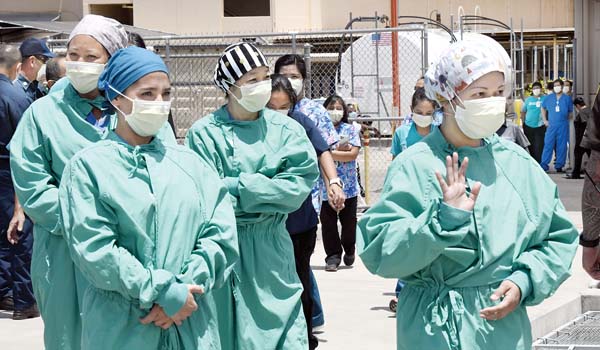
Maui Memorial personnel gather on the hospital’s helicopter landing pad on May 14 to watch a KC-135 Stratotanker from Hawaii Air National Guard’s 203rd Air Refueling Squadron fly over in honor their efforts during the pandemic. — The Maui News / MATTHEW THAYER photo
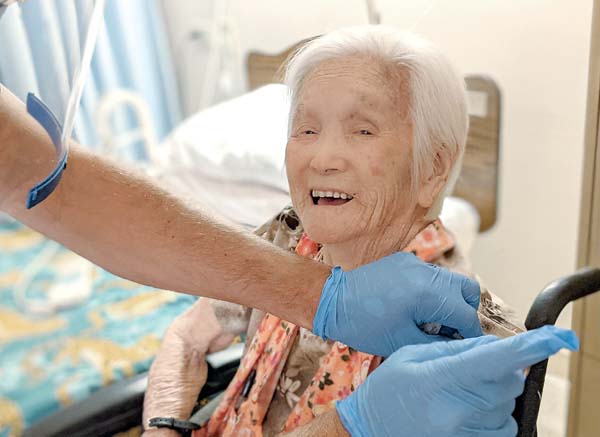
Hale Makua Kahului resident Waiko Ginoza smiles as she receives her initial COVID-19 vaccination in December at the nursing facility. A year into the pandemic, Hale Makua officials said that cutting back on visitation and quick responses to the first cases helped prevent a large outbreak. — HALE MAKUA photo
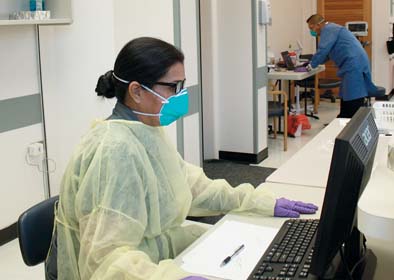
Registrar Casi Moreno (foreground) and Jerry Grey assist with flu and COVID-19 specimen sampling at Maui Medical Group in March 2020. Over the past year, Maui Medical has avoided large outbreaks due in part to strict travel rules for staff, masking policies and free testing, officials said. — The Maui News / MELISSA TANJI photo
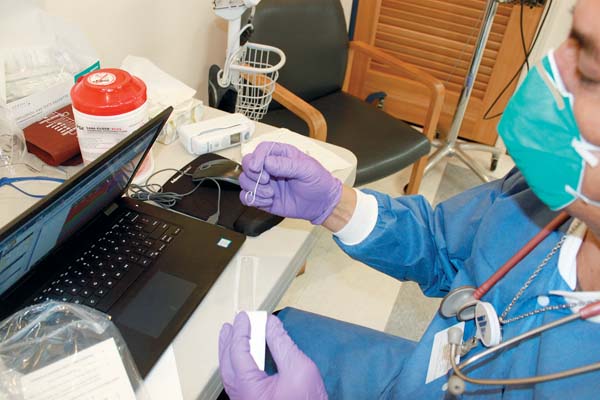
Jerry Grey shows the swab used for a COVID-19 test at Maui Medical Group in March 2020. — The Maui News / MELISSA TANJI photo
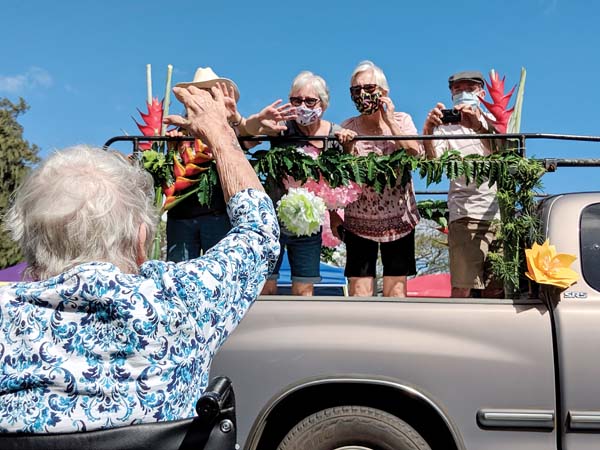
Hale Makua Kahului resident Marjorie Miller (foreground) waves to her family as they pass by in the back of a truck during a Cinco de Mayo parade outside the facility last year. — HALE MAKUA photo
Maui Memorial personnel gather on the hospital’s helicopter landing pad on May 14 to watch a KC-135 Stratotanker from Hawaii Air National Guard’s 203rd Air Refueling Squadron fly over in honor their efforts during the pandemic. — The Maui News / MATTHEW THAYER photo
Hale Makua Kahului resident Waiko Ginoza smiles as she receives her initial COVID-19 vaccination in December at the nursing facility. A year into the pandemic, Hale Makua officials said that cutting back on visitation and quick responses to the first cases helped prevent a large outbreak. — HALE MAKUA photo
Registrar Casi Moreno (foreground) and Jerry Grey assist with flu and COVID-19 specimen sampling at Maui Medical Group in March 2020. Over the past year, Maui Medical has avoided large outbreaks due in part to strict travel rules for staff, masking policies and free testing, officials said. — The Maui News / MELISSA TANJI photo
Jerry Grey shows the swab used for a COVID-19 test at Maui Medical Group in March 2020. — The Maui News / MELISSA TANJI photo
Hale Makua Kahului resident Marjorie Miller (foreground) waves to her family as they pass by in the back of a truck during a Cinco de Mayo parade outside the facility last year. — HALE MAKUA photo
Trending
EDITOR'S NOTE: This is the first in a limited series looking back on the past year since COVID-19 arrived in Maui County. Each story will explore an industry directly impacted and reshaped by the pandemic. Today focuses on health care.
From caring for patients with coronavirus to battling outbreaks, Maui's health care system has borne the brunt of the pandemic since the first cases arrived in Maui County.
COVID-19 spawned dramatic changes in local hospitals, doctors' offices and long-term health care facilities, including testing for both staff and patients, restricting visitors, strict distancing and masking protocols and the need for more cleaning, more safety precautions and more personal protective equipment.
Maui County's heath care operations have also partnered and worked even more closely with government and community entities, especially the state Department of Health.
But while the pandemic has altered the health care landscape, officials at Maui Memorial Medical Center, Maui Medical Group and Hale Makua Health Services said that not all the changes were bad, as the pandemic pushed them to improve communication, united their staff and taught them valuable lessons.
Maui Health: Lessons in communication
On March 11, 2020, Maui Health-operated Maui Memorial Medical Center had its first positive COVID-19 test, an airline employee who did not need to be admitted, said spokeswoman Tracy Dallarda.
Weeks later on March 28, 2020, the hospital tested a patient had been admitted to the hospital for the reasons other than the virus. About three days later, they received a positive result. The patient, who was asymptomatic, became the hospital's first patient with COVID-19.
And "that's where the learning started," Dallarda said.
That early cases kickstarted the first hospital cluster, which eventually spread to 14 patients and 38 health care workers from early April until it was deemed closed by the state Department of Health on May 19.
As cases mounted, the outbreak spurred criticism from health care workers who were frustrated over hospital policies and community members who called for the removal of top leadership.
Hospital administration has said that slow COVID-19 test turnaround times at the beginning of the pandemic, lack of communication and circulation of staff and patients through the hospital were at the heart of the outbreak.
Dr. Michael Shea, ICU medical director and physician lead for the hospital's Emergency Operations Center, said this week that the hospital learned many lessons, especially during the outbreak.
"I think communication is probably lessons one, two and three," Shea said. "I think we were so busy in the beginning, all things were changing so much, the information coming from the CDC changed every day. Trying to follow the science, we were making responsible decisions for our patients and our staff. I think communication wasn't focused on as much at it should have been or we did the best we could and we got better at it."
By the time a second cluster arose, circumstances were different. Now there were rising cases in the community, but there was also more testing and quicker test turnaround, and computer software instead of manual processes were used for contact tracing.
Dallarda said the second cluster started Aug. 13 and grew to 31 patients and 35 health care workers. While larger, this one "was very short-lived" compared to the first cluster, she said. "It was locked down within two weeks."
Dallarda said the hospital has seen more than 20 COVID-19 deaths but was not sure if the state Department of Health classified them as caused by COVID-19 or "related" to the virus, as the majority of deaths included underlying illness.
The DOH did not have updated information on the cases on Friday.
Dallarda said that employees and providers continue to test negative even as Maui continues to see community spread.
The hospital also had to adjust the way it housed patients. Warm units were established for patients who were suspected of having the virus or who tested positive. Each warm unit was walled off with a plastic zippered door and an antechamber where staff could don protective equipment.
Other changes included COVID testing for patients entering the hospital, a policy that continues today.
Maui Health President and CEO Michael Rembis said tests are administered even for emergency room patients who may need to be admitted; they're done early on to cut down on wait times.
Staff are also being tested as well, especially in the emergency room, where workers don't always know the status of patients, Shea said.
And, while cleanliness was always a high priority, Rembis said "we upped our game" and hired an outside cleaning company to sanitize public areas in addition to other cleaning conducted by hospital staff.
"Our very high level of cleaning is here to stay," Rembis said.
Visitors are also still limited, prompting nurses and physicians to step into caregiver roles, Shea added.
And as long as the pandemic is still ongoing, Shea said there will still be a contact tracing team and an Emergency Operations Center.
Maui Health also launched social media town halls with the public, featuring hospital officials discussing and taking questions about health matters from the community.
"Who would have thought a hospital would do social media town halls?" Shea said. "It was important to get information to the community and take live questions and answer their questions and be able to provide a reliable source of information because there is so much out there that can be confusing. I think that is here to stay."
Rembis added, "we need transparency; that is a very important lesson as CEO that I have learned. We will continue that lesson going forward indefinitely."
"I think we've done a really good job of taking care of patients of this community," Rembis added. "I can tell you the physicians have worked extremely hard, the nurses have. I think we have done a good job providing care and equally a good job now of protecting ourselves. It is so important that if we are going to take care of the patients, the first order is we have to protect our employees, who are then going to be there for the patients and our community."
Another major impact of the pandemic was financial; the hospital for a short time halted elective surgeries, and a decline in travel also meant fewer visitors to treat. The hospital also had added expenses with the increase in equipment to prevent the spread of the virus.
However, Rembis added that the pandemic has hurt all Maui's economy. "We are all in this together," he said.
Maui Medical Group: Making rules early on
From strict travel policies for staff, to an early mask rule, to free COVID tests for workers at any time, Maui Medical Group said it was able to keep the virus away from its workers and patients.
"We have been extremely blessed with only one employee that contracted COVID while working with patients in our Wailuku clinic," said Cliff Alakai, administrator for Maui Medical Group, a provider with clinics across the island.
Two hospital workers contracted the virus at Maui Memorial, but "fortunately these employees recovered quick without complications," Alakai said. He added that a "small amount" of employees, maybe around three, contracted the virus, mostly from family members.
Overall, Alakai felt that Maui Medical Group weathered the pandemic well.
"Our people have been really, really good," he said. "We have been so blessed considering . . . actually a lot of the medical practices I know outside the hospital didn't have a lot of issues."
Part of that came down to policy -- even though medical staff could get quarantine exemptions as essential workers, Maui Medical Group required anyone traveling off island to quarantine for two weeks early on during the pandemic, Alakai said. When cases were rising on Lanai and Molokai, Maui Medical also imposed quarantine for workers traveling to those islands, but has since lifted the rule.
"We were very strict on that . . . We didn't want to take a chance," Alakai said.
Maui Medical Group has now relaxed its travel policy for employees who have received two doses of the vaccine. Patients are still asked questions about travel.
More than 95 percent of Maui Medical's doctors, nurses and other medical staff have been vaccinated, with 65 percent of nonmedical staff also receiving the vaccine. Alakai said that number is increasing.
Maui Medical also created outdoor spaces and made sure staff were not congregating in lunch rooms. In waiting rooms, seats are still blocked off to allow for social distancing, and the Clinical Laboratories and Walgreens pharmacy in their facility are for patients with appointments only.
"This is to keep the waiting areas less busy," and allow for social distancing, Alakai said.
At one point, Maui Medical held off on minor surgeries -- such as sinus operations and "lumps and bumps" issues -- that have since been reinstated.
One thing that clinics like Maui Medical Group are concerned about is that some patients have put off medical care and are now showing up with problems that got worse because they waited.
"So if anyone is behind, if you were scheduled for a screening, get it done," Alakai said.
Maui Medical Group is also administering about 50 to 70 vaccines a day Monday through Friday.
Through the pandemic, Maui Medical has also performed COVID-19 testing; of about 14,000 tests, an estimated 239 have been positive, Alakai said.
Hale Makua: Cutting down on visitors
For Hale Makua, Maui's largest skilled and intermediate nursing home, one of the biggest hurdles during the pandemic was halting visitation.
Visitors had to undergo screening starting in early March 2020, and shortly after, Hale Makua locked down its facilities in Kahului and Wailuku. Only essential workers were allowed, and only after they passed a health screening.
"It has been very difficult as families could not visit at all initially," said Teana Kaho'ohanohano, administrator for Hale Makua Kahului. "We created drive-thru visitation opportunities and implemented calls and video conferencing with families as much as possible."
The first cases reached the Kahului facility in April, reportedly connected to the cluster at the hospital, which discharges some patients to Hale Makua.
"After first discovering our first positive case, we were worried but we were ready," Kaho'ohanohano said. "Our team has done a great job in implementing infection control measures and having a mitigation plan in place."
The facility began more screening measures, including admitting new residents only after two negative COVID tests, she added. Overall, the Kahului facility has had 11 staff and four residents test positive.
The Wailuku facility has not had any cases.
"Both locations were very aggressive when it came to preventative measures, and families and staff were extremely supportive," she said. "It proved successful as we have not have any large clusters in either facility."
However, the facilities are still required by the CDC to test all residents and staff monthly due to the county's positivity rate.
Tests will be done more frequently if the positivity rate goes up or if a positive case is found at the facilities, she said.
As the pandemic wore on and visitators were still not allowed, Kaho'ohanohano said staff was creative and held activities in open areas so residents could enjoy socializing while remaining physically distanced. There have been virtual church services, outdoor live music, drive-thru visitations and a parade.
Visitations were later allowed outdoors, with masks and social distancing protocols.
Health screenings continue for everyone entering the campuses.
So far, 85 percent of Hale Makua's 250 to 300 residents at both of its facilities (the number fluctuates) have received the vaccine. And, about 60 percent of the 500 staff members have as well.
Kaho'ohanohano said that many of the changes prompted by COVID will remain in place for now.
"COVID isn't going away any time soon," she said. "We expect to continue screening upon entry for COVID symptoms and will continue to encourage our community to get vaccinated. We hope visitors/families are allowed in with increased vaccination rates."
Hopeful for the future
As people continue to be vaccinated, health care providers at the hospital, the clinic and the long-term care facility are hopeful that staff and patients can get back to life as they knew it before the pandemic.
Alakai said there are many kupuna who "are so thankful they got their shot," especially after months of strict orders and warnings that kept many of them cooped up at home.
He said a group of elderly residents who received their shots from a Maui Medical Group clinic was "talking story; they are having a great time."
One couple at the clinic even offered to bring back another kupuna they befriended for her second shot.
"It was truly amazing," he said.
At Maui Memorial, Shea said that workers often stop to check in at the vaccination clinic in the lobby.
"Every day I walk by on the first floor there is a little balcony that overlooks the vaccine clinic," he said. "I will see multiple health care workers of all types leaning over the railing and just absorbing the positive vibes from this. It really brings a charge to the day."
* Melissa Tanji can be reached at mtanji@mauinews.com.