
Schools expect more elementary students back in class next week
Teachers’ union agrees to amended guidelines
Trending
More public school students, especially in elementary grades, could be heading back to the classroom next week under revised health and safety guidelines that include masking and increased cleaning if 6 feet of social distancing is not possible.
About 12 percent of Hawaii's elementary school students are currently having full-time, face-to-face learning in schools, state Department of Education Superintendent Christina Kishimoto said during a news conference Monday afternoon.
"Our goal collectively is to have over 50 percent of our students at the elementary level in person, during quarter four, with all students who want to be in person to be minimally coming to campus on a rotational basis if that's what's needed," Kishimoto said.
Face-to-face learning is "so vital for our students, especially our youngest learners," Kishimoto added.
Parents can still choose to keep their children on distance learning.
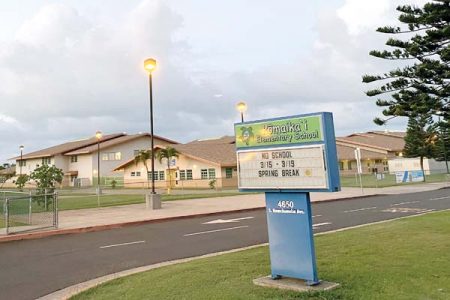
Public school students are currently on spring break and will head back to the classroom for the fourth and final quarter of the year Monday. The DOE said that individual schools were finalizing plans and communicating directly with families prior to spring break. Each school will decide how and when to bring back their students.
In Maui County, schools that already have full in-person instruction include Maunaloa and Kilohana elementary schools on Molokai, which have been doing face-to-face learning since the start of the school year, said DOE spokeswoman Nanea Kalani.
Kaunakakai Elementary has been in a blended model since the third quarter and has virtual learning just one day a week.
Lanai High and Elementary School has had students in pre-K to grade 5 in daily face-to-face learning for the third quarter.
Hana High and Elementary School has had daily face-to-face learning for students in pre-K up to grade 12, Kalani added.
The DOE said it has worked with the state Department of Health and has also informed the Hawaii Government Employees Association and United Public Workers unions of the changes. HGEA represents school administration and office assistants, while UPW represents building maintenance workers, cafeteria helpers and school custodians.
Hawaii State Teachers Association President Corey Rosenlee said Monday afternoon that the union reached an agreement with the state to increase fourth quarter in-person learning based on teacher vaccinations, case counts and CDC guidance.
Rosenlee said that by the time more students come back to campus, the "vast majority" of teachers will be vaccinated. Hawaii also has low COVID-19 case counts. He added that HSTA also consulted with the DOH and the CDC.
A combination of these factors "has determined it is safe to do this," Rosenlee said.
The union, state and Hawaii Board of Education agreed upon strategies including cohorting, physical distancing (ideally at least 6 feet), adjusting ventilation systems, introducing additional outside air and/or increasing air exchange, physical barriers (most important when masking and physical distancing cannot be maintained) and cleaning high-touch areas.
If 6 feet of distancing is not possible, Kishimoto said that under the new guidance, schools will follow other steps such as wearing masks, taking breaks to wash hands and wiping down common surfaces.
HSTA's Deputy Executive Director and Chief Negotiator Andrea Eshelman said that when 6-foot social distancing is not possible, there must be proper open air ventilation and air filtering systems, and students should be placed in cohorts. Mask breaks should be taken outdoors or in a well-ventilated area if an outdoor area is not accessible, and students should be 6 feet apart. Eshelman said the union will follow up with the DOE on proper ventilation in classrooms.
Other aspects of the memorandum agreement include:
• Advance notice: Schools shall provide a minimum notice to teachers of seven calendar days before an increase in in-person schooling.
• Remote work during quarantine: In cases where a school's buildings are closed and students are sent home because of COVID-19, teachers who have to quarantine can work from a remote location.
• Consistent masking, staying home when sick, sending a teacher or student home if they become sick at school and proper hand hygiene.
"Our goal right now is to use this quarter to prepare for the summer and ultimately, hopefully have all students back in person for the fall," Kishimoto said.
* Melissa Tanji can be reached at mtanji@mauinews.com.