
More programs opening up for disabled residents
But some ‘critical development’ was lost for youngsters
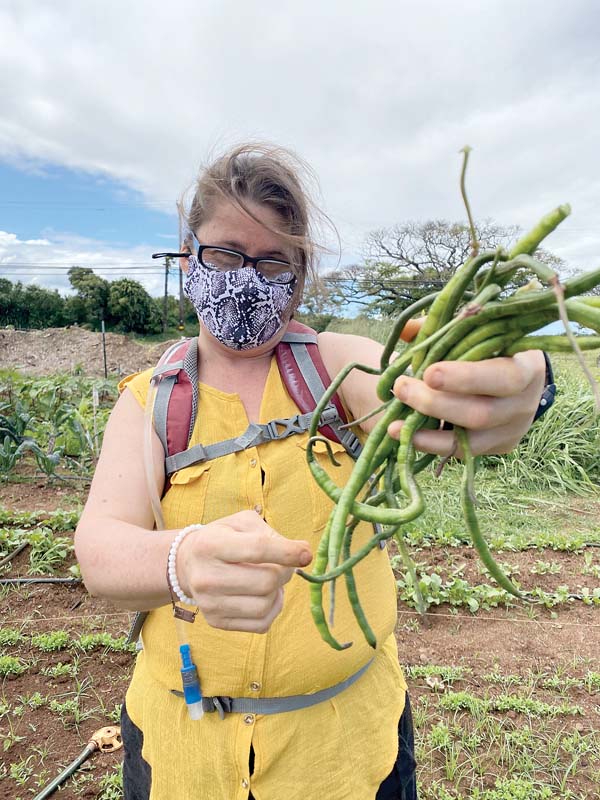
La‘akea Village client Juna Teague smiles while holding a handful of freshly picked beans last month on the campus in Paia. Programs for disabled adults have been opening up more as the pandemic abates. — The Maui News / MELISSA TANJI photo
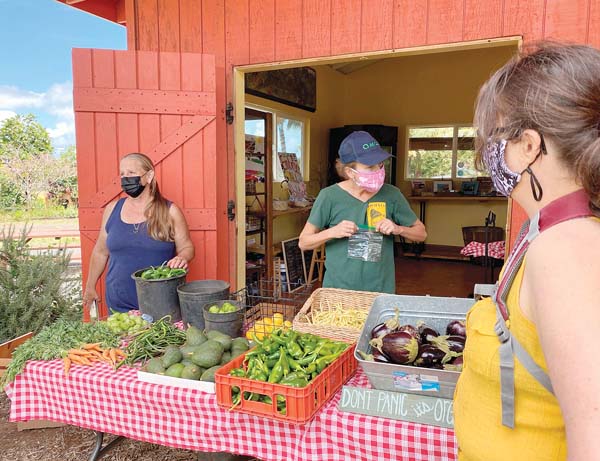
La‘akea Village Board President Susan Graham (from left), board member Betsy Bergevin and client Juna Teague hang out at La‘akea ’s country store along Baldwin Avenue last month. — The Maui News / MELISSA TANJI photo
La‘akea Village client Juna Teague smiles while holding a handful of freshly picked beans last month on the campus in Paia. Programs for disabled adults have been opening up more as the pandemic abates. — The Maui News / MELISSA TANJI photo
La‘akea Village Board President Susan Graham (from left), board member Betsy Bergevin and client Juna Teague hang out at La‘akea ’s country store along Baldwin Avenue last month. — The Maui News / MELISSA TANJI photo
Trending
PAIA -- More than a year after the COVID-19 pandemic set in, La'akea Village was busy again -- masked clients picked beans with staff on the campus fields in Paia, while other clients and volunteers readied produce to be sold at their country store.
The activity last month at La'akea Village, where autistic and intellectually and developmentally disabled adults can live and work, was a complete turnaround from a year ago when the campus was quiet, with minimal clients and staff.
"I'm feeling cautiously optimistic and hopeful about things getting back to somewhat of a normal at La'akea," Executive Director Sarah Menzies said Tuesday. "Already we are more active, engaged and connected. It's a beautiful thing."
During a visit in the fall, the morning circle time that brought clients together in the community building was muted, as the event went virtual. The country store was closed. Instead of fields of busy workers, only one client sat at a picnic table with two staff members playing games.
Client Juna Teague said that the pandemic "sucked." She was glad to be picking beans outdoors again.
"Services dropped down when the pandemic began and has been slowly increasing over the year," Menzies said. "Now we see the same trend continuing with more participants returning to La'akea, able and feeling more safe to be in the community again."
During the pandemic, getting people feeling connected and engaged was the "biggest loss our community experienced," Menzies said.
Some adults in the program liked distance learning, but others didn't. The pandemic interrupted routines, preventing some from working and prompting others in the residential program to go for walks to alleviate boredom.
But as the program opens up, staff are seeing clients picking up on past skills, "which is so great to see," Menzies said.
La'akea Village is among the many Maui organizations serving vulnerable populations that weathered the COVID-19 pandemic.
At Imua Family Services in Kahului, Executive Director Dean Wong said the organization has also reopened its programs, including in-person home services and its preschool.
The nonprofit assists young children and their families to overcome learning challenges in "their most critical formative years" by using play-based instruction, according to its website.
But Wong said "there is no new normal" and that they are "adapting, modifying and stepping out on new limbs each day."
Imua's clients, he pointed out, "have to live compromised every day, and nothing they relate to is ever 'normal,' whatever normal is."
The pandemic meant lost progress for some Imua kids.
"Children are not like clocks that you can hit the reset button and time is just made up -- the first five years are the most critical years in childhood development because over 90 percent of the brain development occurs in the first five years," Wong said.
"Time lost here with developmental services is never made up -- it is critical development that is lost."
Wong said staff is seeing regression and more acting out in some children since the pandemic.
"This is something that we will continue to see in the coming months and years in our children," he added.
Dr. Lori de Crinis at Imua said the loss of skills previously learned could lead to toilet accidents, disrupted sleep, decreased independence, loss of concentration, language regression and behavior challenges.
She said parents should notify their pediatrician of any regression and work on solutions to decrease the amount of stress, such as going for a walk and using positive reinforcement rather than punishment.
During the pandemic, Imua did virtual visits with families and children. Its preschool shut down during the initial closures around the island but then pivoted to create child care for essential workers, Wong said. The organization also developed online preschool programs.
Like many businesses and nonprofits, Imua took a financial hit, and "our ability to create revenue particularly through fundraising events took an obviously huge toll," Wong said.
Funding from outside sources, including the state Department of Health for Early Intervention Services, saw some "dramatic cuts" that will make it very difficult to provide mandated services, Wong said. However, some of the critical funding may be restored through the federal American Rescue Plan, he said.
At Ka Lima O Maui, meanwhile, half of the programs for adults with disabilities continued as its grounds and custodial crews provided essential services during the pandemic.
Ka Lima O Maui is the largest employer of adults with disabilities in Maui County, Executive Director JD Wyatt said. It holds several grounds and custodial contracts with Maui County Parks and Recreation as well as the Wailuku and Kihei police stations.
"Our crews worked every day in 2020 to keep many of Maui's beach parks and grounds safe and sanitary," Wyatt said.
Only a few positions could be adapted to work-at-home jobs, and for the most part, staff was out in the field, he said.
Ka Lima O Maui also has an adult day service program for about 30 clients who are not job candidates.
Because this group is at higher risk for COVID-19 complications, Wyatt said the organization stopped the programs for about three months. However, staff made adjustments and taught clients how to use Zoom so they could interact with friends.
"As it's critical to their health to have social opportunities and engage with staff and their fellow participants, clients were very expressive about their frustrations and sadness about the pandemic and how it altered their lives," Wyatt said. "Since we keep our days full of activities for our clients, they expressed eloquently how much they missed being part of programs and doing fun things out in the community with their friends and support workers."
Ka Lima had a cake "drive-by" where clients could pick up some sweets and see who was around. There was also a grab-and-go lunch for clients around Christmastime, with one client dressing up as Santa and assisting Wyatt with distributing food.
Wyatt said things are opening up for the day programs, but about 15 to 20 percent of Ka Lima O Maui's clients continue to stay home.
The organization has partnered with Mauliola Pharmacy in the Cameron Center to get staff and clients vaccinated and was finishing up their shots late last month.
"Although we know more normal operations are on the horizon, we continue to stick to our COVID-19 protocols and policies to keep everyone safe," Wyatt said.
* Melissa Tanji can be reached at mtanji@mauinews.com.