
Most Hawaii cases of Brazil variant found in Maui County
Health officials warn that strain is more contagious and resistant to antibodies
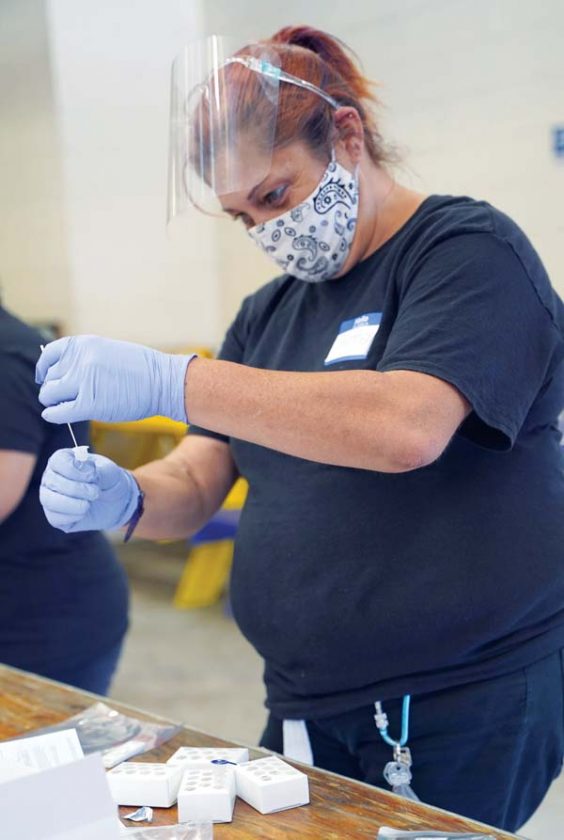
Doctors of Waikiki lab technician Heather Hakes finds the results of a post-arrival rapid COVID-19 antigen test on May 4 at Kahului Airport. The county launched the program in hopes of determining how many cases were being brought in by travel. As of Monday, 61,848 travelers had been tested upon arrival, with 25 positive antigen test results, two of which came out positive during confirmatory testing. The Maui News / KEHAULANI CERIZO photos

Chelsea Vincent, a lab technician with Doctors of Waikiki, works at Kahului Airport during the launch of Maui County’s post-arrival testing program May 4. Maui County is now seeing most cases of the P.1 variant first discovered in Brazil, according to the state Department of Health, which released a report on Wednesday showing that the P.1 variant has been found in 36 specimens in the state, with 22 of them in Maui County, 13 on Oahu and none in Kauai or Hawaii counties.
Doctors of Waikiki lab technician Heather Hakes finds the results of a post-arrival rapid COVID-19 antigen test on May 4 at Kahului Airport. The county launched the program in hopes of determining how many cases were being brought in by travel. As of Monday, 61,848 travelers had been tested upon arrival, with 25 positive antigen test results, two of which came out positive during confirmatory testing. The Maui News / KEHAULANI CERIZO photos
Chelsea Vincent, a lab technician with Doctors of Waikiki, works at Kahului Airport during the launch of Maui County’s post-arrival testing program May 4. Maui County is now seeing most cases of the P.1 variant first discovered in Brazil, according to the state Department of Health, which released a report on Wednesday showing that the P.1 variant has been found in 36 specimens in the state, with 22 of them in Maui County, 13 on Oahu and none in Kauai or Hawaii counties.
Trending
Maui County, which has recently battled higher per-capita COVID-19 variant cases than other islands, is now seeing most cases of the variant first discovered in Brazil that health officials say is more contagious and more resistant to antibodies.
The P.1 variant has been found in 36 specimens in the state, with 22 of them in Maui County and 13 on Oahu, according to a report released Wednesday afternoon by the state Department of Health's State Laboratories Division. There were none found in Kauai or Hawaii counties.
Acting State Epidemiologist Dr. Sarah Kemble said in a news conference Wednesday that the P.1 variant is one "of concern."
"It has greater transmissibility and it needs greater antibody neutralization to be overcome, so, meaning there will be greater concern you (would) be able to be reinfected even if you have already had some strain of COVID," Kemble said.
Earlier this month, Maui District Health Administrative Officer Dr. Marc Nishimoto said that the variant from Brazil is displacing the California variant, which had dominated Maui's cases about a month ago.
He said the California variant is 20 percent more transmissible that the original COVID-19 virus, while the strain from Brazil is "much, much more transmissible than the California variant."
DOH officials said Wednesday that COVID-19 variants of concern account for a greater percentage of total COVID-19 cases in Hawaii than ever and that the percentage continues to rise. Officials stressed vaccinations to prevent the spread of the variants.
The Centers for Disease Control and Prevention classifies variants of concern because of their attributes, including increased transmissibility, decreased neutralization by antibodies generated during previous infection or vaccination as well as increased severity of disease, the DOH report said.
State Laboratories Division Director Dr. Edward Desmond said the variants of concern now make up more than 90 percent of the genomes sequenced by their lab.
Since June of last year, the division has been taking samples across the state and conducting genome sequencing in search of COVID-19 variants.
"We detected our first variants in January and in just four months they have replaced the original COVID-19 lineages as the COVID we find most often," Desmond said in a news release.
In Hawaii, the variant of concern most widely found is the B.1.429 California variant with 631 cumulative cases detected, followed by the B.1.1.7 variant first found in the U.K. with 304 cases, the B.1.427 California variant with 40 cases, the P.1 variant first found in Brazil with 36 cases and the B.1.351 variant discovered in South Africa with 12 cases.
Maui County has seen 242 cases of the B.1.429 California variant, 22 cases of the variant from Brazil, 14 cases of the variant from the U.K. and three cases of the B.1.427 California variant.
Oahu has recorded 261 cases of the B.1.429 California variant, 201 cases of the variant from the U.K., 23 cases of the B.1.427 California variant, 13 cases of the variant from Brazil and 11 cases of the variant from South Africa.
Hawaii County has had 29 cases each of the variant from the U.K. and the B.1.429 California variant as well as two cases of the B.1.427 California variant.
In Kauai County, the B.1.429 California variant was found in 25 cases, while the variant from the U.K. was detected in three cases and the B.1.427 California variant was discovered in two cases.
The most common variant has changed in recent months. In March and early April, the B.1.429 California variant was the dominant strain, detected 631 times in the state through sampling.
But since late April, the B.1.1.7 variant from the U.K. has become the most dominant strain in Hawaii, accounting for at least 61 percent of variants circulating in the islands and detected in 304 instances, the DOH said.
Kemble said during the news conference that the variant from the U.K. is more transmissible than the California variants and can cause serious illness and hospitalization if a person is not vaccinated. The variant does not appear to evade vaccine-induced antibodies.
Health officials had blamed variants for a spike in cases and clusters in Maui County during the winter and early spring, including an outbreak at the Maui Community Correctional Center that began in February and wound down around mid-April after two staff members and more than 90 inmates tested positive for the virus.
Kemble said that Maui County's situation "shows there was a community event with transmission of the B.1.429 initially and then takeover of the B.1.1.7, and so we did probably have importation of these new variants presumably from the Mainland to here, and once that gets a foothold in the community, you can see how quickly those variants can spread."
"We struggled with continuing higher case rates on Maui for several months between January and March, and that's finally beginning to tamp down, and that's really encouraging," Kemble said. "But it does demonstrate some of the struggle with trying to break transmission of the variant."
* Melissa Tanji can be reached at mtanji@mauinews.com.