
Scientists monitor Molokini as tourists return
With limited capacity and growing demand, boats may make more trips
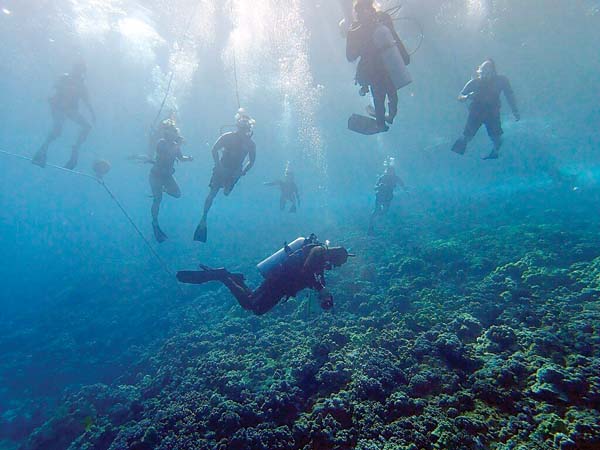
Alan Friedlander (center, bottom), chief scientist of Pristine Seas and National Geographic Society, surveys Molokini last week while surrounded by visiting divers and snorkelers. — Photo courtesy of WHITNEY GOODELL

Clutching a clipboard, Alan Friedlander keeps track of wildlife as he looks for potential impacts from the return of snorkelers and boat traffic. — Photo courtesy of WHITNEY GOODELL
Alan Friedlander (center, bottom), chief scientist of Pristine Seas and National Geographic Society, surveys Molokini last week while surrounded by visiting divers and snorkelers. — Photo courtesy of WHITNEY GOODELL
Clutching a clipboard, Alan Friedlander keeps track of wildlife as he looks for potential impacts from the return of snorkelers and boat traffic. — Photo courtesy of WHITNEY GOODELL
Trending
Changes in fish populations and behavior were already apparent last week as tour boats and snorkelers returned to Molokini, according to a researcher who's been studying the waters around the crater for 20 years.
"We definitely saw some differences between last year and this year -- last year there were virtually no boats out; this year, anywhere from 18 to 20 boats at peak times," said Alan Friedlander, chief scientist of Pristine Seas and National Geographic Society and director of the Fisheries Ecology Research Lab at the University of Hawaii. "So it seems like it's back up to what it was before, if not even more so."
During the early months of the pandemic, researchers had a unique opportunity to study Molokini's ecosystem free of the commercial tours that usually fill the crater off Maui's leeward coast. One year later, with visitor arrivals surging and a busy summer season around the corner, scientists are back in the water to understand the impact of human activity on the marine environment.
Last summer, within a few months after COVID-19 protocols halted commercial boat traffic, more fish and larger predators like ulua, omilu and reef sharks, as well as dolphins and manta rays, had begun to return to the waters off Molokini.
But between April 2020 and this year, there was roughly a 25 percent drop in total fish biomass, Friedlander said.
During dives last week, he observed an absence of omilu, sharks and other predators inside the crater.
The fish were seen on the backside of the 77-acre crater, which is "in line with what we would expect, Friedlander said. "These animals get displaced out of their preferred habitat to a different habitat just because of all the people there. Animals are definitely responding to that."
Friedlander, who is the co-author of five research publications on Molokini conducted in collaboration with the state Department of Land and Natural Resources' Division of Aquatic Resources, has been surveying the same sites at Molokini for the past 20 years, witnessing a substantial decline in reef fish populations.
Even though there were no tour boats for a year, private fishing boats and poachers were still spotted in the crater, according to Friedlander and the DLNR.
When commercial activity resumed and visitor arrivals increased, boats could operate only under strict protocols -- starting with a maximum capacity of 10 people including crew, then transitioning to 50 percent capacity and now 75 percent.
"I think what started happening was that we started seeing more and more vessels at any one time than ever because there was so much demand and the vessels couldn't take the normal load," said Russell Sparks, aquatic biologist for the Division of Aquatic Resources-Maui. "That could be part of what explains observations from Alan's work is that the boats make a lot of noise, they're coming and going, maneuvering and changing directions, so having more boats might be worse than having more people.
"Obviously having more people in the water splashing around is not good, but what I've learned from being out there is that the noise of these boats, particularly the bigger boats, is substantial."
Molokini is the most heavily visited marine protected area in the world, Friedlander said, drawing about 375,000 people during a regular year, which translates to about 100 people in the water at any given time.
On a positive note, Sparks said that Molokini's deep waters and strong currents help mitigate physical damage to the coral reefs or pollution settling in the area.
"That's all pluses for Molokini, but I still think there's a lot we're learning about how heavy human use affects the natural distribution of fish in the area and how that cascades through the webs and the interconnections between these species," he said. "This all concerns us."
While Friedlander conducted his annual survey last week at his go-to spots, Sparks and his team surveyed 40 random sites at both shallow and deep reef points at Molokini.
The DLNR has been collecting detailed data from marine reserves since 2015, which includes counting fish populations, estimating their size, recording species, counting and quantifying urchins and other large invertebrates, analyzing reef health and more.
Both groups compare findings once data is collected and analyzed.
While research is still ongoing and not all the data is ready, Sparks said "I'm pretty sure there's a significant difference" between spring 2020 -- when there was no human activity and the amount of predator fish increased -- and today.
In the 1970s, Molokini was established as a Marine Life Conservation District because of its "unique geology and marine life."
"If you look at the legislation for Marine Life Conservation Districts, these are supposed to be the most special places in the state of Hawaii," Friedlander said. "The main purpose is for protecting marine life, and then it's access, and then it's commerce, and it doesn't seem to be the way that things are going down now."
Molokini serves as a connector and resting ground between Kahoolawe and Maui when species travel between those islands. Human activity and boat traffic can disrupt their travel, hinder fish reproduction and affect behavior, he said.
The crater also has value for the local communities and businesses, so better ways to manage the area would help to mitigate the detrimental effects on the marine environment and its resources, he said.
"There needs to be that happy medium where you've got people enjoying the place, people enjoying the natural experience, operators making money, but the resources being healthy and also not having any poaching going on, so to find that is going to be a challenge," Friedlander said.
The bottom line is that people need to recognize that Molokini is a "very special place, it's irreplaceable, but it's also fragile," he said.
There are currently no restrictions as to how many commercial boats can be anchored at Molokini at one time, according to the DLNR. However, only 40 commercial use permits can be issued for the Molokini Marine Life Conservation District.
DAR aims to revisit legislation that caps the number of commercial boats at 12 in the crater at one time once the impacts of the pandemic subside, Sparks said, adding that he understands the challenges that this would bring for businesses operations.
"It's not going to solve all the problems but it should help," he said.
In general, he noted that the boating industry has been "cooperative and willing to work with us" to find a solution that would be both effective financially and safe for Molokini's environment.
* Dakota Grossman can be reached at dgrossman@mauinews.com.