
As cases rise, frustrated teachers call for safer classroom conditions
Union says health precautions not being followed, wants to negotiate with state
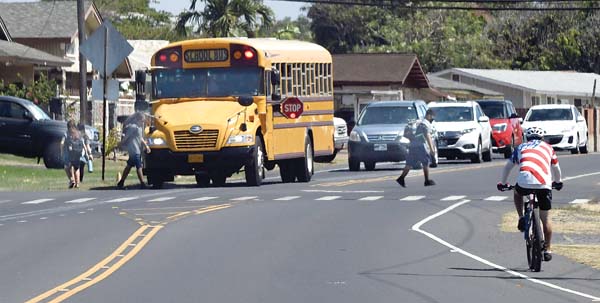
A school bus drops off students on Lono Avenue in Kahului after classes on Aug. 6. The Maui News / MATTHEW THAYER photo
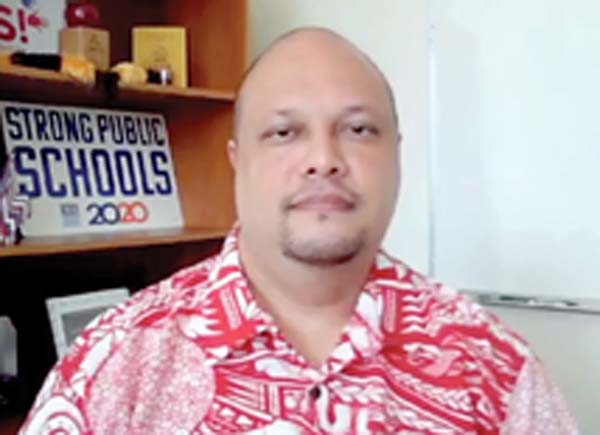
HSTA President Osa Tui (in photo) and Secretary-Treasurer Lisa Morrison (third photo) speak during a media briefing on Wednesday afternoon via Zoom. The Maui News / DAKOTA GROSSMAN photos
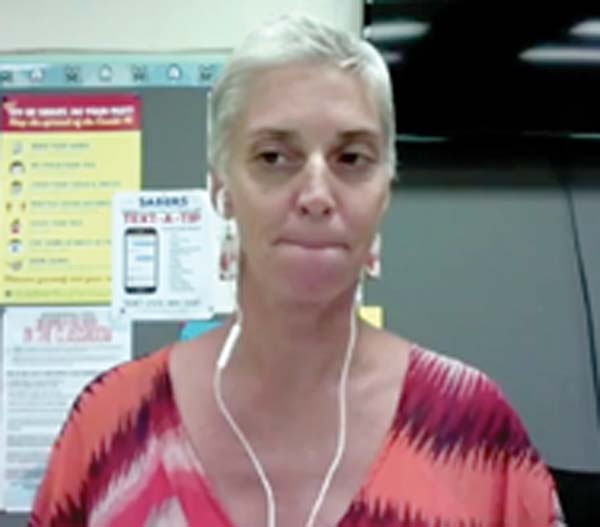
Lisa Morrison
A school bus drops off students on Lono Avenue in Kahului after classes on Aug. 6. The Maui News / MATTHEW THAYER photo
HSTA President Osa Tui (in photo) and Secretary-Treasurer Lisa Morrison (third photo) speak during a media briefing on Wednesday afternoon via Zoom. The Maui News / DAKOTA GROSSMAN photos
Lisa Morrison
Trending
Frustrated and overwhelmed with potentially unsafe working and learning conditions, like crowded classrooms and school buses, poor ventilation and inconsistent COVID-19 reporting, Hawaii public school teachers and their representatives are demanding action.
In an open letter that received about 2,000 signatures of support from teachers statewide, the Hawaii State Teachers Association outlined the safety concerns from staff and requested that the issues be addressed through negotiations.
The letter was sent Wednesday morning and targeted state Department of Education Interim Superintendent Keith Hayashi, Hawaii Board of Education Chairperson Catherine Payne and board members as well as Gov. David Ige.
"Our teachers are crying out for this insanity to stop and for the department to live up to their word and be truly accountable to what they are telling the public is happening at our schools," HSTA president Osa Tui Jr. said during a virtual news conference on Wednesday afternoon. "It's hypocritical of the governor to limit indoor social gatherings to 10 or fewer, but to allow class sizes in the upper 20s, 30s and even into the upper 40s -- it just does not make sense."
Because health and safety guidelines are not being properly enforced, like wearing face masks and social distancing, many public schools have reported positive COVID-19 cases among students at varying grade levels and teachers, HSTA said.
Kahului Elementary School had the most reported coronavirus cases last week in Maui County, where administrators had to send six classes full of students into self-isolation as well as a few teachers who were exposed.
In total, there were 31 cases in the Baldwin-Kekaulike-Maui Complex Area and eight cases in the Hana-Lahainaluna-Lanai-Molokai Complex Area.
"Our students are not robots who will keep still the entire day -- they are curious and carefree children who sometimes don’t know of the dire consequences that could befall them and those they interact with," Tui said. "And more and more, we're seeing schools having to shut down classrooms and quarantine dozens upon dozens of students at a time or move children to cafeterias when teachers are forced to quarantine."
Vaccinated teachers who reveal their vaccination status are not asked to get tested even if they are considered close contacts, though many will get voluntarily tested "to make sure they are not spreading COVID" to other faculty, students and their families, said HSTA Secretary-Treasurer Lisa Morrison.
Reporting, responding and notifying of any COVID-19 cases or exposures have also been inconsistent, Tui said. Some teachers have also said that there are discrepancies in the numbers, he added.
Additionally, there are not enough substitute teachers on island or supervisory staff on campus to meet the demands when mass quarantines take place or if other teachers are asked not to come to work due to signs of illness or potential exposures, said Morrison, who’s also an arts and communication teacher at Maui High.
"This means we have a larger number of people are moving in and out, inevitably, which is problematic, so it's been very hard to get substitutes because you can imagine that a substitute would not really be eager to go into a school that has a live number of COVID cases," she said. "I'm concerned because since the department did not have a plan from the beginning to do this safely, that it's more of a disruption to school than we had at times last year."
Hayashi, however, defended DOE's decision to bring students back to the classroom, saying that "in-person learning is the best education model for successful student outcomes."
"It is our duty and responsibility to keep our schools open for students who need us not only for in-person learning, but for socialization, services tied to mental health and even meals. But we cannot do this alone," Hayashi said in a statement Wednesday. "Our schools are doing everything within their control to diligently implement the core essential strategies set by the state Department of Health, and evidence so far shows that these efforts are working. While community transmission levels have increased, we have no known cases of students getting sick with COVID-19 as a result of coming to school and there is no evidence indicating our schools are amplifiers of transmission."
Hayashi said that schools have the flexibility to combine different mitigation measures to make the classroom safer.
"The core essential strategies schools are implementing consistently are: promoting vaccinations for staff and eligible students, staying home when ill, consistent and correct masking and proper hand hygiene," Hayashi said. "Cohorting, physical distancing, improving ventilation and cleaning and disinfection, meanwhile, are additional mitigation strategies to be applied in combination to the greatest extent possible."
HSTA, however, said worries over access to personal protective equipment and proper ventilation in crowded classrooms are not being addressed, and that students are still coming in contact with a wide variety of groups despite attempts to cohort.
Earlier this year, Hawaii public schools had received federal and state funding to help with improving ventilation and sanitation efforts and implementing safety protocols for in-person learning, but Morrison said little work has been done so far.
Her classroom at Maui High has no windows and has one door that leads to the indoor hallway. Some of her classes yield up to 26 students, so social distancing "is just not possible."
"And that's at a school that I feel is doing a good job trying to be careful," Morrison said. "I'd be interested to hear what someone thinks about the ventilation and how that relates to COVID in my classroom."
Over the summer, the building with Morrison's classroom was under construction to fix the air conditioning ducts, but when the state's financial management system was shut down for about a month, no procurement orders could be made.
"So I am actually teaching underneath an open industrial ceiling, no ceiling and tiles at this time," she added. "While I do believe schools are making an effort within their means, it's pretty much the same thing that happens every year."
Cohorting classes hasn't worked either, both union officials said.
With two children at Paia Elementary School, Morrison said that they ride the bus to school with one set of students, spend time with other kids at the cafeteria, are in class with their cohort group, and then mix with other students at lunch and recess, and then take the bus after school.
"Cohorting sounds like a great mitigation strategy, but it's not realistic to what happens in public education and it's impossible to cohort in middle school and high school," she said.
While the state was preparing for about 175,000 public school students to return to in-person learning, an HSTA survey on July 30 indicated that around 60 percent of members felt somewhat unsafe or very unsafe for themselves and about 70 percent for their students.
When teachers were asked a week later to provide comments on conditions with students back on campus, over 80 percent of responses showed "how unsafe conditions were and continue to be," according to HSTA.
During the 2020-21 academic school year, HSTA and DOE agreed to modify the HSTA collective bargaining agreement to ensure safer practices in the workplace in light of the COVID-19 pandemic in the form of a memorandum of understanding, including having the option for distance learning.
However, Tui said that the memorandum expired on June 30 and the "state refuses to address protocols" and bargain a renewal and update of the memorandum for this school year.
Ige and the Health Department have also since publicly stated that they have no threshold as to how many cases would result in schools returning to 100 percent distance learning.
Morrison said that the DOE also "did not make a long-term plan" to be ready in the event that remote or blended learning would become necessary, and that schools did not distribute devices that students would need to work from home.
"I have students who are unable to come to school at the moment who I am unable to give electronic work to because they don't have that capability at home," she said. "And then you're talking about large inequalities between children who have and children who do not."
Concerned that COVID-19 numbers could "keep going up and up," Tui said that HSTA is asking the community to stand together to advocate for safer working conditions in the education system, especially with the recent introduction of the delta variant.
"We are all invested in making sure that there is accountability when our students' safety is not being held at the highest priority," he said.
A Board of Education meeting is being held today beginning at 9:30 a.m. on WebEx. Written testimony can be sent to testimony.boe@boe.hawaii.gov.
* Dakota Grossman can be reached at dgrossman@mauinews.com. Managing Editor Colleen Uechi contributed to this report.