
Officials: Hawaii in ‘crisis’
Cases soar to more than 2K over three days
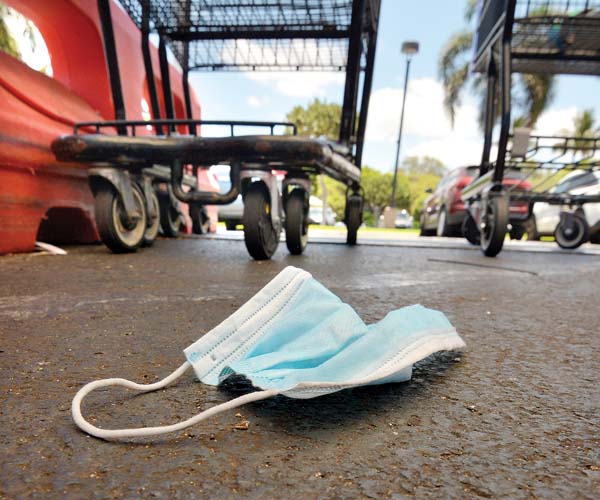
A discarded mask sits outside Kihei Safeway store. — The Maui News / MATTHEW THAYER photo
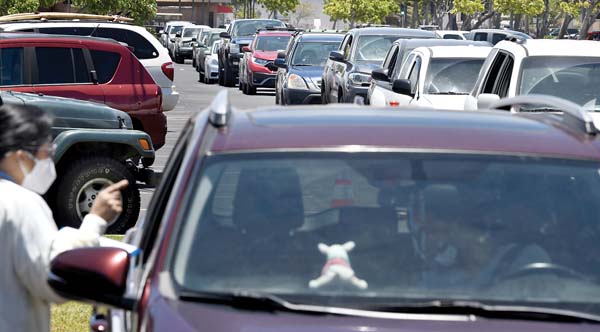
Drivers wait for their turn to be tested for COVID-19 in Kahului recently. — The Maui News / MATTHEW THAYER photo
A discarded mask sits outside Kihei Safeway store. — The Maui News / MATTHEW THAYER photo
Drivers wait for their turn to be tested for COVID-19 in Kahului recently. — The Maui News / MATTHEW THAYER photo
Trending
Gov. David Ige and Hawaii’s top health official said Friday that the state is in a "crisis" as it topped 2,000 new COVID-19 cases over the past three days, though no new restrictions are on the horizon.
"Yes, we are in a crisis, and we need to take immediate action to help reverse the trend, help reduce the number of COVID-positive patients that we have in our community," Ige said during a news conference Friday morning.
He urged people to get vaccinated, stay home when sick and get tested for COVID if they think they are infected or have been exposed. He said that even if people are vaccinated, they should still take precautions, social distance and wear a mask while indoors, citing breakthrough cases in which vaccinated residents have caught the virus.
On Friday the state reported 1,167 new and probable cases statewide, the highest single-day count since the pandemic began, though DOH spokesman Brooks Baehr said in an email that some of those cases were from a backlog of older cases due to an interruption to the electronic lab reporting system earlier in the week. During the three days impacted by the data interruption, the average daily count is 729 cases, Baehr said.
Oahu reported the chunk of the new cases Friday with 837, followed by Hawaii island with 151, Maui with 109 cases, Kauai with 46, Molokai with six and 18 residents diagnosed out of state. Lanai did not report any cases.
Ige said that no matter when the cases are reported, 1,167 more people are infected with COVID, of which an "overwhelming majority" are unvaccinated.
"Friday the 13th has never been so frightening. It is real, it is terrifying and tragically it is preventable," Ige said.
"We continue to trend in the wrong direction. Our hospitals are filling up, they are treating younger and younger people," the governor added, pointing to the death of an Oahu man in his 30s announced on Thursday.
He said the surge is unfair to the health care workers who are being asked to "save us."
"The choices we make can save us," Ige said. "We can and we must turn this around."
Despite the rising case numbers, Ige said that "we don't have any special plans at this time" to impose new restrictions. He said the situation is constantly being monitored and asked the public to contain the spread.
Maui County residents also will not see new restrictions for now.
Managing Director Sandy Baz said in an email Friday afternoon that the county is working with Ige and state health officials "to determine the restrictions that would be most effective in mitigating these high case counts."
He added that any and all requests for emergency health rules must be approved by the governor.
There also will be no new requirements under the Safe Travels program, which the governor has said will end once the state reaches a vaccination rate of 70 percent. Statewide, 61.2 percent of the population had completed the vaccination process as of Friday, according to state Department of Health data.
As for making adjustments to the program or reinstituting pre-travel tests, Ige said that no changes will be made for now.
He said the majority of cases are due to the highly contagious delta variant and are through community spread. Of the 10 to 12 percent of cases related to travel, only 1 to 2 percent are from visitors traveling and most of the travel-related cases are residents coming back and spreading the virus, Ige said.
Health Director Dr. Libby Char said health officials are more concerned about residents who return home from travel as they are the ones to go out and visit neighbors or other residents.
She added that the virus is spreading in small gatherings as it is human nature that "we let our guard down with people we know."
The virus is also being spread in the workplace as people are still going to work while sick and employees are taking off their masks during lunch. She said residents should stay home even if they only think they have seasonal allergies.
Clusters have also grown with the case counts, going from 22 known clusters in July to 45 clusters with 773 infected people within the first 10 days of August, according to Char.
"The hospitals are full and we are at risk," Char said.
She added that there are more than 7,000 active cases in Hawaii. And, if those 7,000 people come in contact with 10 people, that would amount to 70,000 close contacts, making contact tracing difficult. While the DOH would not be able to contact 70,000 people, it will try to reach out to the 7,000, said Char, who asked people not to yell at DOH staff when they get a phone call and to share the information that the department is requesting.
"We are only trying to help you and your loved ones," Char said.
The increase in cases has also led to a "great demand for testing," and Char noted that every island has free testing. Back in July, there were about 1,000 to 2,000 tests administered statewide per day. Now there are 8,000 to 10,000 tests being done each day.
Char asked residents to develop a COVID plan, similar to a hurricane plan, so that if they test positive they have a place to isolate, someone to take care of their family and someone to bring over groceries.
Char did not have numbers on how many breakthrough cases the state has seen so far but said the chances are low.
Baehr said in a email following the news conference that 0.2 percent of fully vaccinated people have resulted in breakthrough cases, or about 20 out of every 10,000.
* Melissa Tanji can be reached at mtanji@mauinews.com.