
Officials preach timing for COVID-19 booster shot
Additional doses are recommended for some, not all
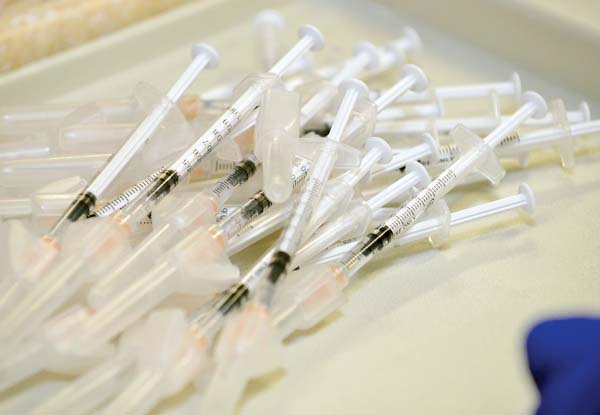
State health officials are recommending moderately to severely immunocompromised residents to seek an additional dose of COVID-19 vaccine as the highly contagious delta variant continues to fuel a surge in cases. The Maui News / MATTHEW THAYER photo
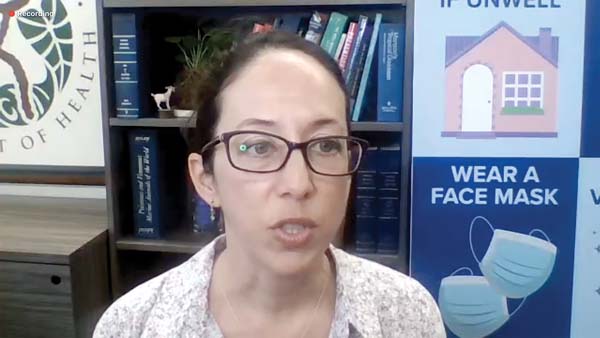
State Epidemiologist Dr. Sarah Kemble discusses COVID-19 booster doses for immunocompromised patients, urging people to consult with their doctors so they can decide the best time to get the shot. The Maui News COLLEEN UECHI photo
State health officials are recommending moderately to severely immunocompromised residents to seek an additional dose of COVID-19 vaccine as the highly contagious delta variant continues to fuel a surge in cases. The Maui News / MATTHEW THAYER photo
State Epidemiologist Dr. Sarah Kemble discusses COVID-19 booster doses for immunocompromised patients, urging people to consult with their doctors so they can decide the best time to get the shot. The Maui News COLLEEN UECHI photo
Trending
Hawaii health officials are recommending residents with weakened immune systems to seek an additional dose of COVID-19 vaccine, though they cautioned the general public against rushing their own booster shots to guard against fast-spreading variants.
"They're looking at rolling out booster doses in the fall. What this does not mean is don't run out and get your booster dose today if you don't have a medical indication to do so," State Epidemiologist Dr. Sarah Kemble said Thursday. "You actually want to make sure when the time comes that you get your booster dose at the right time to get the maximum benefit from that dose, and that's projected to be eight months after your initial vaccine series."
Days after the Centers for Disease Control and Prevention recommended a booster vaccine against COVID-19 for Americans with weakened immune systems, the Hawaii Department of Health also encouraged moderately to severely immunocompromised individuals to get an additional dose of mRNA COVID-19 vaccine. The booster shot should be given at least 28 days after the second dose of either the Pfizer or Moderna vaccine, the department said.
"We want to make sure those doses are available to those who need them, but we also want to make sure that people who have complex medical conditions do talk about this with their doctor before going to decide on the exact timing of that dose. That may be important for some people," Kemble said. "This advisory that went out today is really targeted to the medical providers in our communities that they understand and can have those conversations with their patients."
Qualifying conditions and treatments for the booster dose include but are not limited to:
• Active treatment for solid tumor or hematologic malignancies.
• Receipt of solid-organ transplant and taking immunosuppressive therapy.
• Receipt of CAR-T-cell or hematopoietic stem cell transplant (within two years of transplantation or taking immunosuppression therapy).
• Moderate or severe primary immunodeficiency (e.g. DiGeorge syndrome, Wiskott-Aldrich syndrome).
• Advanced or untreated HIV infection.
• Active treatment with high-dose corticosteroids (i.e., at least 20 milligrams prednisone or equivalent per day), alkylating agents, antimetabolites, transplant-related immunosuppressive drugs, cancer chemotherapeutic agents classified as severely immunosuppressive, tumor-necrosis blockers and other biologic agents that are immunosuppressive or immunomodulatory.
Some vaccination sites are already preparing to offer booster shots to immunocompromised residents, such as the University of Hawaii Maui College, which will have Moderna booster shots available at its clinic from 9 a.m. to 1:30 p.m. Saturday.
Additional doses or booster shots are not recommended for the general public at this time, the department emphasized. Kemble said the CDC is discussing potential booster doses "not because people didn't mount a full response to the vaccine the first time around," but because recent studies have begun to show a decrease in the ability of the vaccine to prevent symptomatic infection.
"The good news is they're seeing very robust, continued strong immune response that protects people against hospitalization and other severe outcomes from COVID-19," Kemble said.
While consistently among the top states for vaccine progress, Hawaii has been fighting an uphill battle against a record surge of COVID-19 cases while trying to convince vaccine-hesitant residents to get the shot. State officials tried incentives before resorting to mandates for government workers and student-athletes, prompting a wave of backlash.
When asked Thursday how the state could encourage vaccination without punishments or mandates, Lt. Gov. Josh Green said, "there is a way, and we do expect to see a surge in vaccinations in the near future when the FDA approves the vaccination fully," which he said is likely to happen soon. He also anticipated rates to improve once a vaccine is approved for children under the age of 12, possibly in the fall.
Green said that personally, he would've liked the state to wait until the vaccine had full U.S. Food and Drug Administration approval before mandating it for government workers.
"Not because I think it's unsafe in any way. I just think that logistically it would've been easier to make the argument from the business standpoint," Green said. "But the governor's being very thoughtful and he's concerned about the number of cases that are out there. ... My personal feelings have been that we not mandate vaccines, but instead we get people there through the science and through the FDA approval."
Mayor Michael Victorino pointed out that Maui, Hawaii and Kauai counties have mandated testing, not vaccinations, in hopes of "incentivizing the fact that if you get vaccinated, you don't have to get tested on a regular basis."
Health Department data as of Thursday showed Hawaii averaging 713 cases per day, and with such a high load for contact tracers, Kemble said it's difficult to get people to pick up the phone and provide information that could help health officials calculate how many breakthrough cases are connected to the highly contagious delta variant. The state has better data on the vaccination status of hospitalized individuals and fatalities because officials have access to their health records. However, given that the Health Department's most recent variant report attributed 93 percent of cases to the delta variant, "whatever trends we're seeing are reflective of what's happening with delta."
"We are certainly at a critical juncture," Kemble said. "We're hearing from our hospitals that they're hurting. We're hearing that there's limited bed space. And we know that with the projected hospitalizations that always follow the increasing cases, we haven't seen the end of it yet. The hospitalization numbers will increase."
Green said as hospitals fill up, this will prevent other patients from getting care.
"I'm not blaming anyone. I know people have deeply personal reasons to choose whether or not to get vaccinated," Green said. "I know there's distrust in government. I know that there's distrust in science to some degree, and a lot of people prefer to use natural immunity to get through these challenges. I understand that with all my heart. But I also understand the science, and the science tells me if you're vaccinated, you're much safer."
* Colleen Uechi can be reached at cuechi@mauinews.com.