
UH-Maui lab tech works to stop an invasive seaweed
Papahanaumokuakea voyage yields information on newly ID’d nuisance that’s smothering corals and algae
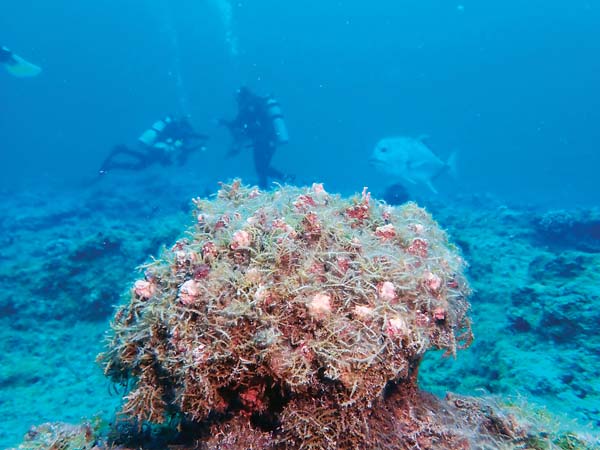
Chondria mats overgrow the native yellow- colored coral Porites. — HEATHER SPALDING / COLLEGE OF CHARLESTON photo
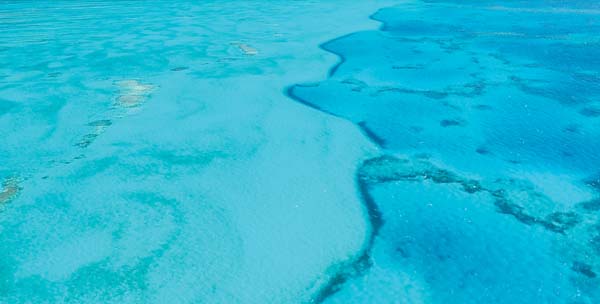
Aerial footage shows the so-called “Chondria Highway” at Manawai. The black bands along the edge of the reef are thick accumulations of Chondria that extend for miles along the eastern inner reef. — KEOLOHILANI H. LOPES JR. / JIMAR photo
Chondria mats overgrow the native yellow- colored coral Porites. — HEATHER SPALDING / COLLEGE OF CHARLESTON photo
Aerial footage shows the so-called “Chondria Highway” at Manawai. The black bands along the edge of the reef are thick accumulations of Chondria that extend for miles along the eastern inner reef. — KEOLOHILANI H. LOPES JR. / JIMAR photo
Trending
A team of researchers returned earlier this week from a 20-day voyage to the Papahanaumokuakea Marine National Monument, where they studied a newly identified invasive seaweed smothering corals and algae.
Staff with the University of Hawaii-Maui College water quality lab and colleagues from the National Oceanic and Atmospheric Administration, UH-Manoa and the College of Charleston were on a mission to research ways to mitigate the spread of the fast-growing nuisance alga called "Chondria tumulosa," which is posing a serious threat to native species.
During the voyage, divers found Chondria at about 30 percent of surveyed sites at Manawai.
"This alga is invasive-like, so it overgrows and smothers everything in its path, including corals," said Andrea Kealoha, director of UH-MC's water quality lab and lead scientist on the research grant. "Underneath these thick Chondria mats were dead corals -- only the skeleton is left. If the alga persists and spreads, it has the potential to completely alter an ecosystem."
Papahanaumokuakea is one of the largest marine conservation areas in the world and experiences very little direct human impact, Kealoha added.
UH-MC lab technician Arik Dadez said on Thursday that there's "tons of desirable fish and algae since you can't harvest anything because it is a protected area."
"The fish aren't used to seeing people and come right up to you, which makes for great photos and video," Dadez added.
Many of the known stressors that impact the Main Hawaiian Islands, such as nutrient pollution or overfishing, "we don't see in the monument," Kealoha said.
"The ecosystem is pristine, the fish are abundant and the corals are healthy," she said.
However, thick mats of the Chondria tumulosa were first documented in 2019 taking over native corals and algae at Manawai.
It was identified as a species new to science in 2020.
The team spent eight days conducting research around Manawai to investigate possible "oceanographic phenomena" that may be contributing to the presence and distribution of Chondria.
"This alga is a new species, and so the first task is to learn everything we can about it," Kealoha said. "What kind of ocean conditions does it like? Where does it like to grow? How does it reproduce and disperse? Understanding these dynamics will help us to develop ways to prevent its spread."
Scientists and researchers are still unsure how Chondria got there. Invasive species can travel through many vectors, such as ocean currents or on the hull of a ship, she explained.
"It's also possible that this alga is native and has been there the whole time," she added. "Our lab is investigating whether changes in ocean conditions, such as temperature or nutrients, may have caused this alga to grow and spread rapidly."
Dadez had collected water samples around the atoll, including for temperature, salinity, nutrients, pH, chlorophyll and stable isotopes.
The data can take anywhere from six months to a year to analyze, but UH-MC's water quality lab and UH-Manoa plan to study the hundreds of samples and compare the data from sites with and without Chondria to understand the different conditions in which this alga can live and thrive.
Other research included Chondria physiology and ecology studies, as well as drone surveys that will be paired with satellite imagery to develop methods for detecting the alga from space, according to a news release.
NOAA researchers noted the presence of a 20-foot-wide sheet of unattached "tumbleweeds" that extended for several miles. There's even video footage of the "Chondria Highway" posted by Brian Hauk of the Joint Institute for Marine and Atmospheric Research on Papahanaumokuakea's website, which shows the density and intense overgrowth of this invasive species.
"We came across a long patch of the nuisance algae inside the lagoon, which was given the name 'tumble town' as the algae would tumble around like tumbleweed on the lagoon floor, where it began to grow on the sand," Dadez said.
Despite there being populations of herbivorous fish, researchers have found no evidence that fish or other organisms are eating Chondria as part of their diet.
"They documented kala grazing on it, but then would spit it out," Dadez said. "After we left tumble town and on our transit back to the Imua (the crew's vessel), we came across a floating patch of the Chondria, which was never seen before."
So what does this mean for the state of Hawaii and its surrounding marine ecosystem? Kealoha said that given its rapid spread at Manawai in such a short time, "there is potential for it to spread to the Main Hawaiian Islands."
Still, the science team follows strict management practices to prevent human spread to other locations throughout the Hawaiian Archipelago, she said.
In the meantime, to help prevent its spread, agencies overlooking the monument developed a system for any vessels approved to travel near Manawai.
"All diving gear and boats are soaked in high concentrations of bleach solutions and examined for fragments of the alga prior to departure from Manawai," according to a news release posted on the Papahanaumokuakea website.
Another research team is currently at the Papahanaumokuakea Marine National Monument, and scientists will be investigating whether the alga has spread to other islands and areas within the monument.
This trip was Dadez's longest voyage ever and his first time to Papahanaumokuakea.
"It was an amazing experience. Pictures and videos don't come close to the actual," he said. "I wish we got to see the entire monument but because of the nuisance algae we were only allowed to stop at French Frigate Shoals to test gear and survey islands impacted by Hurricane Walaka. Then straight to Pearl and Hermes for eight days of sampling followed by an intensive cleaning/decontamination of the small boats and Imua to ensure we didn't bring anything back with us."
Living on a boat for 20 days consisted of tight sleeping quarters, limited Wi-Fi and early wake-up calls. The day began with signing the day's safety sheet, safety meetings, loading gear into small boats, conducting field research, processing samples, recording data and prepping for the following day.
The research was supported by NOAA's Office of National Marine Sanctuaries and a grant from the National Fish and Wildlife Foundation.
"Papahanaumokuakea is one of the last remaining pristine coral reef ecosystems in the world," Kealoha said. "Given the devastation this alga could cause, we must do everything we can to prevent its spread in the monument and to the Main Hawaiian Islands."
To learn more about the study, visit www.papa hanaumokuakea.gov/new-news/2021/08/02/nuisance-algae/.
For more information on UH-MC's Water Quality Lab and the services they provide, visit maui.hawaii.edu/water lab/.
* Dakota Grossman can be reached at dgrossman@mauinews.com.