
County: ‘Fully vaccinated’ will mean getting a booster
State says it will adopt new CDC guidelines on shortened quarantine
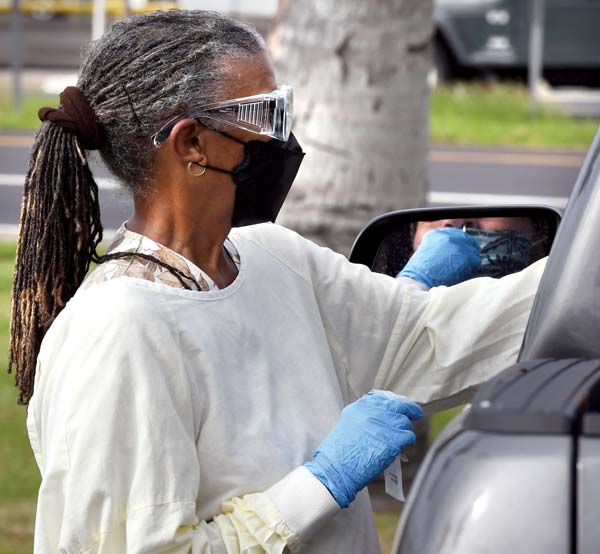
Doctors on Call nurse Shirley Ramey swabs a patient’s nose while doing a test for COVID-19 Wednesday afternoon at the Kahului testing site near Maui Mall and Whole Foods. The Maui News / MATTHEW THAYER photos
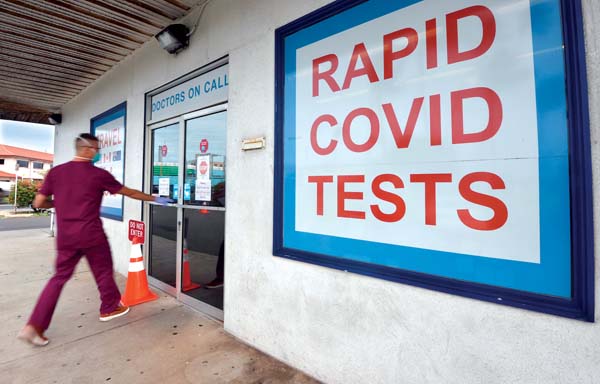
Doctors on Call licensed practical nurse James Mehling hustles into the testing site near Maui Mall and Whole Foods grocery store Wednesday afternoon. With the demand for testing skyrocketing on Maui, staffers said people have been lining up starting at 3 a.m. this week to be at the front of a line that has had as many as 150 vehicles when it opens at 8 a.m. Mehling said Wednesday set a record for positive cases at the site.
Doctors on Call nurse Shirley Ramey swabs a patient’s nose while doing a test for COVID-19 Wednesday afternoon at the Kahului testing site near Maui Mall and Whole Foods. The Maui News / MATTHEW THAYER photos
Doctors on Call licensed practical nurse James Mehling hustles into the testing site near Maui Mall and Whole Foods grocery store Wednesday afternoon. With the demand for testing skyrocketing on Maui, staffers said people have been lining up starting at 3 a.m. this week to be at the front of a line that has had as many as 150 vehicles when it opens at 8 a.m. Mehling said Wednesday set a record for positive cases at the site.
Trending
Starting Jan. 8, "fully vaccinated" in Maui County will mean anyone who's gotten their first series of Pfizer, Moderna or Johnson & Johnson as well as a booster shot, creating an extra requirement for customers hoping to eat, drink or work out indoors.
During the county's news conference on Wednesday, Managing Director Sandy Baz announced the new definition, which will impact "high-risk businesses" in Maui County such as restaurants, bars and gyms, where proof of vaccination or a negative COVID-19 test is currently required to enter. While that requirement isn't changing, the new definition now means that proof of vaccination will require a booster shot for those who are eligible to get one.
"The rules themselves and the application isn't changing, it's just the definition of what 'fully vaccinated' is," Baz explained after the news conference.
People who aren't vaccinated or who don't have a negative COVID-19 test will still be able to frequent businesses outdoors as they can under the current rules.
The new definition of "fully vaccinated" will also impact county employees, who are currently required to undergo regular testing if they are not vaccinated. Once Jan. 8 rolls around, those who are vaccinated but haven't gotten their booster shot will need to be tested as well, Baz said.
With the omicron variant fueling a new wave of cases across the state, Baz added that the county made the decision "because the booster is available and the Department of Health, Director (Elizabeth) Char, has indicated to us that those that haven't gotten the booster, and it has been a significant amount of time since they got their original vaccination, aren't as resistant or inoculated from the virus."
Hawaii expanded eligibility for booster shots to all adults ages 18 and older in late November, following guidelines from the U.S. Centers for Disease Control and Prevention. Since then, Char and the Department of Health have been urging boosters for people ages 16 and older who got their second Pfizer shot six months ago, those ages 18 and older who got their second Moderna shot six months ago and anyone who got the J&J single-shot dose two months ago.
The Health Department also announced Wednesday that it was revising the state's COVID-19 isolation and quarantine policies to line up with the CDC, which recently recommended shortening quarantine times from 10 to five days in hopes of getting employees in health care, aviation and other crucial sectors back to work more quickly.
Starting Monday, COVID-positive individuals in Hawaii must isolate for at least five days and until symptoms are gone, and continue to wear a mask for five days after isolation, the Health Department said. The new rules apply to anyone regardless of vaccination status.
Those who are exposed to the virus and have gotten their booster shot, or who have been fully vaccinated within the past six months for Pfizer and Moderna or within the past two months for J&J, do not need to quarantine but must wear a mask for 10 days and get tested on the fifth day.
Those who are exposed to the virus and have not gotten the booster or are not fully vaccinated must quarantine for five days, wear a mask for five days after quarantine and get tested on the fifth day.
"We are adopting the CDC recommendations as one part of our effort to blunt the current very rapid spread of the omicron variant," State Epidemiologist Dr. Sarah Kemble said in a news release Wednesday. "These guidelines are practical to implement, making it easier for people to do the right thing. The guidance also acknowledges the waning immunity we are seeing with time after initial vaccination."
She pointed out that there is still a lot to learn about omicron and that guidance may evolve in the coming weeks.
As of Wednesday, the state was averaging 1,485 new cases a day and a test positivity rate of 13 percent, according to Department of Health data. The surge has largely centered on Oahu, which was averaging 1,269 cases and a 15.3 test positivity rate, followed by Maui County at 103 cases and 9.6 percent, Hawaii County at 71 cases and 8.5 percent and Kauai County at 43 cases and 7.5 percent.
Char said that the increase in cases and changes in the pandemic also underline the role testing plays. On Wednesday, a long line of cars snaked down Kanaloa Avenue and through the War Memorial Complex as residents waited to pick up one of the few thousand free rapid self-test kits that Maui County was passing out.
Early on in the pandemic, the focus was primarily on polymerase chain reaction, or PCR tests, nasal swabs that were considered the most accurate for detecting the virus. Later on, rapid antigen tests rose in popularity as cases increased, labs struggled to keep up with turnaround times and hospitals needed to know quickly whether a patient might have the virus.
"I think now we're shifting to more of a public health model where the tests are more of a public health tool where people can do it in the comfort of their home and test immediately . . . and so we have been procuring, to the extent that we can, at-home test kits, and it makes sense to use them especially in certain areas," Char said during a news conference Wednesday. "We're just trying to make sure people have all kind of accessibility to tests and that we have different tools available for people to get tested, whether it's PCR tests or antigen tests or at-home antigen tests."
When asked during the news conference whether the state planned to expand its definition of "fully vaccinated" to include booster shots, particularly for the Safe Travels program, Gov. David Ige said that "we certainly are evaluating that."
"The Safe Travels system is a complex system and we are, you know, also evaluating the point at which we would end the program," Ige said. "So there are many decisions that we'll be making over the next few days, and certainly we'll be making announcements as necessary. But any changes to Safe Travels would require a minimum of two weeks to implement."
The program currently requires trans-Pacific travelers to show proof of vaccination or a COVID-19 test in order to bypass quarantine.
* Colleen Uechi can be reached at cuechi@mauinews.com.