
$1.6B in federal aid targets health, tourism, unemployment
Governor details state’s use of American Rescue Plan Act funds
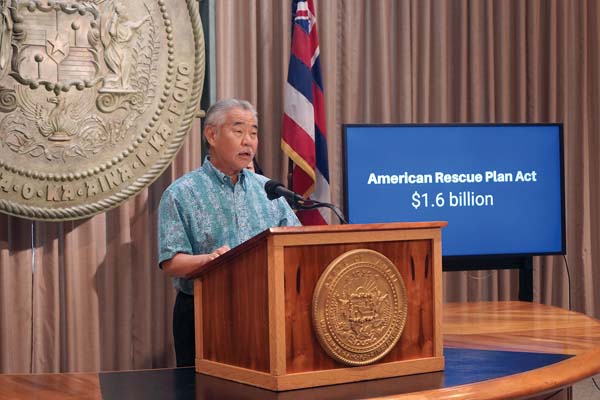
Gov. David Ige discusses the state’s use of $1.6 billion in American Rescue Plan Act funds during a news conference on Oahu Tuesday afternoon. Photo courtesy of the Governor’s Office
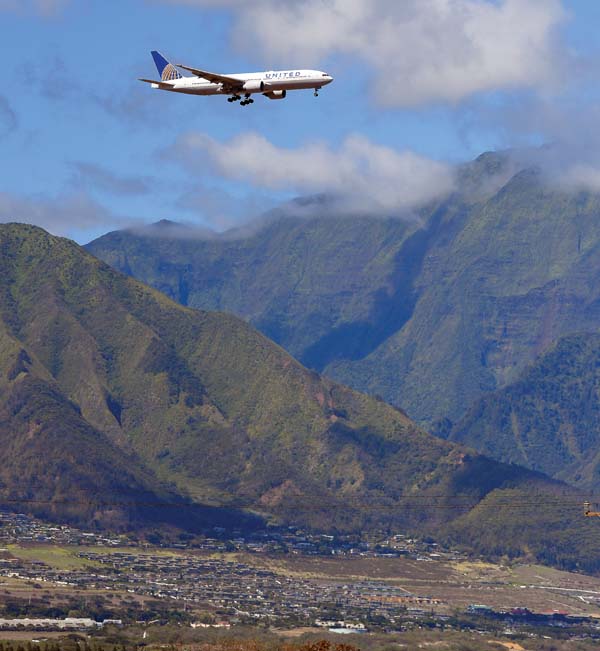
A United Airlines jet flies over Maui’s central valley in October. The state allocated $60 million in American Rescue Plan Act funds to the Hawaii Tourism Authority to help reboot the visitor industry-reliant economy during the pandemic, as well as $41 million to run the Safe Travels program that has implemented travel restrictions to prevent the spread of COVID-19. The Maui News / MATTHEW THAYER photo
Gov. David Ige discusses the state’s use of $1.6 billion in American Rescue Plan Act funds during a news conference on Oahu Tuesday afternoon. Photo courtesy of the Governor’s Office
A United Airlines jet flies over Maui’s central valley in October. The state allocated $60 million in American Rescue Plan Act funds to the Hawaii Tourism Authority to help reboot the visitor industry-reliant economy during the pandemic, as well as $41 million to run the Safe Travels program that has implemented travel restrictions to prevent the spread of COVID-19. The Maui News / MATTHEW THAYER photo
Trending
Maui hospitals, state jails and University of Hawaii campuses were among the many institutions that received a cut of the $1.6 billion in federal COVID-19 aid funding provided to the State of Hawaii last year.
Gov. David Ige said Tuesday that the state had allocated all $1.6 billion in American Rescue Plan Act funds that it received last May to help with the pandemic.
"COVID resulted in a global economic shutdown, which had immediate negative impact on our state," Ige said during a news conference on Tuesday. "We had to cut many programs and services and our state workers were at risk of being furloughed. Our hospital and health care system was pushed to the limits. Our tourism industry was shut down and our economy was on the brink of collapse.
"At the same time there was increased demand for essential government services and the social safety net was more important than ever," Ige added. "These ARPA funds were pivotal in helping us continue essential services and supporting our most vulnerable populations."
Funding was doled out to multiple state programs and sectors, including:
• Unemployment and jobs: $70 million to the unemployment insurance call and adjudication center and $800 million in unemployment insurance loan repayment.
• Hospitals and public health response: $50 million to the state Department of Public Safety to strengthen COVID response, $11 million for the Maui Health System hospital subsidy, $10 million for COVID-19 test kits and $8 million for the state Department of Health COVID administrative support.
• Visitor industry: $60 million to the Hawaii Tourism Authority and $41 million to the Safe Travels Hawaii program.
• Essential services: $10.8 million to homeless services, $1.5 million to senior centers and $1.3 million to family health services.
• Education: $28 million to the University of Hawaii system and $1.3 million for financial need scholarships (HI Promise Program).
• Infrastructure: $2.7 million to modernize the financial system and $1.5 million in broadband infrastructure planning.
Ige said that broadband access is "at the core of the equity issue here in the islands."
"We know that those without internet access are at a distinct disadvantage in our community," he said. "The pandemic showed us that there is a digital divide here in the islands and there are some in our community who don't have access to reliable high-speed internet services."
He added that some of the ARPA funding is written into his supplemental budget request to the state Legislature, which begins its session today. This includes increased costs for operations at jails and prisons as well as continued funding for the Safe Travels program, which has been regulating travel throughout the pandemic in hopes of preventing more COVID cases in the islands.
The program, which the governor called "the most complex and important COVID response program that we have," currently requires proof of vaccination or a negative pre-travel test in order to bypass quarantine. Ige said the state eventually hopes to expand the vaccination requirements to include a booster shot. However, he said that would require more staffing and special technology.
"There are lots of logistics and details that need to be ready," he explained. "We were already seeing staffing shortages like many are seeing across the state. We have been unable to hire all of the people that we need to implement the Safe Travels program. ... So that's part of it. If we are going to be implementing the requirement we want to be certain that we have the personnel to implement it, and that's why being able to automate or utilize software to help with the verification of vaccination status is very helpful and would help us implement the program quicker."
* Colleen Uechi can be reached at cuechi@mauinews.com.