
State scales back quarantine in schools amid staff shortages
Absences of teachers and students make for a ‘chaotic’ start to new year
Trending
As students and staff continue to be absent in schools across the state, a Maui High School teacher described the first two weeks of the second semester as the most "chaotic" it has ever been since the pandemic began.
Mathematics teacher Jodi Kunimitsu said that in one of her classes of 26 students, 58 percent were absent on Friday. While it's hard to know if all the absences are COVID related, some students do email to say they have been close contacts with a COVID case and need to quarantine, Kunimitsu said.
She now faces the dilemma of how to instruct her classes, juggling the needs of both the students who come to class as well as those students who are out at different times and will have to catch up when they return.
To top that off, teaching staff are shorthanded as well, a problem that existed before the pandemic but has grown more complicated with quarantine and exposure protocols.
"There is always more teachers out than we have coverage for," Kunimitsu said. "There is never enough subs."
She said it is normal for students to be placed in the cafeteria when there is no teacher available and that this was even a practice last semester.
Last week, state Department of Education Interim Superintendent Keith Hayashi said 800 teachers had called in sick and another 800 were out due to other reasons, or about 12 percent of the workforce. DOE did not provide a breakdown by school or say how many of the absences were due to COVID-19.
Data on teacher absences and substitute fill rates "was provided as a one-time snapshot as schools resumed in-person learning" and are not readily retrievable on a daily basis, DOE said. However, the department added that it will provide upon request a weekly snapshot on Fridays for at least the next two weeks regarding substitute teacher numbers and fill rates.
During a news conference Tuesday with the state departments of Education and Health, Hayashi said that absences for students and teachers have gone down a bit this week compared to last, but that still about 12 percent of the teachers are absent.
Kunimitsu said she doesn't have exact counts of fellow teachers who may be absent but that "it does seem to be that more teachers are out." She didn't fault her administration for not working hard, but rather put the blame on the DOE.
"I think the biggest frustrations for teachers is there was no plan. There was no plan for additional safety," she said.
N95 masks are recommended to prevent the spread of the highly contagious omicron variant, but Kunimitsu said none were provided and the same amount of students are piling in the classrooms with no additional cleaning protocols.
Hayashi has continually pointed to DOE safety measures already in place, such as promoting vaccinations, masking, social distancing and hand-washing. As cases mounted during winter break and the state teachers' union expressed concerns about returning to in-person classes, Hayashi remained committed to in-person learning, saying it was important for students socially and academically.
On Tuesday, the state Department of Education and the state Department of Health formally announced updated guidance for schools which shorten isolation and quarantine times for teachers and students. The move could help put students and teachers back into class sooner, DOE acknowledged.
"The new reduced isolation and quarantine guidance supports our efforts to continue to prioritize in-person learning while upholding safety protocols in our schools," Hayashi said during the news conference Tuesday morning. "The revisions also recognize the protection that vaccinations provide for our staff and students, and the added protection boosters provide for eligible staff."
Reducing isolation and quarantine from 10 days to five days aligns with recent guidance from the Centers for Disease Control and Prevention.
State Epidemiologist Dr. Sarah Kemble said that CDC-cited evidence has shown that omicron may have a shorter infectious period and incubation period, making the shorter quarantine time appear sufficient.
Employers, however, have to strike a balance between staffing issues and health concerns as omicron has left many industries struggling with vacancies.
"There are also considerations -- what is the practical balance in maximizing safety and enabling critical services to continue," Kemble said during the news conference.
Hayashi said when schools are short staffed, there are "different strategies" for the students, such as sustained silent reading for studies for other classes or tests coming up. If students have access to computers they can work online for other classes. He acknowledged that if a teacher is not available for a class, students may be placed in a cafeteria or auditorium for supervision.
Hawaii State Teachers Association President Osa Tui Jr. expressed concerns about whether students were really able to study or learn in those large groups -- they may simply be on their phones instead. Tui said the DOE and the Board of Education should help resolve the issues and were given opportunities to work with the teachers' union.
"This is a problem that didn't have to happen, but just has gotten worse by the lack of planning," Tui said during a news conference on Tuesday afternoon.
He reported that schools are scrambling with no template for what to do and reiterated his message about how the DOE did not work with the union early on.
Tui said that even schools on Molokai and Lanai are experiencing large absences of students, with around 40 percent of students absent on Lanai.
"This is affecting the entire state," he said.
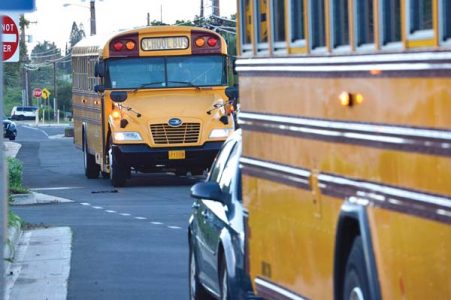
On Maui, COVID-related staffing shortages among DOE contractors are also causing disruptions in bus routes.
Four bus routes affecting King Kekaulike High and Kalama Intermediate were disrupted last week due to drivers calling in sick and no backup drivers available, a DOE spokeswoman confirmed Tuesday.
One route continues to be out since last week. The DOE will know by the end of this week if the route will resume, the spokeswoman said.
On Tuesday, companies that provide student transportation to the schools did not immediately answer inquiries about other possible service disruptions.
Moving forward, schools will follow DOH guidance directing students and staff who test positive for COVID-19 or have COVID-19 symptoms to isolate for five days regardless of vaccination status. They can return when all of the following conditions are met:
• Five full days have passed since symptoms first appeared or since test was conducted.
• No fever for 24 hours.
• Symptoms have improved.
Students and staff who have been in close contact with a person who has COVID-19 should quarantine for five days after last contact if:
• They have not completed their primary vaccine series (two shots of Pfizer or Moderna or one shot of Johnson & Johnson).
• They are 18 or older and have completed their primary vaccine series but have not received a recommended booster when eligible.
Students and staff should get tested on day five of quarantine, even if they do not have symptoms. They are not required to quarantine if they are:
• Ages 5 to 17 and have completed their primary series of COVID-19 vaccines.
• They are 18 and older and have received all recommended vaccine doses including boosters.
* Melissa Tanji can be reached at mtanji@mauinews.com.