
Sea turtle strandings in 2021 down from 2020
Most stranding events found in South Maui

Maui Ocean Center veterinarian Paul McCurdy examines a green sea turtle patient at MOC Marine Institute. MOC Marine Institute Photos / NOAA Permit: 21260.
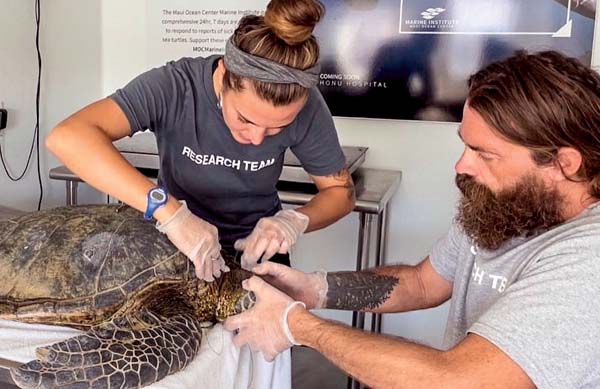
Maui Ocean Center Marine Institute sea turtle technician Mikaela Dibble-Kahn (left) and Executive Director Tommy Cutts remove fishing line from the neck of a juvenile green sea turtle.
Maui Ocean Center veterinarian Paul McCurdy examines a green sea turtle patient at MOC Marine Institute. MOC Marine Institute Photos / NOAA Permit: 21260.
Maui Ocean Center Marine Institute sea turtle technician Mikaela Dibble-Kahn (left) and Executive Director Tommy Cutts remove fishing line from the neck of a juvenile green sea turtle.
Trending
Fishery interactions made up the majority of the 231 documented stranding events among sea turtles on Maui in 2021, with the "hot spot" being South Maui, according to data from the Maui Ocean Center Marine Institute.
Executive director of the Sea Turtle Conservation Program, Tommy Cutts, said that interactions with nearshore coastal fisheries are the biggest threat to sea turtles in Hawaii, with about 202 of the stranding cases (87 percent) in Valley Isle's coastal areas last year caused by entanglement in fishing line and gear, while others were injured from hooks and or nets.
According to the Marine Institute's recently released Sea Turtle Conservation Program 2021 Annual Report, which contains preliminary data on documented injured, sick, distressed, or expired sea turtles on Maui from Jan. 1 to Dec. 31, 2021, the 231 strandings last year was down from the 276 reported in 2020.
Of the 231 sea turtles, 229 were green sea turtles and two hawksbill; 203 of the total sea turtles were found alive and 28 died.
However, Cutts said that he was "optimistic" about the reports.
"We have focused much of our education and outreach efforts on collaborative initiatives to reduce the threat of fisheries interactions on Maui, including school programming and the expansion of our Fishing Line Recycling Program," he said. "We have seen significant effort from members of the fishing community to retrieve lost gear off the reef and an increase in underwater cleanups from environmental groups across the island."
As part of the Fishing Line Recycling Program, there are specialized fishing line recycling bins along with signage at more than 40 beaches and popular fishing locations around Maui to give fishermen an easy spot to discard their used line.
In terms of fishery interactions, there was also a slight drop with 202 last year, down from 230 documented in 2020. There were 102 fishery interactions in 2019.
"Maui County's tourism industry closed beginning in March through October 2020 to help prevent the spread of COVID," Cutts said. "During this time, we observed an increase in recreational fishing activity at beaches across the island."
Among the 231 sea turtles reported stranded last year, most cases were documented in South Maui with 136, followed by West Maui with 54, north shore with 29, and Central Maui with 12.
There is a large green turtle population on the south side, Cutts said, and the "easily accessible reefs" paired with calm waters attract many snorkelers, divers, and swimmers.
Most of the calls the institute receives on the sea turtle response line are from ocean goers who observed a hooked or entangled sea turtle underwater.
"In other areas of the island, like the north shore, where snorkeling is less accessible, most of the reports we receive are when an injured turtle is observed on the beach basking," Cutts added.
Besides fishery interactions, ten turtles were found stranded due to being stuck in the sand, five stuck in rocks, two with shark bites, one boat strike, two with disease, and the remaining nine with unknown causes.
The report said that MOC Marine Institute launched a community-based beach cleanup program called Honu Hero in June 2021 to reduce trash along the shoreline for the health and safety of turtles.
More than 40,000 pieces of debris were collected, with hard plastic pieces being the most prominent, followed by paper and or cardboard, cigarette butts, glass pieces and food wrappers, according to the report. The top five items collected accounted for 67 percent of all trash.
MOC Marine Institute's sea turtle rehabilitation program aims to provide high-quality medical care to sick and injured sea turtles while working to return the turtles to the ocean as quickly as possible, according to the report.
Partnering with NOAA Fisheries, the committee meets weekly to discuss sea turtle patient progress, treatment plans, and criteria for release.
The heaviest treated patient last year weighed in at 291 pounds, according to the report.
Last year, nearly 81 percent of stranded sea turtles on Maui sustained injuries that required a minimal amount of treatment and the patients were released back into the ocean within 24 hours of their rescue, the report said.
About 47 sea turtles required long-term rehabilitation, or more than a week of care -- three from Oahu, five from Hawaii island, and 39 from Maui.
Majority of long-term rehabilitation cases were due to fisheries interactions and two turtles received treatment for buoyancy disorders, which is when a sea turtle has difficulty submerging or is unable to dive, often caused by a build-up of gas in the turtle's body cavity.
As part of the institute's monitoring and citizen science program, staff biologists record information such as the time and date of the stranding and other details about the turtle.
Before a turtle patient is released, staff insert Passive Integrative Transporter (PIT) tags into sea turtle patient's hind flippers, which are about the size of a grain of rice and can be detected by a scanner.
An alphanumeric tag is also placed on the turtle's shell by using a Dremel to safely etch the shell with the initials of the island and the number of the stranding case. The groove is then filled with white paint that does not harm the turtle, but makes it easy for observers to view the turtle's number without disturbing it, the report said.
If a turtle strands more than once and is recaptured, it is not given a new tag number, the report said.
There were 138 new tags given and 22 recapture events last year.
Community members and visitors assist with data collection of sea turtle patients by reporting their sightings of tagged turtles on Maui.
"Their sightings help us to see how the patient is doing post-release and gain an understanding of green turtle foraging habitats, migration, and distribution," the report said.
With fishery interactions being the top threat, Cutts said that the community can help by participating in underwater cleanups; report hooked or entangled sea turtles on Maui through the sea turtle response line at (808) 286-2549; report abandoned fishing net to the hotline at 1-800-4-Da-Nets; or volunteer to join the sea turtle response and rehabilitation team.
Anglers can also make sure to retrieve lost fishing line and gear from the reef and dispose of it in fishing line recycling bins provided by MOC's Marine Institute.
"We can all make a difference and help reduce threats impacting sea turtles," Cutts said.
Staff are also working with a 7th-grade student from Kihei Charter School on an upcoming beach cleanup from 8 to 10 a.m. on Saturday at Kealia Boardwalk.
For more information or to volunteer, visit www.mocmarineinstitute.org.
* Dakota Grossman can be reached at dgrossman@mauinews.com.