
Bills would crack down on abandoned cars
Lawmakers also weigh measures to tax rental car companies
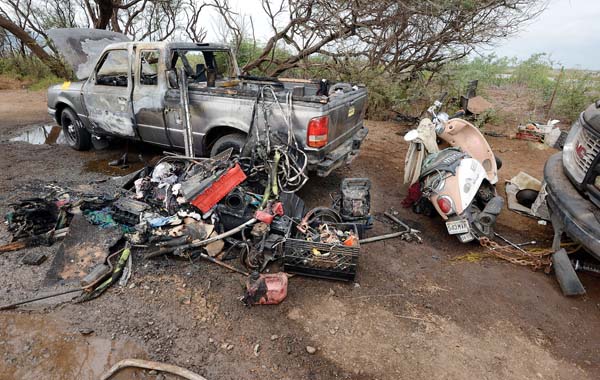
A burned-out camper truck sits along North Kihei Road in January 2019. Lawmakers are considering bills that would regulate abandoned vehicles by holding owners subject to a tiered fine system and allow counties to deny certificates of registration or transfers of ownership until fines related to abandoned vehicles are paid. The Maui News / MATTHEW THAYER photos
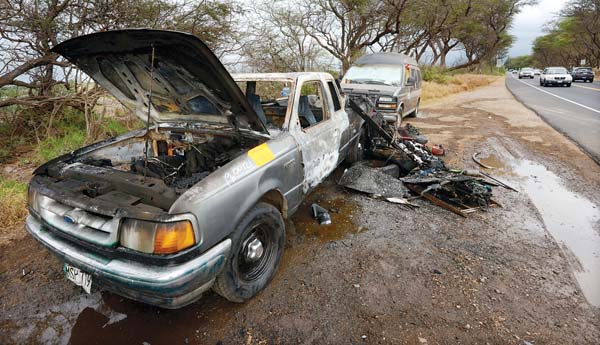
Lawmakers are trying to clamp down on abandoned vehicles, a problem that’s long plagued Maui roads.
A burned-out camper truck sits along North Kihei Road in January 2019. Lawmakers are considering bills that would regulate abandoned vehicles by holding owners subject to a tiered fine system and allow counties to deny certificates of registration or transfers of ownership until fines related to abandoned vehicles are paid. The Maui News / MATTHEW THAYER photos
Lawmakers are trying to clamp down on abandoned vehicles, a problem that’s long plagued Maui roads.
Trending
Lawmakers are considering a series of bills aimed at regulating and mitigating the impacts of abandoned vehicles, a long-standing problem along Maui cane fields and roadsides.
Maui County has been seeking solutions for years, state Rep. Troy Hashimoto said, adding that abandoned cars and other motorized vehicles, specifically, have "always plagued our highways and streets."
"So I think this is something that the Legislature is really trying to focus in on and trying to deincentivize the abandoning of vehicles and make it easier for the counties to do their job to collect all of those abandoned vehicles," Hashimoto said during a Maui Metropolitan Planning Organization meeting on Monday.
Currently under review is House Bill 1414, which would hold the registered owner of a vehicle that was deemed abandoned or derelict subject to a tiered fine system.
Another measure, HB 1411, requires that the previous and current owners' addresses be provided on the certificate of ownership when the title to a motor vehicle is transferred.
This bill imposes fines on anyone who provides false or fraudulent information on the certificate.
The Hawaii County of Mayors, of which Maui County Mayor Michael Victorino is the president, submitted written testimony on Feb. 23 in support of the bill. The mayors pointed out that in 2019, there were a total of 4,700 abandoned vehicles on Oahu, 1,620 on Maui, 1,620 on Hawaii island and 900 on Kauai.
"These abandoned vehicles are an eyesore in communities, harmful to the environment, and a financial burden to the counties," the mayors said in a letter. "Because of fraud occurring at the vehicle title transfer level, there is an ongoing issue with locating the proper owner that has been abandoned."
The Senate Committee on Transportation is hosting a public hearing at 3 p.m. today for both bills.
Other measures aimed at cracking down on abandoned vehicles include HB 1412, which requires the counties to provide a minimum distance a vehicle must be moved within a specified time frame after a vehicle is initially inspected for abandonment.
Lastly, HB 1413 allows the director of finance of a county to require payment of outstanding charges and fines owed to the county relating to the disposition of an abandoned vehicle -- including for costs related to towing, storage, processing and disposal -- before issuing a certificate of registration or completing a transfer of ownership.
Public hearings are scheduled for both bills at 3:15 p.m. Thursday before the committees on Transportation and on Government Operations.
Lawmakers are also eyeing ways to offset the impacts of cars on the roads by regulating rental and tour companies.
One proposal that's been killed time and again but that Maui County continues to fight for is HB 1632, which sets weight limitations for tour operators and rental vehicles on Hana and Haleakala highways.
"I think this will be able to mitigate some of your tourism impacts," Hashimoto said. "I think the rental car companies are finally saying that they're OK to be taxed because I think they've seen some of the negative tourism impacts, so that's a big change from previous years where they were very, very resistant from any type of taxation increases."
If passed, this bill would establish user fees to access Hana and Haleakala highways for certain vehicles and allow the funds to be used for the development and improvement of both highways.
"Ensuring appropriate maintenance is sustained for the long-term future is paramount for the public safety of our residents, businesses, and visitors," Maui County Council member Mike Molina said in written testimony in support of the measure on Feb. 9. Molina holds the seat for the Makawao-Haiku-Paia area that includes portions of both roadways.
Advocates for tour operators, however, have pushed back against the measure, saying that visitors who drive the dangerous Road to Hana without the proper knowledge are the real problem, not tour companies.
"It is the unguided visitors that cause the most conflict and damage. Regulating legal operations, which are not the cause of the conflict, is cruel, lacks positive, creative thinking, and is anti-business," Toni Marie Davis, executive director of Activities & Attractions Association of Hawaii, said in written testimony on Feb. 10. "These locally owned and operated businesses directly employ hundreds of Maui residents and, indirectly, thousands of Maui residents."
Other bills moving through the Legislature that Hashimoto said the public should keep their eyes on also aim to address tourism impacts.
HB 1452, for example, would subject U-drive motor vehicles -- vehicles rented or leased for six months or less -- to the same motor vehicle registration fees as other motor vehicles, and HB 1688 would allow the counties to use certain motor vehicle registration fees to mitigate and address the impacts of tourism-related traffic congestion.
Maui County Council Chairperson Alice Lee said in written testimony that one of the reasons for supporting the HB 1688, specifically, is because this measure "is a form of tourism management that can help to ensure quality of life for residents, the health of the environment, and the continued value of the visitor experience."
Lastly, HB 1971 would regulate peer-to-peer car-sharing companies, such as Turo, an industry that's grown in popularity within the visitor market, by establishing insurance requirements, imposing the general excise tax and rental motor vehicle surcharge tax on peer-to-peer car-sharing programs and requiring people engaging or continuing in a peer-to-peer car-sharing program to register with the Department of Taxation.
"We're finally trying to regulate that after years of resistance from the rental car companies," Hashimoto said. "I think people are finally seeing that Turo is here to stay -- I think we're going to try and get to the finish line and try to regulate them."
* Dakota Grossman can be reached at dgrossman@mauinews.com.