
State COVID-19 restrictions set to expire, mask mandate remains
Safe Travels Program, vaccination mandates for government employees to end

The state building in Wailuku is lit up on Tuesday evening. Gov. David Ige announced Tuesday that the state will end key COVID-19 restrictions on March 25, including the Safe Travels program for domestic travelers and the requirement that government employees and visitors to state facilities provide proof of vaccination or a negative COVID-19 test. The Maui News / COLLEEN UECHI photo
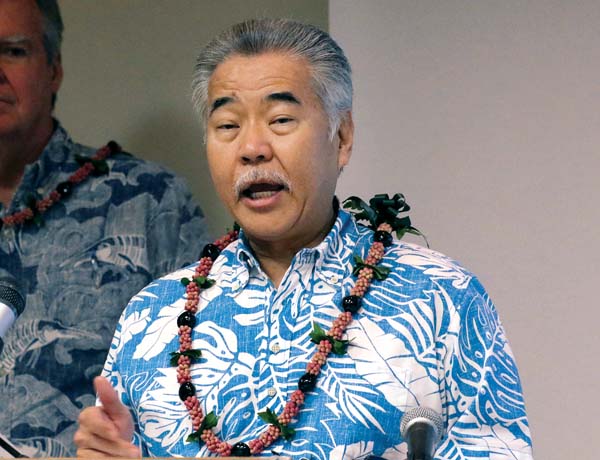
Gov. David Ige speaks to reporters at the state Department of Health’s laboratory in Pearl City, Hawaii on March 3, 2020. Hawaii plans to lift its COVID-19 quarantine requirement for travelers this month, meaning that starting on March 26 those arriving from other places in the U.S. won’t have to show proof of vaccination or a negative test to avoid sequestering themselves for five days. AP file photo
The state building in Wailuku is lit up on Tuesday evening. Gov. David Ige announced Tuesday that the state will end key COVID-19 restrictions on March 25, including the Safe Travels program for domestic travelers and the requirement that government employees and visitors to state facilities provide proof of vaccination or a negative COVID-19 test. The Maui News / COLLEEN UECHI photo
Gov. David Ige speaks to reporters at the state Department of Health’s laboratory in Pearl City, Hawaii on March 3, 2020. Hawaii plans to lift its COVID-19 quarantine requirement for travelers this month, meaning that starting on March 26 those arriving from other places in the U.S. won’t have to show proof of vaccination or a negative test to avoid sequestering themselves for five days. AP file photo
Trending
All of the state's emergency COVID-19 measures, except for the indoor mask-wearing mandate, will expire on March 25, including the vaccination or testing requirement for state and county government workers as well as the Safe Travels Program for domestic travel.
Gov. David Ige said during a news conference on Tuesday that this decision is a result of the drop in COVID-19 case numbers and hospitalizations, adequate supply of personal protective equipment and the state's improved abilities to respond to the virus.
Still, face coverings are required at any indoor facility indefinitely as officials monitor the changes and follow the guidance from various health agencies.
"We see continued falling of the virus activity in our communities and our hospitals are getting better and better, the case counts in hospitals are reducing everyday," Ige said. "We will continue to evaluate the situation and monitor disease activity closely across the state, the country and globally, and we will adjust accordingly to keep our entire community healthy, from keiki to kupuna."
Other rules that limited gathering sizes indoors, created social distancing requirements and established vaccination guidelines to enter certain businesses have also been terminated per announcements from all four county mayors over the past few days.
"As counties loosen restrictions, it is important to remember we are still living in a pandemic," the state Department of Health told The Maui News via email. "We can maintain the positive momentum we enjoy if we continue to respect one another by staying up to date on our vaccines and wearing masks in indoor public spaces."
DOH attributed Hawaii's high vaccination rate, approach to masks and "our aloha for one another" to having the second-lowest COVID-19 death rate in the nation.
The March 25 expiration date comes two years after the state established its first COVID-19 emergency proclamation on March 4, 2020, shortly after the COVID-19 outbreak began in Hawaii. One of the longest-running COVID rules in Hawaii has been the state's travel quarantine, imposed in the early days of the pandemic and gradually scaled back as cases dropped and when vaccines became available.
The Safe Travels Program, which currently requires travelers to show proof of vaccination or a negative COVID-19 test prior to landing into Hawaii, has screened 11.3 million passengers since its implementation in October 2020.
On March 26 at 12:01 a.m., the mandatory quarantine for incoming domestic travelers will end, as well as all the pre- and post-arrival screenings at airports. Trip reservations scheduled between now and March 25 are still subject to the Safe Travels Program, Ige said.
"The cooperation of our travel partners, the airlines and the hotels have been tremendous. I think we are all planning to reinforce the notion that masking is still required in the State of Hawaii," he added. "We will continue to advocate that we want people who are vaccinated even if it's not an explicit requirement and I do expect that Hawaii's reputation as a safe and healthy place to travel has been reaffirmed during this pandemic."
The end of the emergency proclamation also means that state and county employees will no longer need to provide vaccination status or negative test results to their departments.
Likewise, visitors and those doing business on state property will no longer need to provide vaccination status or negative test results to enter the facilities.
On Friday, Maui County became the first to announce that all county public health emergency rules would end Tuesday, not including the statewide indoor mask mandate.
This means that vaccination, testing or medical documentation requirements for certain high-risk businesses and activities are repealed. Still, Maui County Communications Director Brian Perry said Monday that some facilities or businesses "may have their own rules" for people to follow.
Indoor gatherings such as social events or organized sports no longer have limitations on size or physical distancing. Similarly, all businesses, restaurants and other establishments can now operate at full capacity.
Mayor Michael Victorino said during the news conference on Tuesday that the county will be phasing in the reopening of larger-capacity community centers in the next month or two while keeping an eye on case numbers.
"We believe that we need the time to just make sure we methodically and systematically open up, that we keep our community safe and healthy, and that we go right into the graduation season, which many of these community centers are used," Victorino said. "So we want to make sure they are available when they are most needed."
Residents will soon be able to start participating in Maui County Council meetings in person once more. County meetings and hearings have been conducted remotely via interactive technology throughout the whole pandemic, but the Council Chamber will reopen for in-person testimony starting the week of March 28, said David Raatz, Deputy Director of Council Services.
Meetings will still be broadcast live on BlueJeans to allow the public another means to testify from wherever they are.
"We haven't asked council members where they will be participating from," Raatz said. "From the public's perspective, everything will be the same, with the exception that they can come to the Council Chamber to testify, if they'd like."
Since Victorino's announcement Friday, other counties have been following suit.
Honolulu County Mayor Rick Blangiardi said Tuesday that the last remaining county order, called Safe Access Oahu, which requires people to show proof of a vaccine or a negative test to enter establishments, such as restaurants and fitness centers, would expire on Saturday.
Hawaii and Kauai counties started to make similar moves, confirming during the news conference that they already dropped all of their emergency proclamation rules, besides the mask mandate, on Monday and Tuesday.
Though nearly all of the COVID-19 rules are expiring, a statewide "call for freedom" caravan took place Saturday, with hundreds of drivers making their way from Maalaea to the Queen Ka'ahumanu Center to stop and wave signs in protest against longstanding mask mandates.
Ige said Tuesday that he is aware that Hawaii is one of the only states that has not lifted the indoor mask rules, adding that "our situation in Hawaii is more complex than other areas."
In the meantime, face coverings will still be required indoors at schools, airports, jails, hospitals and other facilities while the state evaluates the situation and consults with each entity, he said.
"We do realize that we're coming up to spring break and we anticipate that there will be changes and people traveling that will introduce increasing virus activity in the public school setting," Ige said. "And as I said, we are the only state that is responsible for jail and hospital facilities and others, so we are looking at the overall community and will be addressing the mask requirements moving forward, but we want to look at and we do understand that these situations interact with each other and we want to make sure that we make the best decision on behalf of the community."
Moving forward, there are "no specific thresholds" for reimposing the emergency rules, said Ige, reassuring residents that the state and county governments are better equipped than before to handle COVID-19 outbreaks and illness.
"We know we are in a much better place than where we were earlier in the pandemic, we have significantly increased testing capacity here in the state, we have the ability to test at home, we have more successful therapeutics and treatments," he said. "I do think we are prepared for any surge. I think we've learned a lot."
Getting vaccinated and boosted, wearing a mask outdoors in large gatherings, staying home when sick and other safety measures are still encouraged, Ige said.
"If there is one thing you can take away from this announcement, it's this: The pandemic is not over. Tragically, we continue to see those that we know and love continue to suffer from COVID-19," said Ige, citing the 143 COVID-related deaths in February. "You do not need an emergency proclamation to take precautions and I think all of us have learned what we need to do to keep ourselves and our family healthy and safe."
* Dakota Grossman can be reached at dgrossman@mauinews.com.