
State to monitor variants as it moves ‘in a good direction’
DOH: Earliest pandemic restrictions may not be needed if cases surge

Signs at Kahului Airport in August remind people to keep their masks on and social distance. As the pandemic improves and cases decline across Hawaii, officials are dropping restrictions but say they will continue to monitor for variants and provide weekly data to help inform the state’s COVID-19 response moving forward. The Maui News / MATTHEW THAYER photos
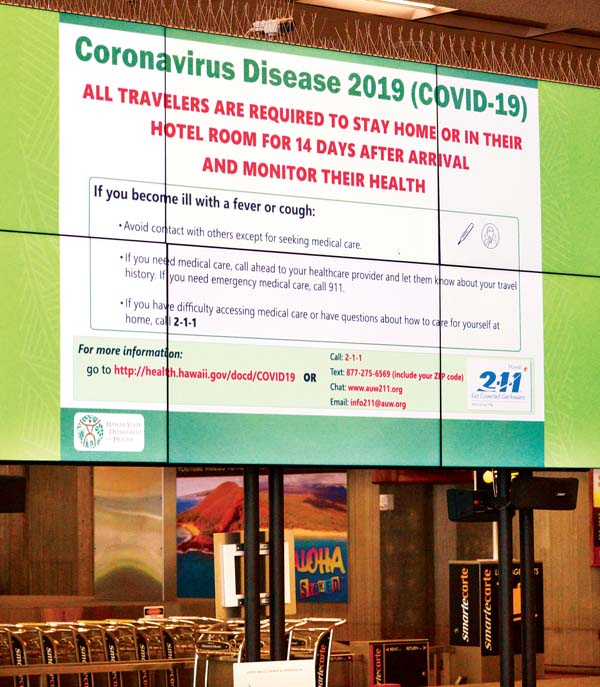
A digital video display at the Kahului Airport in April 2020 reminds travelers of the state’s 14-day quarantine. Discussing Hawaii’s response to the pandemic moving forward, the state’s health director said the strictest measures imposed in the earliest days of the pandemic may not be needed if cases surge again.
Signs at Kahului Airport in August remind people to keep their masks on and social distance. As the pandemic improves and cases decline across Hawaii, officials are dropping restrictions but say they will continue to monitor for variants and provide weekly data to help inform the state’s COVID-19 response moving forward. The Maui News / MATTHEW THAYER photos
A digital video display at the Kahului Airport in April 2020 reminds travelers of the state’s 14-day quarantine. Discussing Hawaii’s response to the pandemic moving forward, the state’s health director said the strictest measures imposed in the earliest days of the pandemic may not be needed if cases surge again.
Trending
Hawaii is moving in the right direction as COVID-19 case counts hit a downward trend across all counties and as residents have learned to "coexist with the virus," but health officials said Wednesday that they will still continue variant surveillance and sequencing, monitoring for any new variants and providing testing and weekly data.
"We're in a good place right now, we're moving in the right direction. We have a little ways to go to get back to our pre-delta baseline, but we're definitely moving in a good direction," said state Department of Health Director Dr. Elizabeth Char during an informational briefing with the Senate Health Committee and the House Committee on Pandemic and Disaster Preparedness. "Remember the basics -- it's worked thus far, it makes sense, the science absolutely supports it."
The four island county mayors also joined the virtual meeting to discuss current COVID-19 trends and future responses to the pandemic.
In the event that there is another surge, multiple factors are taken into consideration to decide whether reimplementing mandates is necessary, though Char does not believe that the same "draconian measures" will be needed.
"We have learned so much and we have evolved along with this virus that what we did with this virus early on may not be what we need or want going forward," Char said. "I think the governor is reserving that possibility, but I think moving forward it's how best we serve the community."
Restrictions and mandates are beginning to ease now following Gov. David Ige's announcement that the statewide emergency proclamation will end on March 25.
However, officials will still keep their eyes on main determinants, such as the percentage of hospitalizations caused by COVID-19, case counts, new variants, outbreaks, Centers for Disease Control and Prevention guidance, community characteristics and other indicators.
"It's not a specific number," Char said. "I think it goes beyond that. I think it really needs to be tailored to the communities. We're going to go to weekly reporting, but I think we have a better sense just from all the work that we're doing."
In response to the COVID-19 pandemic, the CDC launched the National Wastewater Surveillance System in September 2020, she added, which can track the presence of the virus in wastewater samples collected across the country.
Health departments can use wastewater as another way for communities to respond appropriately to COVID-19.
"We are trying to ramp that up as quickly as possible," said Char, adding that DOH is trying to get the full system operable by summer.
As of Wednesday, Maui County was 18 new cases a day and a test positivity rate of 3.4 percent, according to the DOH website. The county's vaccination rate is 70 percent of the total population. Ten people were hospitalized with COVID-19 at Maui Memorial Medical Center as of 9 a.m. Wednesday, according to Maui Health.
Another surge is always a possibility, Mayor Michael Victorino said Wednesday, but "we've learned how to be prepared" and how to respond to a pandemic through mitigation strategies, funding, appropriate tools and collaboration between different agencies and the community.
Victorino said with optimism that there have been "very little" problems since repealing the county emergency rules relating to COVID-19 on March 1.
"We're looking forward to some normalcy in our way of life," Victorino said. "This has been very positive for the economy -- people are out there dining, people are doing a lot more shopping and we see our residents who feel that this is what they've been looking forward to for over two years."
Although case numbers are trending down, vaccinations and booster shots will remain available at Maui Memorial Medical Center on Mondays and Fridays, as well as at Minit Medical clinics and pharmacies.
There have been 2.8 million shots administered in Hawaii, better than most states, Char said.
"Our response will evolve as the pandemic evolves," State Epidemiologist Dr. Sarah Kemble said.
Testing is scaling back statewide, Kemble said, but there's a shift toward antigen testing, point-of-care testing and at-home testing kits. In-school testing programs will still be available for the remainder of the school year.
Vaccines for keiki 6 months old to 4 years old are expected over the next few months, she said.
The Health Department is also transitioning from daily COVID-19 data reporting to weekly data reporting. Updates will now occur every Wednesday, starting next week.
To stay on the right track, Kemble said that masks are still "a good idea" when at hospitals and health care facilities, crowded indoor events, schools, congregate living facilities, as well as for those who are immunocompromised or at-risk.
Staying home when sick or getting tested if exposed to COVID-19 will still be pertinent moving forward, Char said.
"I think if we continue with these preventive measures, it will really keep us moving in the right direction," she said.
* Dakota Grossman can be reached at dgrossman@mauinews.com.