
Amid the clean energy push, experts worry some will be left behind
Hawaii Energy Conference panelists mull solutions that won’t burden residents with more costs
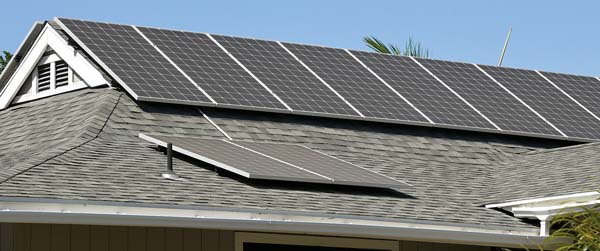
Solar panels are shown on the roof of a Kihei home in October. The Maui News / MATTHEW THAYER photos
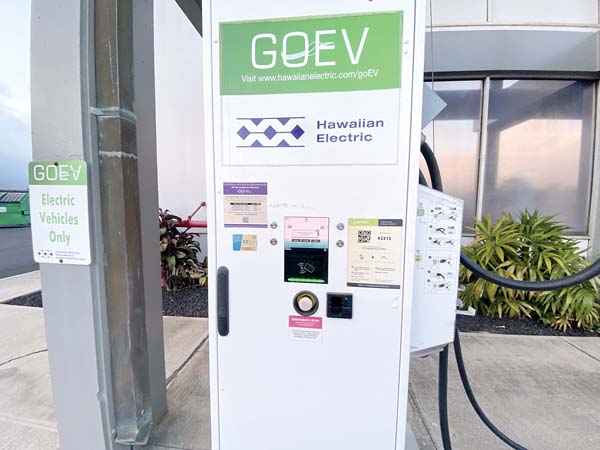
An electric vehicle charging station is shown outside the Hawaiian Electric building in Kahului in March. The Maui News / COLLEEN UECHI photo
Solar panels are shown on the roof of a Kihei home in October. The Maui News / MATTHEW THAYER photos
An electric vehicle charging station is shown outside the Hawaiian Electric building in Kahului in March. The Maui News / COLLEEN UECHI photo
Trending
As Hawaii races toward electrification, one critical piece to the puzzle of reducing carbon emissions, some communities feel like they can't keep up.
The state has set a goal of reaching net zero energy, or having 100 percent of its electricity using clean renewable energy sources, by the year 2045, and the largest culprit of greenhouse emissions is coming from the transportation sector, such as cars, ships, airplanes and public transit.
During the first day of the 9th annual Hawaii Energy Conference on Tuesday, panelists discussed ways to reach electrification without burdening the people.
"A key reason for my advocacy is climate change," Noel Morin, president and founder of the Hawaii Electric Vehicle Association said. "These issues are disproportionately impacting the poor and underprivileged communities and they are also the least capable of adopting some of the much-needed solutions."
Some of these solutions come from swapping gasoline for electricity. There are more than a million cars and trucks in Hawaii, burning more than 30 million gallons of gasoline each month, Morin said, which contributes "significantly to emission and local pollution."
"I should stress as well that since gas cars are only 25 percent efficient, our residents also waste a lot of energy and money, since most of the fuel that goes into our gas cars is lost as heat," he added.
There are changes that can be made to driving habits that can mitigate climate impacts, such as carpooling, implementing a net-zero public transportation system or investing in a full or hybrid electric vehicle, which is 80 percent efficient and can save up to $4,600 over its lifespan compared to gas cars, Morin said.
"There are manufacturers saying that they will be phasing out gas cars in the future. There's this pressure toward electrification in coming up with models and different points so that different needs are going to be met," Morin said. "As we know with competition, we will see price points coming down. It's hard to see right now because the prices of everything are up."
Still, education, funding and resources are needed to mitigate inequities among communities who have not been able to benefit from the green technology movement.
"Like everything in the energy ecosystem, this is going to take all of us together to make this happen," said Jim Kelly, vice president of government and community relations and corporate communications for Hawaiian Electric.
For the industry, it's a challenge to make sure residents of all income levels benefit from the clean energy movement.
"How can you put this together in a package that everybody can participate in without compounding the problems of lower- income people in trying to participate in this well-meaning effort to reduce greenhouse gasses?" said Cynthia Rezentes, a Waianae resident and president of Kealahou West Oahu and Mohala I Ka Wai.
Rezentes shared concerns over the financial feasibility of EVs, EV stations and maintenance, as well as the lack of available infrastructure for charging stations, especially in remote communities.
"The infrastructure in my mind makes the challenge, especially for people who live in more rural areas and are of lower income capacity," Rezentes said. "It's a big risk to take whether or not you want to go that route and add that to the cost of your household expenses when you can't even afford a house, so for me that's the biggest thing."
According to PlugShare, which provides a map of charging stations across the globe, the Kahului-Wailuku-Lahaina areas on Maui have 140 public charging stations (16-24 hours to fully recharge the cars), 26 of which are free. Lanai has two and Molokai has one.
According to the Hawaiian Electric map, there are also five DC Fast Chargers (100 miles per 30 minutes), including one at the Queen Kaahumanu Shopping Center, which costs 28 cents per kWh (9 a.m. to 5 p.m.), 40 cents per kWh (5 p.m. to 10 p.m.) or 38 cents per kWh (10 p.m. to 9 a.m.).
To tackle the issue of access, some governments are opting for creative solutions. Hawaii County Energy Specialist Riley Saito described how county facilities, businesses and nonprofits are trying to move toward a net-zero future through "shared use mobility."
One example is sharing county zero-emission vehicles with the community. During weekday work hours, the officials would use the zero-emission vehicles, but on weekends and holidays, qualified low-income families and nonprofits serving low-income communities could have access to the vehicles to complete their errands or operations.
Outside of transportation, Maui County lawmakers have been pushing for green construction practices and policies to meet net-zero goals and lower costs for residents. Currently, Maui residents struggle under an average electricity rate of 34.85 cents per kilowatt-hour, with rates reaching 38.84 cents on Molokai, according to Hawaiian Electric.
Abigail Anthony of the Rhode Island Public Utilities Commission said during her keynote at the conference that the right rates and benefits are needed in order to encourage residents to convert to electrification.
One of the promises of electrification is that the cost of the system would be spread out over more kilowatt hours and therefore result in lower rates for customers.
"Making sure that the power system is no more costly than necessary is important for keeping the cost of electricity, you know, attractive and competitive with those substitute fuels," Anthony said.
Energy efficiency cannot be achieved unless organizations "manage electric load" through upgraded networks and infrastructure, keeping costs low and competitive, and invest in lower-cost resources. As the smallest state in the country, roughly equivalent to the population size of Oahu, Rhode Island has been investing in long-term, off-shore wind farms.
"Electrification is no longer for early adopters, it's ready to go to scale, but the way we take it to scale is going to matter for the outcome," she said. "This is the place where really rigorous policy analysis matters. If we send out the wrong price signals, we will price out electrification as a climate solution and so this means facing the challenge of good market design head on."
* Dakota Grossman can be reached at dgrossman@mauinews.com.