
‘Golden era’ vs. martial law: Filipinos on Maui see Marcos legacy through different lenses
Some celebrating, others fearful in wake of presidential election in Philippines
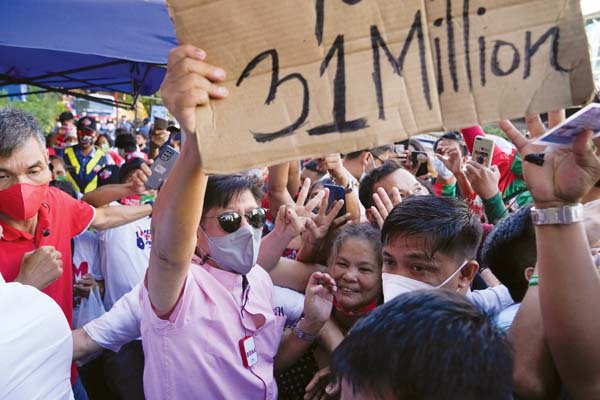
Presidential candidate Ferdinand “Bongbong” Marcos Jr. holds a sign he borrowed from the crowd as he celebrates outside his headquarters in Mandaluyong, Philippines on Wednesday. On Maui, some Filipino residents celebrated the win, saying he shouldn’t be judged by his father, ousted dictator Ferdinand Marcos Sr., while others expressed fears over human rights and democracy amid a Marcos family return to power. — AP photo
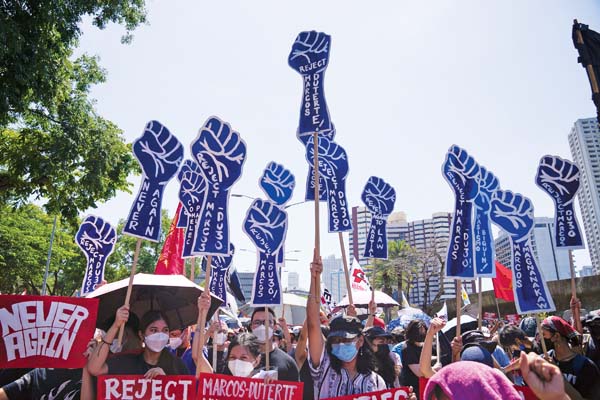
Protesters hold slogans during a rally against presidential frontrunner Ferdinand “Bongbong” Marcos and running mate Sara Duterte, daughter of the current president, during a rally in Pasay, Philippines, Friday. — AP photo
Presidential candidate Ferdinand “Bongbong” Marcos Jr. holds a sign he borrowed from the crowd as he celebrates outside his headquarters in Mandaluyong, Philippines on Wednesday. On Maui, some Filipino residents celebrated the win, saying he shouldn’t be judged by his father, ousted dictator Ferdinand Marcos Sr., while others expressed fears over human rights and democracy amid a Marcos family return to power. — AP photo
Protesters hold slogans during a rally against presidential frontrunner Ferdinand “Bongbong” Marcos and running mate Sara Duterte, daughter of the current president, during a rally in Pasay, Philippines, Friday. — AP photo
Trending
Kit Zulueta Furukawa's hands were shaking as she shaded in her absentee ballot for the 2022 Philippine presidential elections.
The Wailuku business owner born during martial law felt the weight of the elections in her home country -- pitting the current vice president and former human rights lawyer Leni Robredo against longtime politician Ferdinand "Bongbong" Marcos Jr., the son of a former dictator who is remembered by some for ushering in a "golden age" and by others for imposing a reign of political oppression and violence.
"I had to take a deep breath. It was a moment like the world stopped around me," said Furukawa, who cast her vote for Robredo and flew to Honolulu to sign her ballot in person at the consulate. "It was such an emotional vote."
By Wednesday, Marcos Jr. had declared victory after collecting more than 31 million votes to Robredo's more than 14 million votes in an unofficial count from Monday's polls, the Associated Press reported. His vice-presidential running mate, Sara Duterte, also appeared to have won by a landslide.
For many Filipinos in Hawaii, the elections hit close to home, not only for those who voted from overseas or have family there but also for those who remember when Ferdinand Marcos Sr. and his wife Imelda Marcos fled to Hawaii in 1986 after being ousted from power in 1986.
On Maui, the Marcos family's legacy is seen through different lenses, from the economic prosperity that some recall from their youth and the terror that others say their family members felt just for speaking out against the government.
Mike Agcolicol was almost 10 years old and living in the province of Pangasinan when then-President Ferdinand Marcos Sr. declared martial law in the Philippines in 1972.
His mother was a teacher and his father was a lawyer who commuted to Manila and came home to the farm on the weekends. Mostly, Agcolicol remembers the heavy sense of discipline -- the nightly curfews when the roads were empty except for emergencies, the soldiers who told people to cut their long hair, perhaps in hopes of rooting out the rebels who were coming from outside the city, Agcolicol wonders.
Economically, things were pretty good for the Agcolicol family. They didn't go hungry and they owned a secondhand car, a 1964 Falcon, and could travel freely between cities.
For the Wailuku business owner, the thing that sticks out most in his mind from the Marcos era is the infrastructure projects.
"He's a good leader because the economic situation, he'll know what to do, how to borrow, where to put the money in for the projects, infrastructure," Agcolicol said. "Just like all the hydroelectric power plants in the Philippines. Most of the power plants, geothermal plants, power for energy, it's all projects by Marcos. Roadways from north to south, expressways. Cultural centers, convention centers, all over the place."
Agcolicol added that he wasn't taking sides in the election and would have backed whoever won.
"Win or lose we support," he said. "It's for the country."
Maui resident and business owner Angelina Abapo also remembers life during the Marcos era as a time of "peace and order."
"I was in the Philippines during the Marcos regime," Abapo said via text. "And I personally like (how) the late Ferdinand Marcos run the government. His legacy there was peace and order and less corruptions!"
Watching her home country from afar, Abapo said she felt "precarious and at the same time excited as to the results of the election." She believed Marcos Jr. would win, pointing out that he had the support of both the north and the south, where her family is from.
"The resounding victory of BBM and Sara Duterte simply means that the Filipinos including myself believes that their platform of government is the answer to the weakening economy and peace and order in my country," Abapo said.
Abapo said descriptions of Marcos Sr. as corrupt are "propaganda" aimed at destroying the Marcos family's image.
"The fault of the father is not the fault of the son!" she said. "They are the unifying team. Give BBM and Sara a chance to run the country."
Furukawa, however, said Marcos Jr. has spent years trying to change his family's reputation, thriving off a disinformation campaign online that's helped whitewash their past. Hawaii is also "highly Marcos territory," and the favorable picture many Filipino immigrants have of him has been passed down to generations, she said.
"Many families have supported the Marcos family, and if you interact with them, they would say during the Marcos regime, the Philippines was in the golden era," said Furukawa, who hails from Quezon City in Manila. "They don't even mention the martial law, just completely deny the wrongdoing of the Marcoses."
Furukawa said she has family who experienced martial law in the Philippines, including uncles who were involved in student government organizations and rallies and were subject to "red-tagging," essentially getting blacklisted by the government and fearing possible execution. She knows of friends on Oahu who were jailed and tortured, and others who remember the arrival of the Marcos family in Hawaii "with their boxes filled with jewelry and money."
That's why this year's election "brings back some trauma" for the victims of martial law, Furukawa said. Marcos Jr.'s win is not just a loss for Robredo, "it's a loss for the Filipino community."
"This election it was really unprecedented in the way that there's a stark difference in the top two candidates," Furukawa said. "It's a choice between a highly competent economist and lawyer who has proven a great track record, zero corruption issues, versus a strongman who comes from a well-known family with a history of theft, a history of crimes convicted in court, who has billions of unpaid taxes, with not so much to put to his name in terms of projects or accomplishments."
Danielle, who grew up in the Philippines and asked that her last name not be published out of concern for her business, said she voted for Robredo.
"VP Leni Robredo, you can see how much she has helped the Filipinos during the pandemic especially," Danielle said. "I have so many friends who attended the rallies. I watched the rallies online, and it gives hope to us."
Danielle remembers learning about the Marcos regime in high school, about the people who died just because they spoke out against the government, about the news outlets that the government shut down.
She said if Marcos Jr.'s supporters don't want to judge the son on account of the father, they also can't give him credit for his father's work either.
"If he wants to own his dad's accomplishments, why doesn't he want people to connect the bad things his dad did?" she asked. "It's really scary to have a president with that background, even though they've (the Marcos government) built a lot of infrastructure in the Philippines. I think that's what people see. That's why they say oh, they did a lot of stuff. But that was their job."
* Colleen Uechi can be reached at cuechi@mauinews.com.