
Brown’s fate in jury’s hands as murder trial wraps up
Attorneys make final case over whether he killed ex-girlfriend Monsalve

Defendant Bernard Brown (right) stands next to his attorney, Randall Hironaka, as they watch the jury leave the courtroom after closing arguments Wednesday. The Maui News / MATTHEW THAYER photos
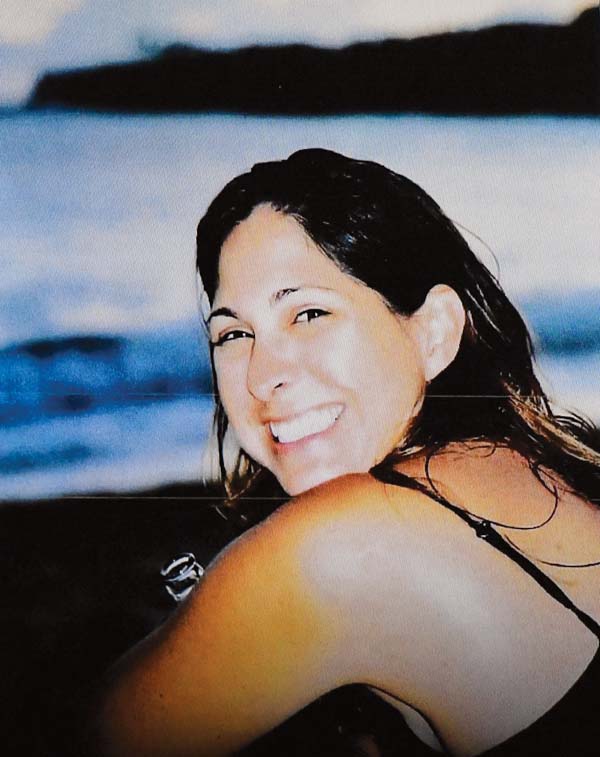
A photo of Moreira “Mo” Monsalve is shown in court as the prosecution wraps up its closing arguments on Wednesday.
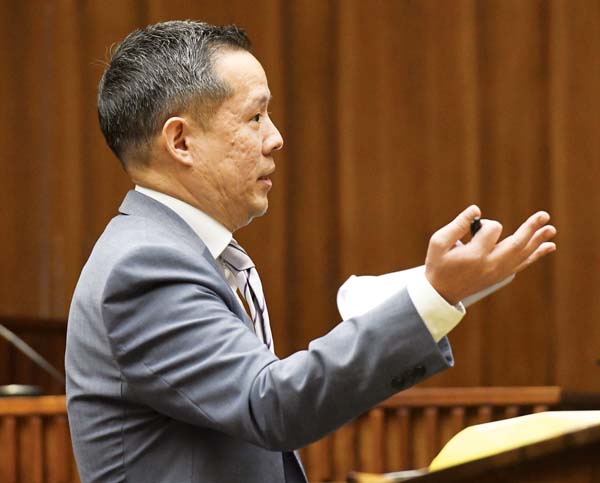
Defense attorney Randall Hironaka makes his case for a not-guilty verdict Wednesday in the murder trial of Bernard Brown. He described the investigation as a “witch hunt” into Brown, the ex-boyfriend of missing Maui woman Moreira “Mo” Monsalve. She was last seen at his Wailuku apartment on Jan. 12, 2014. Deputy Prosecutor J.W. Hupp said Brown’s “mistakes” added up to proof that he murdered Monsalve. The jury began deliberating Wednesday.
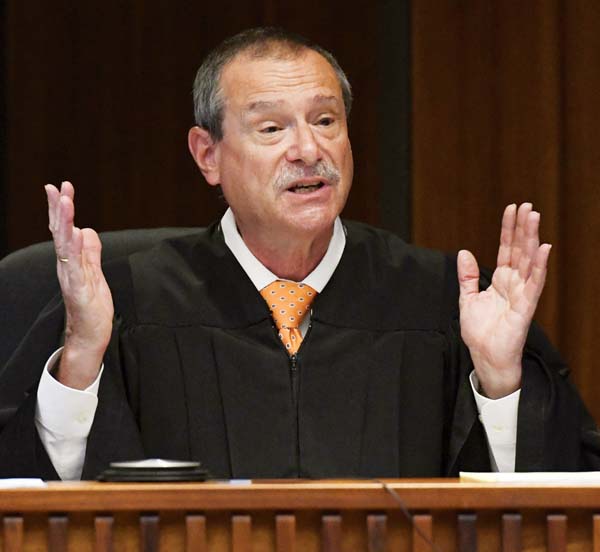
Second Circuit Judge Peter Cahill gives final instructions to the jury Wednesday.
Defendant Bernard Brown (right) stands next to his attorney, Randall Hironaka, as they watch the jury leave the courtroom after closing arguments Wednesday. The Maui News / MATTHEW THAYER photos
A photo of Moreira “Mo” Monsalve is shown in court as the prosecution wraps up its closing arguments on Wednesday.
Defense attorney Randall Hironaka makes his case for a not-guilty verdict Wednesday in the murder trial of Bernard Brown. He described the investigation as a “witch hunt” into Brown, the ex-boyfriend of missing Maui woman Moreira “Mo” Monsalve. She was last seen at his Wailuku apartment on Jan. 12, 2014. Deputy Prosecutor J.W. Hupp said Brown’s “mistakes” added up to proof that he murdered Monsalve. The jury began deliberating Wednesday.
Second Circuit Judge Peter Cahill gives final instructions to the jury Wednesday.
Trending
While Moreira "Mo" Monsalve's body hasn't been found since she went missing eight years ago, her ex-boyfriend Bernard Brown's "mistakes," including what he said and did, added up to proof that he murdered her, a deputy prosecutor said.
"He did a pretty good job of covering up," Deputy Prosecutor J.W. Hupp said during closing arguments Wednesday in Brown's murder trial. "But those little mistakes, those little things he didn't anticipate -- there's a lot of things that came out over time."
Defense attorney Randall Hironaka argued that Monsalve's family and friends and police were focused on Brown from the start and didn't investigate others.
"It was a witch hunt," Hironaka said in closing arguments.
"There was reasonable doubt in this case, a ton of it, based not only on the evidence presented but the lack of evidence," he told jurors.
After hearing from about 35 witnesses in the trial that began Aug. 1, a 2nd Circuit Court jury began deliberating shortly before noon Wednesday. Deliberations were set to resume today.
Brown, 51, has pleaded not guilty to second-degree murder of Monsalve. The 46-year-old mother of three was last seen at his apartment at Iao Parkside in Wailuku the night of Jan. 12, 2014.
Based on the evidence, Hupp said Brown probably killed Monsalve shortly after she arrived at his apartment at about 5 p.m., either before or after his roommate came home "drunk" at 6 p.m., put in earbuds and went to sleep.
"Only the defendant knows why that night he chose to do that," Hupp said. "Was it because she had been drinking and was argumentative? Was it because he realized she really was moving on, that this time the breakup was final? Whatever the reason, he made that decision and there was no turning back."
Although Brown told police he and Monsalve "hung out and watched a movie," his phone records show he made multiple calls to out-of-state numbers that evening, Hupp said.
He said Brown told police and others that Monsalve's son Tyson Felicilda picked her up when she left his apartment, although that wasn't the case.
Activity on both his Facebook account and her phone used the IP address assigned to Brown, Hupp said.
His phone activity stopped in the early morning of Jan. 13, 2014, while her phone was used for multiple searches, including for flights to San Jose, Calif., in Brown's name, Hupp said. He said Brown used Monsalve's phone to do the searches in the middle of the night because his plan was to destroy the phone, which police found in pieces in a dumpster at nearby Papohaku Park on Jan. 16, 2014.
The dumpster also contained a stack of Monsalve's paperwork and her identification to enter her workplace in Kihei. Police searched the dumpster after a man reported finding a pink Coach purse there that was later identified as belonging to Monsalve.
Police at first didn't know if they could recover anything from her phone, which had to be sent to the FBI, Hupp said.
He said Brown dropped off Monsalve's Buick at a mechanic shop in Wailuku the afternoon of Jan. 13, 2014, after finding she had left the keys in the cupholder of his car.
"Nobody else says anything was wrong with the car," Hupp said.
He said Brown had a "head start" in hiding Monsalve's body and cleaning up any evidence because it wasn't until Jan. 14, 2014, two days after she was last seen, that family members and co-workers became worried and reported her missing.
"That's when the wheels started coming off his little bus," Hupp said.
Up to 100 people joined in "massive searches" for Monsalve, he said, and police used cadaver dogs in searches without finding a trace of her.
Hironaka said the evidence presented by the prosecution didn't prove beyond a reasonable doubt that Brown killed Monsalve.
In a statement to police detectives on Jan. 14, 2014, Brown said he was falling asleep when Monsalve left his residence at about 10 or 10:30 p.m. and he thought she was going to leave with her son, Hironaka said. He said the time wasn't exact and Brown didn't say he saw her son pick up Monsalve.
Hironaka said Detective Wendell Loo repeatedly asked Brown if he did something to Monsalve.
"Two days later, it's already started," Hironaka said. "He's being accused of things. He said he didn't do anything."
Brown had been scheduled to leave Maui that day but didn't, Hironaka said.
He questioned the credibility of prosecution witnesses, including some whose testimony differed from their earlier accounts to police.
"You saw some witnesses who exaggerated statements all the way up to witnesses who outright lied," Hironaka said.
He said Savitri Carlson, who talked to Brown after responding to his online post about a table for sale the morning of Jan. 13, 2014, didn't say anything about Monsalve when she first spoke to police. Hironaka said four years later, she talked to police again and said, "Bernard said something happened to Mo."
In the trial, Carlson testified she asked Brown if Monsalve and her children were OK and he said, "No, you don't understand. I got to get out of here."
Hironaka said Carlson "is a microcosm of the witch hunt witnesses in this case."
Brown's ex-girlfriend Sonya Oltmann, who testified he was upset and asked if she could get him a burner phone when he called Jan. 13, 2014, didn't talk to police until months later, Hironaka said. He said it wasn't until five years later that she told police about a voicemail Brown left a week after that call asking if she knew how to erase a hard drive.
Although police evidence specialists tested for blood in Brown's Dodge Nitro, Monsalve's Buick and his apartment, no DNA, fingerprint or other evidence was found to show that Brown killed Monsalve, Hironaka said.
"There's no physical evidence whatsoever," he said.
He said police didn't investigate those who found Monsalve's purse and had her credit cards, although they have arrests or convictions for financial and violent crimes.
"What if they had their phone records and the cell towers put them near Papohaku Park in the middle of the night Jan. 12, 2014?" Hironaka said. "Would it matter to you? Of course, it would."
Deputy Prosecutor Mike Kagami said the woman who was given Monsalve's purse was evasive when she testified about what happened with Monsalve's credit cards, but the evidence showed she and the man who found the purse in the dumpster weren't involved in killing Monsalve.
He argued that Monsalve's phone put her in Brown's apartment throughout the night, with her Facebook account updated using his IP address.
Brown misled Monsalve's friends and "creates false alibis," including a four-second recording that he said was a voicemail she left on his phone at 12:07 a.m. Jan. 13, 2014, Kagami said.
"The defendant himself used Mo's phone to call his phone, trying to say Mo is somewhere else," Kagami said.
Hironaka said there was evidence that Brown and Monsalve had an off-and-on relationship.
"Even after they broke up on New Year's Day, they spent time together, they spent intimate time together," he said. "An intentional state of mind has often been described as desiring or wanting the outcome of death. Did you hear evidence of that, that Bernard desired Ms. Monsalve to be dead?
"It's an emotional case. Obviously something happened to Ms. Monsalve. But you have to decide this case based on the evidence."
Judge Peter Cahill is presiding over the trial.
* Lila Fujimoto can be reached at lfujimoto@mauinews.com.