
Cost, location of school crossing options weighed
Residents support shuttling students to campus as one temporary solution
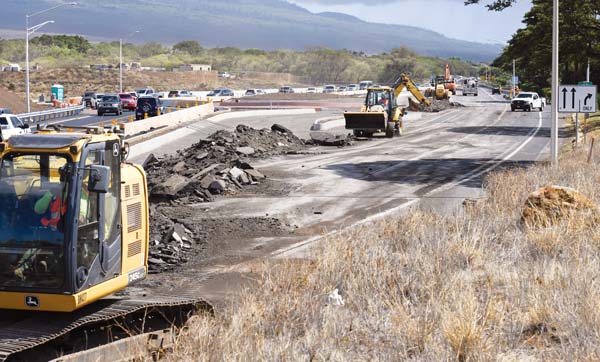
Piilani Highway traffic is diverted onto a completed portion of Kihei’s new, two-lane roundabout. As the state works to finish the roundabout, school officials and community members are considering alternatives such as shuttles to help get students across the highway safely. — The Maui News / MATTHEW THAYER photo
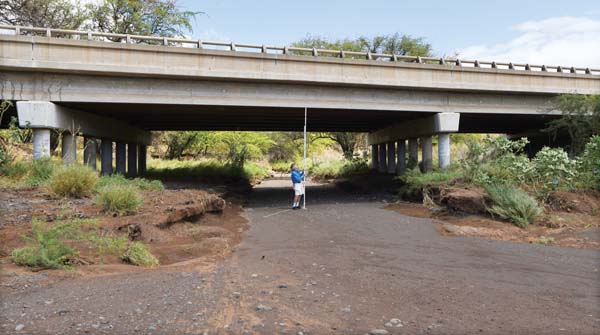
Kihei community member Buck Joiner uses a pair of plastic pipes to to determine the bottom of Piilani Highway’s Waipuilani Bridge is 12 feet above the dry stream bed Wednesday afternoon. Joiner is one of many Kihei residents calling for a pedestrian walkway to be built under the bridge to service Kulanihako‘i High School students, as well as residents and employees who live and work mauka of the busy highway. — The Maui News / MATTHEW THAYER photo
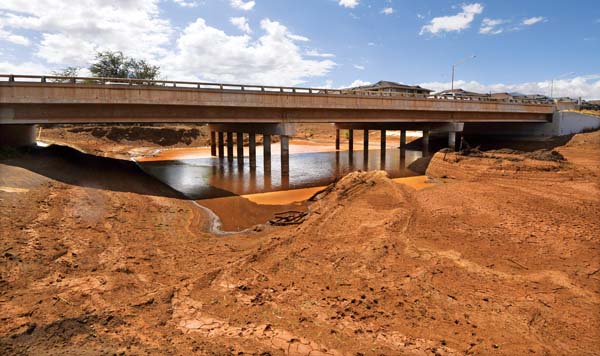
Runoff from a recent storm has turned the pit where crews recently dug out accumulated silt beneath Piilani Highway’s Kulanihakoi Bridge into a muddy pond. Before the debris was cleared it rose to within several feet of the bridge decking. — The Maui News / MATTHEW THAYER photo
Piilani Highway traffic is diverted onto a completed portion of Kihei’s new, two-lane roundabout. As the state works to finish the roundabout, school officials and community members are considering alternatives such as shuttles to help get students across the highway safely. — The Maui News / MATTHEW THAYER photo
Kihei community member Buck Joiner uses a pair of plastic pipes to to determine the bottom of Piilani Highway’s Waipuilani Bridge is 12 feet above the dry stream bed Wednesday afternoon. Joiner is one of many Kihei residents calling for a pedestrian walkway to be built under the bridge to service Kulanihako‘i High School students, as well as residents and employees who live and work mauka of the busy highway. — The Maui News / MATTHEW THAYER photo
Runoff from a recent storm has turned the pit where crews recently dug out accumulated silt beneath Piilani Highway’s Kulanihakoi Bridge into a muddy pond. Before the debris was cleared it rose to within several feet of the bridge decking. — The Maui News / MATTHEW THAYER photo
Trending
KIHEI -- Building an underpass to help Kihei high school students cross busy Piilani Highway could range in cost from $18 million to $30.5 million, while an overpass could cost anywhere from $10.8 million to $20.2 million depending on the location, according to information gathered in a study for the state Department of Education.
Alternative crossing options were presenting during an open house in Kihei on Thursday night as the DOE prepares to open the new Kulanihako'i High School campus in January -- a plan that's contingent on the state building a grade-separated crossing like an overpass or an underpass for students.
But with either option likely to take several years and millions of dollars, the department is looking for short-term solutions in the meantime.
Shuttling students to campus and having a police officer and/or a crossing guard at the roundabout crosswalk are some of the "potential short-term solutions" that came out of community listening sessions and a survey in August, as the DOE seeks to help ease residents' concerns over students crossing busy Piilani Highway to get to the new high school on the mauka side of the highway.
The DOE is seeking temporary fixes until it can comply with a state Land Use Commission condition to install a permanent grade-separated pedestrian crossing, which was imposed in 2013 as the commission approved a boundary amendment to allow the development of the high school. Both the community and Maui County's Planning Department have long supported the condition for the safety of the students.
The Planning Department has said it will not sign off on a certificate of occupancy for the school if the LUC conditions are not met.
Randall Tanaka, assistant superintendent for DOE's Office of Facilities & Operations, said on Thursday that they hope to go before the LUC in November, but they have not been able to get on the docket yet.
He added that the state Attorney General's Office will bring the petition before the LUC.
In the meantime, Kulanihako'i High School Principal Halle Maxwell said on Thursday that she is trying to purchase two shuttle vans which could be used to transport students who may otherwise need to cross Piilani Highway to get to the new school.
She is envisioning having possibly two student meeting sites in Kihei, all on the makai side of Piilani Highway, where the students could be picked up and dropped off in the mornings and afternoons following school.
She added that students who qualify will receive bus service, while other students may be dropped off by their parents.
Currently the new school has 30 freshmen enrolled who attend high school classes at Lokelani Intermediate.
Maxwell said she did not know what freshman enrollment could look like in January at Kulanihako'i, but didn't expect it to be large, knowing that as a parent it would be hard to move a student from one school to another in the middle of the academic year.
The school will only have a freshman class this year, then add one grade each year through grade 12.
"Right now we just have small numbers so that's very doable (to use the shuttle) and that will get us through the end of the year and maybe even next year while all these other solutions are getting put into place," Maxwell said in an interview during a community open house meeting Thursday evening at the Lokelani Intermediate School cafeteria.
Some at the open house said that interim measures and the current discussion over a crossing would not be necessary right before the opening if the DOE had complied with the LUC conditions years ago.
"We skipped a whole step and now we got to go back," said 35-year-old Kihei resident Chase Traphagen, who was at Kamalii Elementary School when she heard of the possibility of a high school in South Maui. "They want to get away with not doing what they knew they had to do the whole time."
Her friend Sarah Olner also pointed out how long the community has waited for the school and the issues surrounding its opening.
"I think people feel they just can't trust the process," she said.
The open house was held to share results of a pedestrian crossing study for the new high school. Feedback on the study was also gathered Thursday.
Present at the open house were DOE officials along with state Department of Transportation officials and third-party consultants -- G70, a Hawaii-based firm handling the Pedestrian Crossing Alternatives Study, and Skog Rasmussen LLC, a Maui-based firm which has organized and conducted the community outreach.
Alternative crossing locations, timelines and costs presented on Thursday included:
• An overpass at Kulanihakoi Street, with estimated completion between 3 1/2 and 5 years, costing $10.8 million to $14.1 million.
• An underpass at Kulanihakoi Street, with estimated completion between 5 1/2 and 7 years, costing $18 million to $23.4 million.
• An overpass at Waipuilani Gulch, with estimated completion between 5 to 6 1/2 years, costing $13.8 million to $18 million.
• An underpass at Waipuilani Gulch, with estimated completion between 6 to 7 1/2 years, costing $23.4 million to $30.5 million.
• An overpass at East Waipuilani Road, with estimated competition between 6 to 7 1/2 years, costing $15.6 to $20.2 million.
Crossing wasn't a top priority
Hawaii Public Schools Superintendent Keith Hayashi was also in attendance and said he was able to talk to community members and parents who gave their insights about current and future pedestrian plans.
"There is a commitment to get Kulanihako'i open," Hayashi said of the DOE, noting it is something the community, faculty and staff deserve.
"It's going to be an amazing school," he added.
He added that so far at the meeting, parents were supportive of opening the school with the short-term measures in place first, then proceeding with the longer-term grade-separated crossing.
In response to community members who have long said the DOE should have fulfilled the LUC condition years ago, Hayashi said, "It is difficult for me to speak to what happened 10 years ago."
"I'm sure that at that point in time, 10 years ago, whatever the situation was, I'm sure the individuals at that time were making the best decision that they could, under the circumstances at that period," said Hayashi, who was named interim superintendent in August 2021 and full-time superintendent in May.
"We are here now. I just want to be sure we are moving forward," he said, noting they are working with the state Department of Transportation to get alternatives in place to ensure the school can open.
When asked why the state hadn't just built the underpass or overpass already, Tanaka said, "There is some degree of responsibility, that we all take. So, OK, fair question. We are doing design work on it now. So it's not like we stopped. In that period, whatever happened, we didn't make that the number one priority."
Tanaka said there were reasons why the overpass or underpass was not top of mind, including that the data they received showed that pedestrians would not use an overpass and rather would want to cross at grade, as it is easier and faster.
"If you don't have some form of transition and they do not use the overpass, what are you going to do?" Tanaka said, referring to the roundabout being constructed.
Tanaka said that DOT's idea of the roundabout came after the LUC set the condition of an overpass or underpass, as the DOT had just begun placing roundabouts across the state. As the DOT learned more about it, officials felt it could provide a safe crossing for the new high school.
As for traffic issues and navigating the roundabout, Tanaka said the community will get used to driving through it.
Tanaka was not sure what state attorneys will be seeking before the LUC, such as an amendment to the current condition, but said that input gathered from the community and from the pedestrian crossing study will be presented to the commission.
Earlier this month, Maui County Planning Director Michele McLean expressed concern at a Maui County Council committee meeting that the community's desire for a safe crossing will clash with the desire to open the school.
"I think there are going to be compelling arguments for that school to open and we have to be prepared to find some middle ground as long as we feel that it is safe," McLean had said.
Tanaka said the DOE is not trying to put the county in a tough situation.
"We want to work with everybody," Tanaka said.
Information about the study can be found at bit.ly/KiheiHScrossing.
* Melissa Tanji can be reached at mtanji@mauinews.com.