
Family claims land for affordable housing is theirs
The heirs of Pehuino want to protect lands in Waiehu
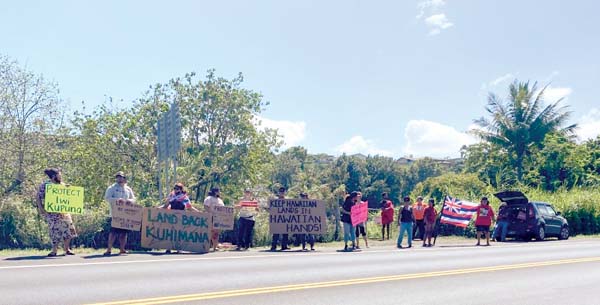
About 40 community members line Kahekili Highway near Waiehu Beach Road Monday, holding Hawaiian flags and waving signs that called for the protection of iwi kupuna, kalo farming, cultural practices, and kuleana lands as an affordable housing project is set to be built nearby. Noelani Ahia photo
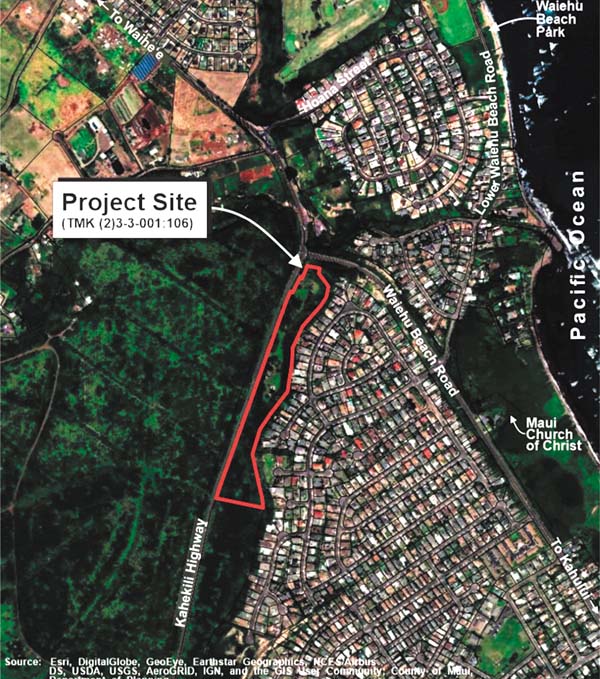
Maui Economic Opportunity plans to build 120, one-, two- and three-bedroom affordable rental units for low-income families. Heirs to Pehuino claim the land is theirs. Maui Economic Opportunity photo
About 40 community members line Kahekili Highway near Waiehu Beach Road Monday, holding Hawaiian flags and waving signs that called for the protection of iwi kupuna, kalo farming, cultural practices, and kuleana lands as an affordable housing project is set to be built nearby. Noelani Ahia photo
Maui Economic Opportunity plans to build 120, one-, two- and three-bedroom affordable rental units for low-income families. Heirs to Pehuino claim the land is theirs. Maui Economic Opportunity photo
Trending
Although notices to vacate and trespassing citations were issued last week, a Native Hawaiian group in Waiehu feels that an undeveloped property slated for a 100 percent affordable housing project is rightfully theirs.
The area they are protecting is where property owner Maui Economic Opportunity plans to build 120, one- , two- and three-bedroom affordable rental units for low-income families earning 30 to 60 percent of the area median income with monthly rents starting at around $569 for a one bedroom.
The campus in Waiehu will include a MEO Head Start Center and community center to be used by the residents and keiki.
Identifying themselves as the heirs of Pehuino, a family is fighting for the lands, saying that the property was granted to their ancestors via an award from the Land Commission back during the Great Mahele land redistribution centuries ago.
Following the notices issued on Oct. 17 by MEO, about 40 community members came out to show support for the family by lining Kahekili Highway near Waiehu Beach Road on Monday, which was the deadline to vacate. They held Hawaiian flags and waved signs that called for the protection of iwi kupuna, kalo farming, cultural practices, and kuleana lands.
"This is ancestral land, this is where their ancestors are buried," said family liaison and advocate Noelani Ahia on Tuesday.
The housing project "threatens the cultural sites and their cultural practices and their relationship to the land," Ahia added.
MEO Chief Executive Officer Debbie Cabebe said that individuals have been unlawfully trespassing, and sometimes living in tents, on the property, which is why the notices were issued. This has slowed an "urgently needed" affordable housing project that was supposed to break ground last year.
"We respect the people, this land and the process to ensure that all legal rights are maintained. It is for this reason that we embraced the exhaustive judicial process, which found, without question, that Maui Economic Opportunity is the legal owner of record with a clear title dating back to King Lunalilo," Cabebe said in a statement. "Claims of ancestral interest in the property have been deemed without merit by the courts."
MEO said that the property is a Royal Patent Grant, an outright purchase of government land, and has traceable records of the land transfers.
She also said that no significant archeological sites and no iwi kupuna, have been identified to date, however, monitoring will continue throughout the project and developers will follow any necessary protocols.
"We would never disrespect the people ever, but this has been fabricated after there was notification that there was going to be a development," Cabebe told The Maui News on Tuesday. "We're a community-action agency. We're trying to help our community, we're not trying to do anything that would harm anybody, that's never something we would do."
When MEO acquired the property in 2005, the land was overgrown with vegetation and was littered with abandoned vehicles, appliances and drug paraphernalia, Cabebe said. The nonprofit cleared the property and began hosting its reintegration programs for incarcerated individuals as well as cultural programs there.
After the programs' funding ended around 2017, MEO looked for other uses of the property so that it wouldn't get overgrown again, Cabebe said.
Things got complicated in 2021 when MEO, in partnership with Hale Mahaolu, announced the plans for the Ke Kehua 100 percent affordable housing project, which sparked the interest and concern of the heirs.
"They weren't super concerned until the development was coming up because prior to that, no one was bulldozing in there or doing anything that was super problematic ... . Right now, their main objective is to protect it from desecration and to continue building their own relationships to the land," Ahia said. "I have personally advocated for iwi protection for many years and I can tell you, unequivocally, that some archaeologists are paid by developers for an outcome. They are paid not to find sites during inventory surveys in order to speed up the permitting and construction process."
The family is not against affordable housing, Ahia noted, but "it's inappropriate to do any housing project on any land where they don't have a clear title."
Cabebe said that at first, there were only a few people coming and going on the property beginning in 2021, but it has recently grown into several encampments and parked cars. Kalo has been growing on the property, too.
But Ahia said, "There are people who are staying there to keep watch, to take care of the aina and to protect."
In an effort to settle claims, MEO filed suit and went to court in July, with the judge ruling that the nonprofit has "possessory and title interest" of the property, Cabebe said.
With the safety assistance of the Maui Police Department, MEO issued trespassing and eviction notices on Oct. 17 and gave dwellers a week to exit the premises. There was only one individual on the property at the time of the citations.
MEO reached out to an area shelter in the event that relocation assistance is needed.
The eviction date passed and "they're still there," Cabebe said.
"We're still going to move forward with the project," she said. "We've been serving this community and helping low-income people since 1965 ... . We just want to service the community. There is no financial interest for us, we just want what's best for the community and the people we serve every day."
* Dakota Grossman can be reached at dgrossman@mauinews.com.