
Maui, Hawaii island focus of beetle weed-control project
Effort to release insect to stop spread of cane tibouchina could start within a year, state says

Adult Syphraea uberabensis beetles feed on cane tibouchina. Studies showed that the plant struggled to grow back after an attack by the beetles. Lon Bulgrin photo
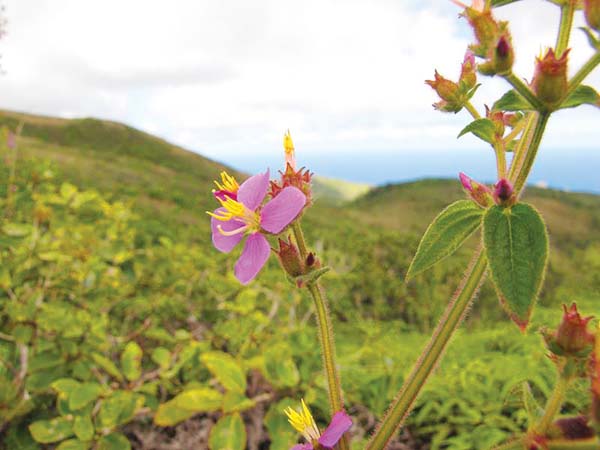
Notable for its pink-and-purple flowers and tall hairy stems, cane tibouchina is an invasive weed found throughout Hawaii’s pastures and forests. FOREST and KIM STARR photo

Cane tibouchina grows along the Waihee Ridge Trail on Maui in 2020. FOREST and KIM STARR photo
Adult Syphraea uberabensis beetles feed on cane tibouchina. Studies showed that the plant struggled to grow back after an attack by the beetles. Lon Bulgrin photo
Notable for its pink-and-purple flowers and tall hairy stems, cane tibouchina is an invasive weed found throughout Hawaii’s pastures and forests. FOREST and KIM STARR photo
Cane tibouchina grows along the Waihee Ridge Trail on Maui in 2020. FOREST and KIM STARR photo
Trending
Starting with high-density areas on Maui and Hawaii islands, a Brazilian beetle that eats cane tibouchina and other related weeds may be released over the next year to help keep the invasive plants from taking over.
The state Departments of Agriculture and Land and Natural Resources said that these insects, Syphraea uberabensis, could help to control cane tibouchina, known as Tibouchina herbacea, a noxious weed native to southern Brazil, Uruguay and Paraguay. It now grows thick in Maui's forests and outcompetes native species.
Syphraea uberabensis is a small beetle whose adults and larvae feed on the invasive plant in the beetle's native region of Brazil, according to the final environmental assessment for the project that was published last month in the Office of Planning and Sustainable Development's "The Environmental Notice."
The DLNR plans to release the beetles on state lands as a form of biocontrol against the invasive plants.
Each tibouchina can produce hundreds of seed capsules that can in turn produce up to 700 seeds the size of a grain of sand. These tiny seeds are easily dispersed through the wind or by wild animals, humans, vehicles or water, according to the EA.
In Hawaii, the semi-woody upright shrub has become prominent in forests on Maui, Molokai, Lanai, Oahu and Hawaii island. Once established, cane tibouchina grows very dense and is difficult to walk through, which can displace native plants and vegetation.
Attempts to control the plant have included the use of herbicide and mechanical removal, but these methods have proven to be costly and not super effective, The Nature Conservancy said, which is why the state is now turning to biocontrol.
Residents involved in conservation work supported the project in letters to the state.
"This weed is very difficult to treat because it is able to access all parts of the mountain since it is wind dispersed," Kula resident Andrei Stanescu, a field assistant who works in the Mauna Kahalawai watershed, said in written testimony included in the EA. "The use of this beetle as a biocontrol would help us to slow the spread of Tibouchina and because manually pulling this weed often causes its seeds to further spread and opens up new habitat for its seeds to spread locally in the disturbance created by pulling."
Olowalu resident Jill LaBram, operations manager for the Mauna Kahalawai Watershed Partnership, said this weed is particularly bad in "pig disturbed and landslide impacted areas."
"It also impacts streams and waterways," LaBram wrote in a letter. "We need this agent as we have no other practical recourse to control it."
Populations of the beetle are expected to increase to effective levels on the target plant within a few years at release sites, according to the DLNR.
"Biocontrol can provide a long-term, cost-effective, and environmentally-friendly solution," the report said.
The costs for distributing the insect for management will be relatively low, the report said, and facilities, equipment, and personnel needed for rearing the insect are simple and minimal.
Establishing self-sustaining populations in field sites statewide likely can be accomplished within one year with a few staff working only part-time -- about $40,000 for one technician over one year. There may be other costs, too, which weren't specified in the report.
The pre-release study was conducted over two years with a $75,000 grant from the Forest Service. Another $75,000 investment will likely cover costs of post-release monitoring.
Agencies contributing to this effort include the USDA Forest Service, state Department of Agriculture and the DLNR. Invasive species committees, watershed partnerships and others involved in weed management are expected to be active partners in identifying release sites and helping to monitor initial establishment at some release sites.
The DLNR told The Maui News last week that the anticipated timeline for the initial releases would be within a year from now, including the time it takes to get all the permits. However, it could be delayed if the regulatory process is slow.
From there, it could take multiple years for the biocontrol insects to populate and be seen throughout the environment, the department added.
* Dakota Grossman can be reached at dgrossman@mauinews.com.