
‘Go-for-broke’ spirit of Maui veterans captured in portraits
Photographer Shane Sato has made it his mission to tell the stories of nisei veterans
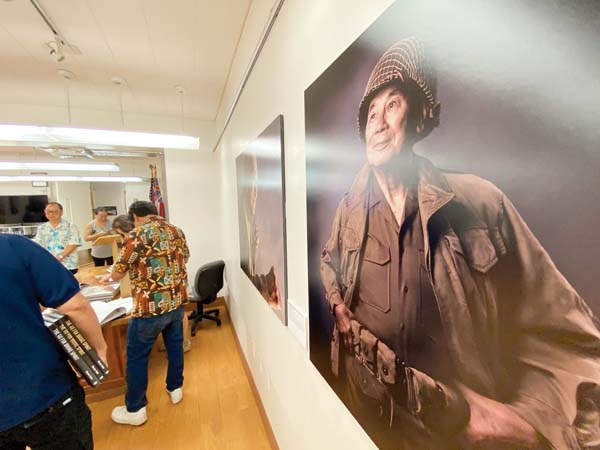
Ike “Mano” Kawahara’s portrait stands tall over the Nisei Veterans Memorial Center exhibit on Sunday afternoon. Kawahara was one of the young Maui boys who trained for the Olympics by swimming in the canals on Maui, but the cancellation of the 1940 and 1944 Olympics during World War II essentially shattered his hopes. The Maui News / COLLEEN UECHI photos

Jill Gushiken (left) of Kahului and Brenda Yospe of Haiku peruse the portraits of Maui’s nisei veterans on display at the Nisei Veterans Memorial Center on Sunday afternoon. Both had grandfathers who were placed in internment camps during the war. Gushiken said her grandfather, a Buddhist priest, was interned on the Mainland even though his sons were fighting for the U.S. She has a photo of her uncle in his military uniform visiting her grandfather in the internment camp.
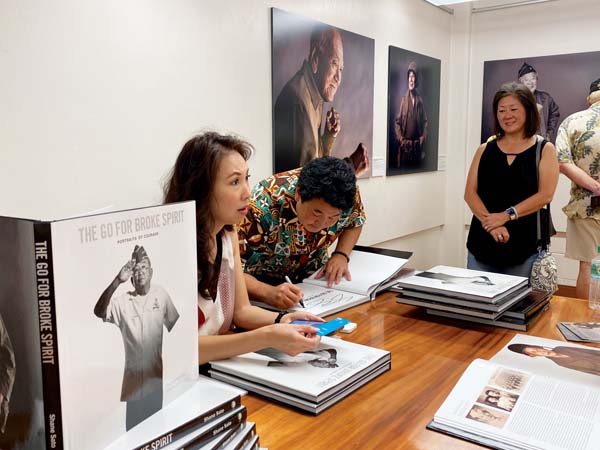
Photographer Shane Sato (center) signs some of his “Go For Broke Spirit” portrait books of nisei veterans alongside his wife, Claire Sato (left) and cousin Joanne Sato (right).

Photographer Shane Sato (from left) poses for a photo with Joni Kawamura of Kahului and Charlene Yashiro of Pukalani, the daughters of the late Willie Goo, whom Sato photographed.
Ike “Mano” Kawahara’s portrait stands tall over the Nisei Veterans Memorial Center exhibit on Sunday afternoon. Kawahara was one of the young Maui boys who trained for the Olympics by swimming in the canals on Maui, but the cancellation of the 1940 and 1944 Olympics during World War II essentially shattered his hopes. The Maui News / COLLEEN UECHI photos
Jill Gushiken (left) of Kahului and Brenda Yospe of Haiku peruse the portraits of Maui’s nisei veterans on display at the Nisei Veterans Memorial Center on Sunday afternoon. Both had grandfathers who were placed in internment camps during the war. Gushiken said her grandfather, a Buddhist priest, was interned on the Mainland even though his sons were fighting for the U.S. She has a photo of her uncle in his military uniform visiting her grandfather in the internment camp.
Photographer Shane Sato (center) signs some of his “Go For Broke Spirit” portrait books of nisei veterans alongside his wife, Claire Sato (left) and cousin Joanne Sato (right).
Photographer Shane Sato (from left) poses for a photo with Joni Kawamura of Kahului and Charlene Yashiro of Pukalani, the daughters of the late Willie Goo, whom Sato photographed.
Trending
KAHULUI -- Masao Motooka had returned home to Hana after World War II when he was asked to help build a coffin for Charles Lindbergh.
The famed aviator was losing his battle with lymphoma and wanted a coffin made of local materials near his home in Kipahulu. Motooka and local carpenter Yoshi Okada spent an entire Saturday making the coffin for the 6-foot-3 Lindbergh out of "green" eucalyptus wood, a material so hard that they had to drill the holes, and so heavy that they couldn't lift it when it was done.
Against his doctors' advice, Lindbergh returned to Maui during his last days, and Motooka considered him a friend.
It's one of photographer Shane Sato's favorite anecdotes from Motooka, the kind of story that emerges through years of listening to and earning the trust of veterans who so rarely spoke of their life experiences during and after the war.
And it's one of the countless stories he coaxed out of veterans who sat for their portraits during Sato's 20-year effort to capture the photos of nisei veterans across the country.
"When I first started, I did not know that I was going to be taking pictures for a book," the Los Angeles-based photographer told a group of Maui residents, veterans and family members at the Nisei Veterans Memorial Center on Sunday afternoon. "I did not know the reason why I was taking these pictures. I just felt that it needed to be done."
Sunday marked the grand opening of an exhibit at the center that features Sato's portraits of 14 of Maui's nisei veterans who appear in his two books: Hiroshi Arisumi, Willie Goo, Barney Hajiro, Takeo "Ike" Ikeda, Ike Kawahara, Takashi Kitaoka, Harry Kiyabu, Masao Motooka, Masaru George Nakasato, Ed Nishihara, Seiya Ohata, Harold Okumura, Tsutomu Tom Yamada and Yoshito "Toe" Yoshino.
The veterans are dressed in their military attire, thick brown uniforms that hang heavy over their thin frames. Lahaina-born Yoshino holds a fighting stance, like he's ready to jump back into the fray all over again. Hana-born Kiyabu has his eyes closed as if in prayer, which he said he often turned to during the war. Puunene-born Hajiro is looking down pensively as he wears his prestigious Medal of Honor, earned for his role leading the charge up "Suicide Hill" to rescue the Texans of the 141st infantry in the battle of the "Lost Battalion."
"When I try and take the photos, I really try and bring out some of the personality in the veteran or the subject, whether that be somber, whether that be strong . . . different types of emotion. It's just what I see in them," Sato explained.
Goo's daughters, Joni Kawamura and Charlene Yashiro, snapped a photo with their dad's portrait -- he's flashing a carefree local boy shaka -- in the exhibit on Sunday afternoon. They said they got to share Sato's first book with their father before he died in 2018.
"It's so beautiful," Yashiro said.
"He put a lot of thought and it captures, I think, their personality," Kawamura added. "It was very nice when he took the pictures. They're so beautiful."
Sato took more than 200 portraits and ending up publishing 160 between his two books, "The Go For Broke Spirit: Portraits of Courage," and "The Go For Broke Spirit: Portraits of Legacy."
"People always ask, 'why did this project take so long?' And I'm sure you know nisei men, and they're not ones to really volunteer and take their pictures or stand out or really want to make a fuss," Sato said.
Every time he went on vacation to Seattle, Maui or Oahu, he'd stop at the local veterans club and see if anyone wanted to take a picture.
"Most of the time it would be no, but sometimes I would go to the wine club nights, and I would let them drink a little bit, and then hopefully I'd get a couple volunteers," Sato said.
Sometimes, even that wouldn't work, as veterans would send him circling the room to other veterans that they thought would be more important or more willing to take their photo. Sato would get caught in an endless "merry-go-round" of requests, much to the veterans' amusement.
"Every once in a while you'd get a veteran who felt sorry for me or something, or just said, 'OK, let's get rid of this guy. I'll take a photo.' They're usually the leaders, and I was able to get some photos," Sato said.
Slowly, his collection began to build throughout the years.
"Funny thing is, is that as the project went into the mid-2000s, more and more people started to volunteer," he said. "Maybe it's because they saw their grandkids. Maybe they felt it was time to share their story. But the project really took a lot of shape much later in life than when I first started."
On one trip to Colorado, he was doing a photoshoot when the heater broke down. Cold and convinced he'd been "tricked" into getting his photo taken, one reluctant veteran in his 90s tried to leave the shoot. Sato, thinking quickly, asked the man what he'd done when he was young.
"I was a boxer," the veteran said.
"Were you good?" Sato asked.
"Of course I was good," the veteran shot back.
"I bet you want to hit me right now," Sato said. "And he goes, 'yeah.' So I said, 'OK, here, why don't you give me your best shot?'"
The two snapped a photo of the veteran taking a mock punch to Sato's chin. The veteran lightened up and agreed to let Sato take his portrait, and it became the cover of the second book.
"It's the persistence, I always say, trying to keep up these stories and trying to keep up the work, because even though it was very difficult, if I didn't keep on trying, if I didn't proceed to try and get this man to come back, I would've never gotten a shot like this, which is actually one of my favorite pictures," Sato said.
He said it's that kind of persistence that's needed to get veterans to keep telling their stories before it's too late. For Sato, it's a personal mission. His Maui-born father and California-born mother -- who was interned at Poston War Relocation Center in Arizona -- told him very little of their experiences as Japanese Americans during World War II, and he hopes his coffee table books will be the conversation starters that get families connecting about their history.
"Too many times when I met different veterans, I heard them say, 'Oh, my son or my daughter, my family, they don't care. They don't want to hear my story.' And then I would talk to the sons and daughters (who said) 'Oh, he doesn't want to talk. He doesn't want to say. He never shares his story.' And it's this vicious cycle that we have to try and break," Sato said.
Sato, who'd been planning to go on tour before the pandemic hit, said he hopes to get grants to continue bringing exhibits to other places around Hawaii and the rest of the country, "hopefully in places where they don't know anything about this."
At the Nisei Veterans Memorial Center in Kahului, the exhibit will be on display until the end of January.
For more information, visit nvmc.org.
* Colleen Uechi can be reached at cuechi@mauinews.com.