
Farmers losing coffee hopeful for new solution
Officials propose using wasp to prey on beetle that’s killing coffee plants
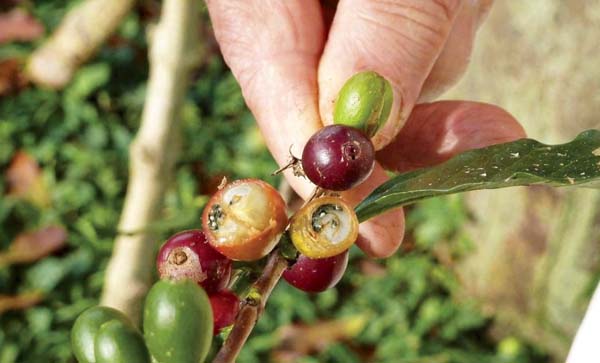
Eggs and larvae of the coffee berry borer can be seen inside a coffee bean. As the invasive pest continues to do damage to vast swaths of local farmers coffee farms, agricultural officials are proposing the use of a parasitoid wasp to control the beetle. — Photo courtesy of USDA/UH-Manoa
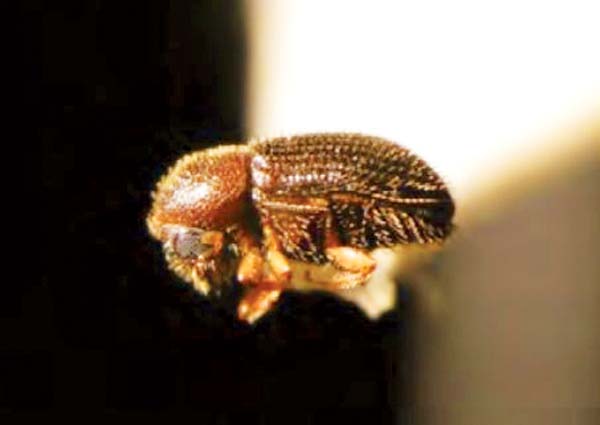
The coffee berry borer was first found in Hawaii in 2010 and has proven to be “the most serious pest” of the plant in most coffee-producing countries. — Photo courtesy of state Department of Agriculture
Eggs and larvae of the coffee berry borer can be seen inside a coffee bean. As the invasive pest continues to do damage to vast swaths of local farmers coffee farms, agricultural officials are proposing the use of a parasitoid wasp to control the beetle. — Photo courtesy of USDA/UH-Manoa
The coffee berry borer was first found in Hawaii in 2010 and has proven to be “the most serious pest” of the plant in most coffee-producing countries. — Photo courtesy of state Department of Agriculture
Trending
Maui coffee farmers are "cautiously optimistic" about the proposed use of a parasitoid wasp in Hawaii to help control the invasive coffee berry borer, a bug that has caused catastrophic impacts to crops.
The University of Hawaii's College of Tropical Agriculture and Human Resources, in collaboration with the U.S. Department of Agriculture's Agricultural Research Service in Hilo, is proposing the release of Phymastichus coffea, which is a small nonstinging bug whose larvae feed on adult coffee berry borers in their native range in Africa, causing beetle death before it can penetrate the coffee berry and lay eggs.
The coffee berry borer is "the most serious pest" of coffee in most coffee-producing countries, according to a draft environmental assessment released last week in the Hawaii Office of Planning and Sustainable Development's "The Environmental Notice."
"If it has the type of impact that previous releases of this parasite has had on coffee production, I am cautiously in favor of it," said Gerry Ross, owner and operator of Kupa'a Farms, a 6-acre property located on the slopes of Haleakala that has lost 50 percent of its coffee yield due to coffee berry borer infestation.
Though there is always the slight possibility for indirect repercussions or negative impacts that researchers haven't thought of, coffee producers are getting desperate for solutions as they also combat the infectious fungus coffee leaf rust, drought, axis deer and other threats.
"I'm pretty excited about it actually," said Maui Grown Coffee President Kimo Falconer, whose Kaanapali farm is about 500 acres in size and lost about 40 percent of its yield when the tiny beetles first found their way to the property a few years ago. "In terms of farming, (coffee berry borer) is definitely one of the hardest things I've had to deal with, for sure."
Coffee berry borers have caused tremendous impacts for farmers all across Maui, which has led to a "real decrease" in producers, said Ross, who is also the president of the Maui Coffee Association.
"The amount of management that you have to do to keep the levels of infestation, hence the damage to coffee, down to acceptable levels is pretty high," he added.
Falconer said Wednesday that it's been "a constant battle."
Currently, there's only one type of live fungus spray that organic farmers can use to attack coffee borers, which takes about three hours to cover a place the size of Kupa'a Farms every three weeks. The spray has to be used at a certain time of the afternoon when the bugs are flying around or on the outside of the bean.
More work is done to separate and sanitize the coffee berries.
"Once they get inside the coffee berry, you don't have a chance," Ross said Tuesday. "You can't get rid of them, so it's a little, almost fortuitous. You're spraying this stuff every three weeks with the hope that it does work."
In Hawaii, the coffee berry borer was first reported in 2010 in South Kona and soon spread throughout Hawaii island coffee farms via hitchhiking and later to other neighboring islands.
Crop losses due to the coffee berry borer infestation in Hawaii in 2019 were estimated at $7.7 million, according to the Hawaii Department of Agriculture. If left uncontrolled, these pests can infest over 90 percent of coffee berries, the report said.
Considering the success rates studied in other countries around the world, especially in Latin America from southern Mexico to Brazil, the draft environmental assessment supports the release of Phymastichus coffea in a geographically isolated place like the Hawaiian islands.
Overall, the release of P. coffea for the biological control of the coffee berry borer will not result in any destruction or other negative impacts on natural or cultural resources in Hawaii, the report said. Testing has shown that the small nonstinging wasp does not attack any native beetles in the same family.
P. coffea was brought over from Columbia to an insect containment facility managed by the USDA Forest Service at Hawaii Volcanoes National Park for host-specificity testing.
Once permits for the release of P. coffea are obtained, field releases will begin on commercial coffee farms on Hawaii island, Oahu, Maui and Kauai, and mainly where borers are prevalent and where flowering periods are frequent throughout the year.
First releases will be made in South Kona.
"If all goes well with the permitting process, we expect to be able to release Phymastichus in Hawaii in Spring 2023, in time for the next coffee/CBB season," said Mark Wright, professor and extension entomologist with CTAHR's Department of Plant and Environmental Protection Sciences.
Wright said on Tuesday morning that there will be no cost to the farmer to release P. coffea on the property.
"We hope to have the natural enemy established here quickly and provide sustained CBB control," he said.
If that does not happen, CTAHR will consider augmentative releases.
Depending on the flowering season, releases of the parasitoid wasp will be made between 70 and 170 days after flowering periods, which is when coffee berries have less than 20 percent dry matter content, according to the report.
Containers would be placed in a cool box and transported to the coffee field. The wasps would be released in the center of the field to search for new coffee berry borers. They would release about one wasp per 10 beetles.
USDA-ARS, the University of Hawaii and the state DOA will be involved in the release and the ongoing evaluation of the project.
"From my standpoint, it's something that will definitely help because coffee berry borer is causing huge waves in the coffee industry, not just in Hawaii but throughout the world," Falconer said. "It's not going to be the silver bullet that cures everything, but it's a good program with integration."
In the meantime, after Kupa'a Farms has its harvest for the year, Ross said they are planning to cut back their coffee trees to knee height so that there will be no beans next season, which means no coffee income for 18 months.
"But, it also means that we will have no place for a coffee berry borer to raise her kids, and so we're hoping that the year after that we'll have coffee," Ross said.
* Dakota Grossman can be reached at dgrossman@mauinews.com.