
Maui advocates for domestic violence victims see greater need amid holidays
More women and children seeking shelter; calls to hotline are up

The living space at Women Helping Women is shown decorated for Christmas on Friday. The nonprofit said it’s seen twice as many women and children seeking refuge at its shelter this year, with more than it had capacity for after Thanksgiving weekend. — Photo courtesy of Women Helping Women
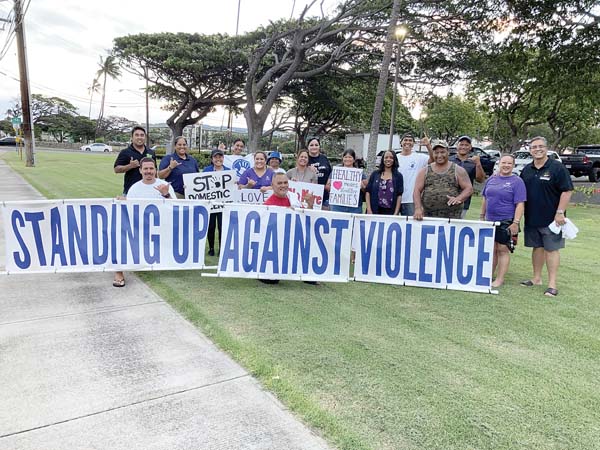
Advocates for victims of domestic violence gather for a sign-waving marking Domestic Violence Awareness month in October outside Queen Ka‘ahumanu Center. Women Helping Women said it’s seen more people seeking shelter, more calls to its domestic violence hotline and “a huge jump” in temporary restraining orders that it’s helped file. — Photo courtesy of Women Helping Women
The living space at Women Helping Women is shown decorated for Christmas on Friday. The nonprofit said it’s seen twice as many women and children seeking refuge at its shelter this year, with more than it had capacity for after Thanksgiving weekend. — Photo courtesy of Women Helping Women
Advocates for victims of domestic violence gather for a sign-waving marking Domestic Violence Awareness month in October outside Queen Ka‘ahumanu Center. Women Helping Women said it’s seen more people seeking shelter, more calls to its domestic violence hotline and “a huge jump” in temporary restraining orders that it’s helped file. — Photo courtesy of Women Helping Women
Trending
Advocates for victims of domestic violence are expecting an increase in need this holiday season, in a year that already has brought twice as many women and children seeking refuge at the domestic violence shelter and more calls to the domestic violence hotline.
"The holidays are the most stressful time for everybody," said Sanoe Ka'aihue, executive director of nonprofit Women Helping Women. "Right around the holidays, we generally see a boost."
After Thanksgiving weekend, there were 31 women and children staying in the organization's shelter, which has a capacity of 26 and has seen its numbers double this year.
"We have families sleeping in living rooms and play rooms," Ka'aihue said. "We always make accommodations for people that need that assistance.
"People are coming to the shelter that have nothing most times or they're not able to grab everything. We basically can provide everything for them and we do."
As part of its 25 Dinners of Christmas fundraiser, the organization is seeking donations of dinners for those staying in the shelter this month.
Ka'aihue said residents are thankful for any meals that are provided.
"We're always excited," she said. "One day someone will donate a steak-and-lobster dinner."
The nonprofit also is accepting Christmas gifts for children and adults.
People can make arrangements to donate by calling (808) 579-9581.
The phone number serves as the confidential 24-hour domestic violence hotline, which has been fielding about 1,200 calls a year.
This year, the number of calls will likely be higher, Ka'aihue said.
She said some calls have been from Mainland residents who want to try to move here to escape domestic violence situations.
"Some people are running away from lives. They think starting a life here is easy, but it truly is not," Ka'aihue said. "We encourage them to find safety and support, whether within their state or a neighboring state.
"We just talk with them, find out what's happening. Sometimes coming to the shelter isn't the answer. Fifty percent of the time, we're able to help them safety-plan, come up with a better solution."
For people who end up in unsafe domestic violence situations on Maui, the organization has a network to help them move to another island or to the Mainland where they have friends or family.
Already this year, the agency has helped in 900 filings of temporary restraining orders, up from 600 or 700 last year.
"It's a huge jump," said Ka'aihue.
Police have said that domestic violence is a top crime in the county, with 279 abuse cases reported in September.
Some other crimes, including assault and terroristic threatening, are related to domestic violence.
"Everything that happens generally stems from domestic abuse, even property damage," Ka'aihue said. "When we talk about issues in our community, I would categorize domestic violence as No. 1.
"Over the past six months, we've seen a lot more cases that have a higher lethality rate."
Those include two murders, including one this month on Molokai, as well as shootings and kidnappings.
"We have been seeing a lot of people that have extreme mental health issues that are also in domestic violence relationships and still lots of substance abuse," Ka'aihue said. "But the biggest thing across the board is chronic homelessness."
She said domestic violence has worsened since the COVID-19 pandemic.
"You've got people that have been operating at a high pace for a long time. What that results in is burnout, hypersensitivity to situations," she said. "Then you've got a whole generation of kids being kept home for two years. Our world just flipped upside down. There's only so much compassion and empathy people will have until everything shifts. We're seeing the results of that this year.
"Domestic violence is the first true pandemic. It's never gone away and it won't go away until we can do more."
Still, "it's not all doom and gloom," Ka'aihue said.
In the pandemic, she said courts allowed some survivors to appear for hearings by videoconference, easing concerns about safety when both survivors and abusers show up.
"We were grateful for that to happen," Ka'aihue said. "We're hoping it could happen in a more permanent way."
In the next couple of years, the nonprofit also hopes to have its own transitional housing for residents after the 90-day limit for staying at the shelter.
Some residents haven't worked before and aren't sure how to manage money, Ka'aihue said.
The year has brought successes, including a stable staff of advocates who include domestic violence survivors.
"When we see a family is thriving, they're doing well and in stable housing, their kids are healthy and happy, those are the ones we treasure and talk about," Ka'aihue said.
"We saw how generous the community is, even in times when things were slim for them," she said. "The community rallied to help as much as they could. I don't think we ever went without.
"We're making the transition slowly into normalcy. We know it's time."
* Lila Fujimoto can be reached at lfujimoto@mauinews.com.