
Work underway to install predator-proof fencing at Kanaha Pond sanctuary
Increasing costs put project over budget; state seeks more funding
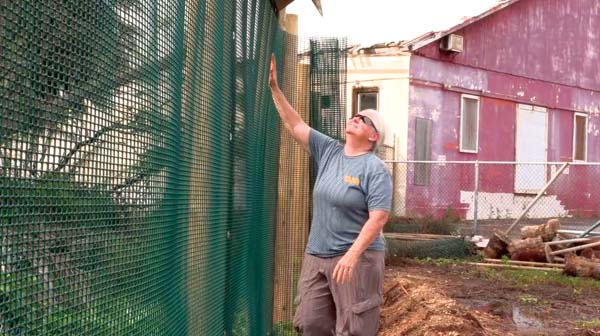
Sasha Smith, Kanaha Pond State Wildlife Sanctuary caretaker, runs a hand along the newer fencing surrounding the sanctuary on Tuesday. — Photo courtesy DLNR
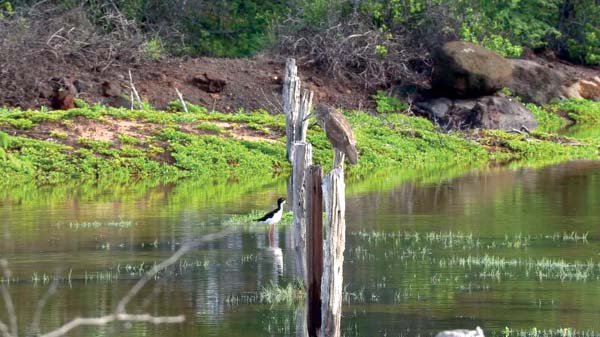
A couple of birds enjoy a peaceful moment in the sanctuary on Tuesday. — Photo courtesy DLNR
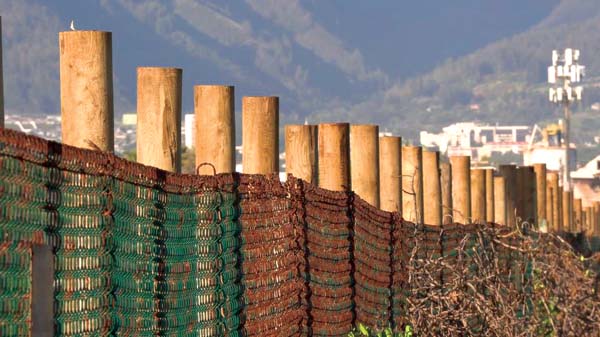
Old, rusted chain-link fencing is shown along the Kanaha Pond State Wildlife Sanctuary on Tuesday. — Photo courtesy DLNR
Sasha Smith, Kanaha Pond State Wildlife Sanctuary caretaker, runs a hand along the newer fencing surrounding the sanctuary on Tuesday. — Photo courtesy DLNR
A couple of birds enjoy a peaceful moment in the sanctuary on Tuesday. — Photo courtesy DLNR
Old, rusted chain-link fencing is shown along the Kanaha Pond State Wildlife Sanctuary on Tuesday. — Photo courtesy DLNR
Trending
The state is seeking more funding to finish replacing an old, rusty fence that surrounds the sprawling Kanaha Pond State Wildlife Sanctuary with predator-proof fencing to keep rats, cats, mongoose and dogs from attacking ground-nesting birds, according to the Department of Land and Natural Resources.
"The old fence is not only not working, but it's deteriorated so much it is actually a hazard. It doesn't keep anything out," said longtime wildlife sanctuary caretaker Sasha Smith of DLNR's Division of Forestry and Wildlife.
The current fence doesn't keep axis deer out, as they can jump over it to feast on many of the 60 species of native plants at Kanaha Pond, DLNR said in a news release Thursday.
The new fence, two and a half miles long, will surround Kanaha. It has a hood or cover on top, which helps prevent feral cats and other predators from climbing over.
"It's as much about keeping predators out, as keeping birds like nene in," Smith said.
Recently, and in the past, individual nene or entire families have gone through holes in the old fence and been hit by cars.
"The fence project is huge for that to help keep our bird families contained in the pond in a safe place," Smith said.
A small section of predator-proof fencing is complete, and posts are up to accommodate more, DLNR said.
The work is being funded by a federal grant from the U.S. Fish and Wildlife Service's National Coastal Wetlands Program and state funds allocated by the state Legislature.
However, in the last year, costs for materials and labor have increased significantly beyond the current budget, according to DLNR.
As a result, the department is working to pursue additional funding to complete the fence around the entire perimeter of the wildlife sanctuary.
The Kanaha Pond sanctuary is the oldest wetland managed by the DOFAW, and despite being sandwiched between the ocean, a busy urban and commercial area and the Kahului Airport, several species of endangered Hawaiian water birds continue to thrive in the sanctuary's ponds. Dozens of species of migratory birds also inhabit the shallow waters and mud flats across the year.
"Kanaha used to be part of Kahului Harbor, it was just a sandy outlet," explained Jeff Bagshaw of the DOFAW Maui Branch. "An early Maui king created fishponds and then during WWII, canals were put in to help drain flood waters from the Maui business district."
Besides providing a home for birds and plants to thrive, wetlands help direct and soak up floodwaters, DLNR said Thursday, which marked World Wetlands Day, established to recognize the importance of the ecological services wetlands provide, not only for wildlife, but for people as well.
Recently the U.S. Fish and Wildlife Service announced nearly $1.5 million in matching federal grants for Hawaii wetlands restoration and conservation, which will provide the majority of funding for three projects, in addition to funding from the state. The projects include:
• Reimagining the wetland landscape in Molokai -- Kahanui wetland acquisition, $401,000 federal grant with a $255,000 state match for a total project cost of $656,000.
• Northwestern Molokai coastal restoration -- Ilio Point predator fence, $460,753 federal grant, $193,805 state match, $653,838 total project cost.
• Huleia Coastal Wetland Phase 2 restoration on Kauai, $627,150 federal grant, $313,575 state match, $940,725 total cost.