
40-year prison term ordered for 2013 killing on Molokai
After initial murder conviction, appeal and case dismissal, defendant finally sentenced
Trending
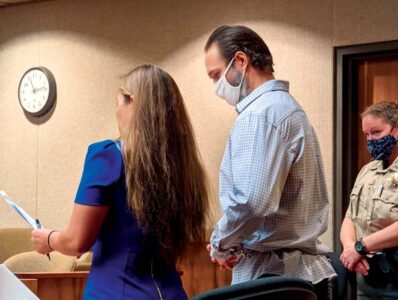
WAILUKU -- After many twists and turns, including a state Supreme Court ruling that led to the dismissal of his case, a 42-year-old man was sentenced Tuesday to 40 years in prison for shooting and killing his then-girlfriend and mother of his four children as she sat on a porch on Molokai in 2013.
The sentencing comes almost exactly 10 years after Marlin Lavoie took a high-powered hunting rifle when he went looking for his girlfriend, 24-year-old Malia Kahalewai, and eventually shot her in the chest on March 20, 2013.
Lavoie, already a felon for a 1999 conviction of first-degree burglary and second-degree robbery, was not supposed to have a firearm at the time.
His record impacted his sentencing Tuesday by 2nd Circuit Judge Peter Cahill, who noted the past felony conviction and Lavoie's actions when he shot Kahalewai while she was seated alongside friends and a child.
Cahill said he needed to protect the public from Lavoie and ordered a consecutive sentence, noting that Lavoie was impulsive the day he killed Kahalewai and "it can happen again."
Cahill said he believed Lavoie was sincere in asking for forgiveness during sentencing, but told him that not only did he take away his children's mother that day, but also took away their father.
During sentencing, Lavoie took a moment to speak and then apologized and asked "for forgiveness."
"I had a lot of time to reflect and I'm just trying to be a better person every day," he said.
On Feb. 23, Lavoie pleaded guilty, in accordance with a plea agreement, to manslaughter based on extreme mental or emotional disturbance, along with pleading guilty to using a firearm in the commission of a felony and being a felon in possession of a firearm.
On Tuesday, Cahill ordered Lavoie be sentenced to 20 years in prison for both the manslaughter charge and using a firearm in the commission of a felony, and that the counts be served consecutively. He was also sentenced to 10 years in prison for being a felon in possession of a firearm. That term will be served concurrently.
He will get credit for the 10 years he has already served.
Kahalewai was staying at a friend's house in the Kawela Barns complex when Lavoie tried to persuade Kahalewai to leave and return to his residence. An argument took place, and she refused to leave. She then went outside and sat on a couch on the porch, continuing to refuse to leave.
Lavoie went to his vehicle and got the high-powered rifle. He then walked onto the porch, pointed it at Kahalewai's chest and fired a single round while friends were around Kahalewai.
The gunshot caused massive internal injuries to Kahalewai, who was pronounced dead shortly after at the hospital.
Friend Nicole Toledo sat next to Kahalewai when she was shot and said Tuesday that it has taken her a long time to get over what happened.
"I hid in my house," she said.
Toledo also said, "March is the hardest month for me," as it marks the time Kahalewai died.
"I hope he gets what he deserves," Toledo said. "What he did was so selfish. He took away someone so special."
Another of Kahalewai's friends, Jamie Maikui, said, "What he did 10 years ago, affected all of us. Malia was my best friend."
Maikui said that since the incident, she has anxiety when she sees men.
"I get scared," she said.
Deputy Prosecutor J.W. Hupp asked for a longer sentence for Lavoie, noting the way he committed the crime as he shot Kahalewai while Toledo sat next to her with a child on her lap.
He said there was no hesitation on Lavoie's part and witnesses recall Lavoie saying something to the effect of "you like leave me" to Kahalewai before he pulled the trigger.
Hupp noted Lavoie's mental health issues that had already surfaced during the older burglary case, but said that "he's responsible for himself."
"There were people willing to help him," Hupp said.
Defense attorney Megan Kau, in asking for a lesser sentence, said they were "not trying to take away from the tragedy that Marlin did," but also noted Lavoie's mental health issues, which 10 years ago were not addressed or talked about like they are now.
For some people with these issues, "they don't understand the nature and the effect it has on them," she said.
Kau said this was not the "sole excuse" or an "excuse" for the incident but a "factor" in conforming to the law.
She added that Lavoie can be a productive member of the community.
Tuesday's sentencing came about eight years after Lavoie was initially convicted as charged by a 2nd Circuit Court jury of second-degree murder and three firearms charges in 2015.
Lavoie was sentenced to life in prison with the possibility of parole, plus another 20 years.
After he appealed the convictions, in November 2019, the state Supreme Court vacated the guilty verdicts and sent the case back for a new trial. The court said testimony shouldn't have been allowed at the trial about five previous acts of domestic abuse by Lavoie.
Lavoie, who had been incarcerated at Saguaro Correctional Center in Eloy, Ariz., was returned to the Maui Community Correctional Center in January 2020.
On the day of his retrial in May 2022, he instead entered a guilty plea of manslaughter based on extreme mental or emotional disturbance as well as using a firearm in the commission of a felony and being a felon in possession of a firearm.
But not long after, in October, Lavoie's case was dismissed without prejudice -- which would still allow the prosecution to recharge Lavoie -- due to a recent Hawaii Supreme Court opinion.
The opinion was handed down Sept. 8 in the case of Richard Obrero, who was arrested in 2019 after allegedly shooting a 16-year-old boy outside the defendant's home in Kalihi on Oahu.
After the grand jury found there wasn't probable cause to indict Obrero, the prosecution filed a complaint and presented evidence at a preliminary hearing where a judge found probable cause to support charges against Obrero, including second-degree murder.
In appealing, Obrero argued that by using the complaint and preliminary hearing process, the prosecution violated state law requiring an indictment or information filing before a defendant can be arraigned in Circuit Court.
Kau filed a motion to dismiss Lavoie's case based on the Obrero ruling. She said in court in October that she believed she had to file the motion in Lavoie's case "to protect the record" because Lavoie wasn't charged by indictment.
Lavoie was then quickly reindicted by a grand jury.
* Staff Writer Melissa Tanji can be reached at mtanji@mauinews.com.