
Initial work done to clean up Haleakala fuel spill
Next steps include taking samples up to 200 feet to gauge contamination extent
Trending
The Maui News
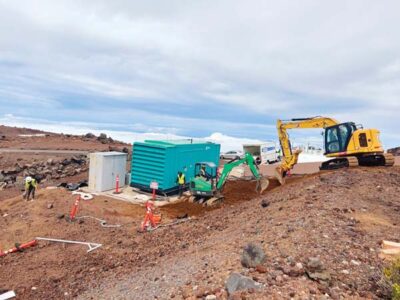
The first phase of soil excavation at the site of the approximately 700-gallon diesel fuel spill atop Haleakala has been completed, with a contract for the second phase of the cleanup soon to be awarded, the U.S. Space Forces Indo-Pacific said.
Phase 1 included excavation of approximately 43 sacks of soil estimated at 84,000 pounds. The work was completed March 22 at the Maui Space Surveillance Complex and was replaced with soil gathered at a nearby site, according to a news release Tuesday.
The removed soil is being safely stored at the summit until a remediation plan is approved in Phase 3. Excavation averaged about 3 feet of depth of previously disturbed soil, due to slope and safety limitations, the news release added.
The military estimated that up to 700 gallons of diesel fuel spilled onto a concrete pad and into the surrounding soil at the Haleakala summit after a pump for an on-site backup generator failed to shut off due to a mechanical issue on Jan. 29. Authorities have said that a power surge amid a lightning storm was the likely cause of the mechanical issues.
Site maintenance personnel discovered the problem the next morning on Jan. 30 and immediately deactivated the transfer pump, the U.S. Space Forces Indo-Pacific has said.
The spill concerned community members along with Native Hawaiian and environmental advocacy groups, who have long raised concerns about the construction of the telescopes on the high-altitude summit that many consider sacred. Haleakala has a unique ecosystem that is also home to endangered and threatened species like the nene and the Hawaiian petrel.
"The Hawaiian community continues to contest the existence of the military industrial complex atop Haleakala including the Daniel K. Inouye Solar Telescope (DKST) and the Maui Space Surveillance Complex," Kahele Dukelow of Kako'o Haleakala said in an email on Wednesday evening. "This most recent fuel spill and the subsequent clean up is just a small symptom of the gross infrastructure that is required to support these military developments. Haleakala will continue to be spoiled, degraded and desecrated as long as these developments persist on our 'aina. Our goal is to remove the military from Haleakala."
The Secretary of the Air Force and the commander of the U.S. Space Forces
Indo-Pacific have apologized for the incident and pledged to work to cleanup the spill and regain public trust.
A contract for Phase 2 is slated to be awarded by the end of this month, the news release said. Once the contract is awarded, a work plan will be developed then approved by the state Department of Health.
Phase 2 involves taking core samples at depths of 40, 80 and 200 feet, to determine the scope of contamination.
Work may start in May. Laboratory results from that sampling will guide the Phase 3 remediation plan. The Phase 2 report should be available by August.
A team of engineers, led by the Air Force Civil Engineer Center, is leading the recovery efforts in conjunction with Native Hawaiian organizations and various governmental agencies.
"We are working seven days a week, weather permitting, in order to safely and respectfully restore this sensitive site," said Col. Marc Bork, Space Delta 2 commander. "We recognize the significance of Haleakala, and we have special obligation to care for it."
Work is also underway to possibly replace the generator with a smaller, more efficient one, minimizing fuel storage requirements.
Part of that discussion involves exploring the addition of a tertiary containment system to prevent a future mishap, the news release said.
The Maui-based 15th Space Surveillance Squadron, which operates the Maui Space Surveillance Complex, is part of Space Delta 2, the U.S. Space Force entity responsible for space domain awareness around the globe, the news release said.
At more than 10,000 feet of elevation, Haleakala's summit provides some of the best astronomical viewing conditions on Earth, which is why it has drawn a host of military and research facilities that have long spurred debate in the community.