
Midwifery licensing bill reaches crucial deadline
Widely discussed measure dies if not pulled out of committee for a vote at Legislature
Trending
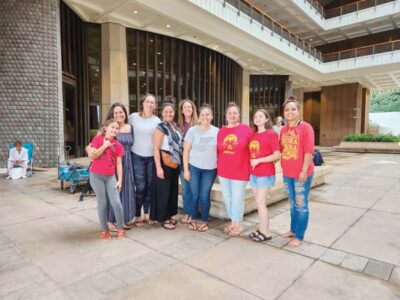
A group of local parents, birth attendants and midwives are rallying in solidarity at the Hawaii State Capitol and across Maui as a deadline approaches today at the Legislature to save a bill on traditional midwifery practices.
The hui has been participating in an ongoing sit-in and rally to urge elected officials, including House of Representatives Finance Committee Chairperson Kyle Yamashita of Maui and House Speaker Scott Saiki, to put House Bill 955 up to a vote today.
Friday was the last day for the Finance Committee to hold a hearing for HB 955, according to the Legislative Reference Bureau's Public Access Room. It was one of three committees that the measure was referred to; hearings were held in the other two committees last month.
The deadline for the bill to cross over to the Senate has passed, however, under House rules, any bill that has been referred to a committee may be recalled from that committee 20 days after referral, which was on Feb. 17 by the Consumer Protection & Commerce Committee.
Today is the last opportunity to revive the bill -- if one-third of representatives (17) vote on the floor in favor of the recall, then the bill can advance to future hearings. Revival does not mean the bill passes just yet.
Maui's Kiana Rowley, an apprenticeship-trained birth attendant who has been advocating on Oahu since last week, said that the bill means much more than women's reproductive rights -- it's about allowing the public to partake in a fair legislative process moving forward.
"Our vigil is not only for the sovereignty of birth but also for fair representation by our elected officials," Rowley, vice president of Pacific Birth Collective, said Wednesday morning from Oahu. "For all of those who are on the fence or who have already decided to oppose, in the spirit of democracy we urge you to hold back and allow this vote to move forward in a fair process, and if it does make it to the Senate, there will be opportunities for your concerns to be heard."
Rowley, who has about 13 years of experience as a birth attendant, health coach and registered nurse, helps between 20-24 women per year do home births on the Valley Isle.
The bill, if passed completely through the House and Senate, would continue to exempt birth attendants practicing on or before July 1, 2025 from licensure requirements, under certain conditions, and expand qualifications for licensure to include the North American Registry of Midwives portfolio evaluation process.
A law passed in 2019, Act 32, required a license for midwifery but allowed some exemptions, including for those operating as birth attendants on or before July 1, 2023, which is why supporters of HB 955 are pushing for passage this year.
Both licensed and exempt midwives go through education and training, whether through apprenticeships, mentoring, certified professional midwife programs, higher education institutions or through traditional and cultural practices passed down.
"Letting this bill die is a huge blow to women's rights to make decisions about our own bodies, and is a tragic disservice to our Neighbor Island communities," said Ki'i Kaho'ohanohano, who's a traditional midwife from Maui, cultural practitioner, member of Pacific Birth Collective and a member of the Hawai'i Home Birth Task Force. "All we are really asking to do is serve our communities."
Since 2019, 28 midwives have obtained licensure but had to financially invest and leave the state to complete the required accredited education because there is no midwifery school here, according to the Hawai'i Home Birth Collective.
Western education training should still be an option for state licensure, but Kaho'ohanohano believes that it should not be mandatory. Losing the exemption would be a "huge injustice" to the cultural knowledge and practices learned from kupuna, she said via phone from the Capitol building.
If the bill dies, traditional and indigenous midwifery practices "will be in jeopardy of cultural erasure," said Kaho'ohanohano, whose five children were all home births.
She said she has practiced midwifery for over 20 years, providing safety, "love and aloha," body autonomy for the mother and comfort for the family during birth.
"We already have a crisis in lack of access to medical services on Neighbor Islands," she said. "By removing so many of the highly qualified birth care providers we've been depending on for decades means a lot more people will be giving birth unassisted, or in cars as they attempt to drive hours to the nearest hospital."
Advocates point to Department of Health data showing that there is no significant difference between hospital and planned home birth outcomes. Home birth risk for neonatal death is 0.1 percent and hospital birth is also 0.1 percent.
Many organizations and individuals testified in support of the bill in February, including the North American Registry of Midwives, Papa Ola Lokahi, Native Hawaiian Health System, National Aboriginal Council of Midwives and others.
But the bill has also drawn opponents, including some certified midwives, local obstetrician-gynecologists and the Midwives Alliance of Hawai'i, which backs licensing midwives.
"Continuing an exemption for self-identified birth attendants creates voluntary midwifery licensure, a permanent ability for anyone to practice midwifery without a license, and invites midwives and birth attendants who have lost their license in other states or had poor outcomes to move to Hawai'i to practice without oversight," the alliance said in written testimony in February.
At the county level, both the administration and council are backing the bill.
Maui County Mayor Richard Bissen Jr. submitted a letter of support.
Last month, the Maui County Council also passed a resolution, introduced by Council Member Keani Rawlins-Fernandez, urging the state to permanently allow birth attendants of all forms to practice midwifery without state licensure. The resolution notes the disproportionate access to health care services in rural areas on Molokai, Lanai and East Maui. It adds that midwifery is one of the oldest women's rights issues in history and that traditional birthing practices of all cultures, including Hawaiian, deserve protection.
Kauai and Hawaii counties submitted similar resolutions.
"Now this last step is negating all that work," said West Maui state Rep. Elle Cochran, who was frustrated with the bill's status Wednesday night. "I just feel for these women."
Cochran was one of eight lawmakers who introduced the bill, along with fellow Maui County state Reps. Terez Amato and Mahina Poepoe. Cochran said it should be a mother's right to choose her birthing options and their midwives.
"I totally support this bill, I think it should see the light of day, I think it should have discussion and it should be vetted," Cochran said via phone. "The one really sad and scary part is, should this die, come July 1, these Native Hawaiian culture practitioners became deemed illegal. The state has now taken away an option and to me, that's not right."
After the Finance Committee did not schedule a hearing, the hui sat outside Yamashita's office on Oahu earlier this month to ask for the bill to be put to a vote. Some flew in from Maui and others flew in from Hawaii island.
The Pacific Birth Collective said the state representative refused to acknowledge his frustrated constituents, so they decided to camp outside his office through the evening, but were asked to leave by Capitol sheriffs.
Yamashita could not be reached for comment on Tuesday or Wednesday.
The organization planned rallies at the Capitol on Oahu and at the county building on Maui on Monday.
Between 10 to 20 people have been camping in tents fronting the Capitol since then to support midwifery of all forms and fair legislative processes, Rowley said.
As of Wednesday, a Change.org petition by Sisterhood Midwifery, whose members include local midwives, has also garnered over 31,000 signatures urging the Legislature to extend the traditional birth attendant exemption.
"Many birth attendants in Hawaii are cultural practitioners who serve our most rural and under-resourced communities," the petition said.
* Dakota Grossman can be reached at dgrossman@mauinews.com.