
Researchers deploy buoy off Maui to collect ocean data
Trending
The Maui News
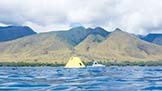
Researchers have deployed a new buoy off Maui that will work alongside uncrewed saildrones to help measure ocean data off multiple islands.
The three, 23-foot Saildrone Explorers began a six-month mission in April to travel around Maui, Oahu, Kauai and Hawaii island sending back real-time data and images to scientists in Hawaii and Washington state who are assessing how climate change and ocean acidification are impacting coastal waters.
A buoy was deployed off Maui in May, and researchers plan to set up two more off Kauai and Hawaii island later this summer, according to UH-Manoa, which is working with the National Oceanic and Atmospheric Administration's Pacific Marine Environmental Lab; the Cooperative Institute for Climate, Ocean, and Ecosystem Studies; and Saildrone Inc. on the project.
The buoys will help collect critical ocean chemistry observations to better assess Hawaii's vulnerability to changes. Researchers also have had two buoys collecting data off the coast of Windward Oahu for more than 10 years.
Data from the buoys will complement the saildrones, whose integration of pH and carbon dioxide measurements gives researchers the ability to better understand whether nearshore waters are accumulating fossil fuel emissions, according to a UH news release. They will be able to develop maps from field measurements to help them look for "hot spots" of ocean acidification.
"Collecting this data is important for Hawai'i because it'll tell us more about different hot spots around each of the islands, where we might want to pay attention to how the water chemistry and water quality is changing in those areas," said Amy Markel, UH-Manoa oceanography Ph.D. student.
The saildrones will zigzag between the island's coastline and 5 kilometers (about 3 miles) offshore. They will only monitor atmospheric and ocean properties and will not collect any data that can be used to identify people, marine mammals or fish locations, UH said. Mariners are encouraged to stay 500 meters (just over 1,640 feet) away from the instruments.
"The saildrones look like sailboats and they're working very close to shore, so if you see them please don't touch them or interfere with their operations," said Christopher Sabine, UH-Manoa interim vice provost for research and scholarship. "They are being remotely piloted and they're operating in safe waters."
The project is funded by a portion of a $50 million gift from Dr. Priscilla Chan and Meta CEO Mark Zuckerberg to the Hawaii Institute of Marine Biology in 2022 to improve Hawaii's ocean health.