
Researchers explore how ‘hedging bets’ can restore coral reef health

Fish swim around a coral reef. A team of scientists led by a UH researcher is offering an innovative approach to choosing coral species for reef restoration. DAMARIS TORRES-PULLIZ photos
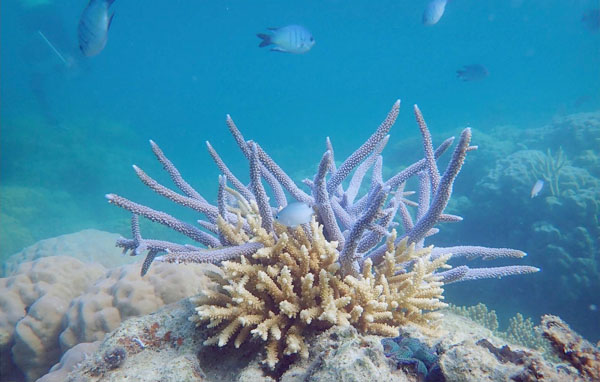
As coral reefs face growing threats, researchers have put together databases of coral species based on their ecological traits to help best select the ideal species for restoration.
Fish swim around a coral reef. A team of scientists led by a UH researcher is offering an innovative approach to choosing coral species for reef restoration. DAMARIS TORRES-PULLIZ photos
As coral reefs face growing threats, researchers have put together databases of coral species based on their ecological traits to help best select the ideal species for restoration.
Trending
The Maui News
An international team of scientists, led by a University of Hawaii at Manoa researcher, is offering an innovative new approach to choosing the best coral species for reef restoration, using a method that's similar to the hedging approach used for investment portfolios.
"The ecosystem services that coral reefs provide for people, such as coastal protection and fisheries, depend upon coral species with a broad range of what are called life history strategies, for example slow to fast growing, mounding to branching shapes, and under to upper storey," said Joshua Madin, study lead author and research professor at the Hawaii Institute of Marine Biology in the UH-Manoa School of Ocean and Earth Science and Technology. "Therefore, restoration practitioners need to consider this range of local species when restoring coral reefs -- much like forest restoration requires more than just fast-growing plants."
The scientists worked together to develop the approach during a workshop organized by the University of Melbourne and the Australian Institute of Marine Science, according to a UH news release Monday. A study on their findings was published in the Journal of Applied Ecology on Sunday.
Coral reefs worldwide are rapidly disappearing due to human-related activity, with global warming being the biggest threat, according to UH. That's made coral reef restoration a growing research field and industry. Most coral reefs comprise tens to hundreds of stony coral species, yet there aren't sufficient resources to restore them all. Methods for selecting species that will best maintain species diversity and ecosystem function are currently unavailable, according to UH.
The research team combined databases of coral species traits with their ecological characteristics, including their resistance to thermal bleaching, to see how best to select sets of species for restoration using a hedging approach, much like that used for investment portfolios.
"Selection based on ecological characteristics is important for hedging against future species loss, whereas trait diversity is important for hedging against the loss of certain ecosystem services, reef-building groups, life history categories and evolutionary variety," said Madin.
This hedging approach provides a simple framework for aiding restoration practitioners in selecting target species for their projects, depending on spatial scale and resources, UH said.
"For example, if a program only has funds to focus on 20 coral species, they would want to focus on the sets of species to get the most ecosystem bang for their buck," said the paper's senior author, Professor Madeleine van Oppen from the University of Melbourne and the Australian Institute of Marine Science. "Current coral restoration programs tend to focus on easy to collect, 'weedy' coral species, which have similar characteristics and cannot support ecosystem services on their own."
The study also found that, if species data are limited, selecting species at random is much better than selecting species that are easy to collect. The extra effort required will pay off in terms of preserving ecosystem services that communities rely on. The method can be applied to any coral reef for which coral trait data are available.
The new approach to selecting coral species is already being applied to a hybrid reef program in Hawaii funded by the Defense Advanced Research Projects Agency. The goal is to create an engineered structure that provides habitat for corals and other reef life while protecting coastlines from flooding, erosion and storm damage.