
Upcountry fires spark debate over water for A&B
State says there wasn’t enough to fight fire; Sierra Club says state is exploiting tragedy

People walk along an EMI diversion at Twin Falls Wednesday. The Maui News / MATTHEW THAYER photos
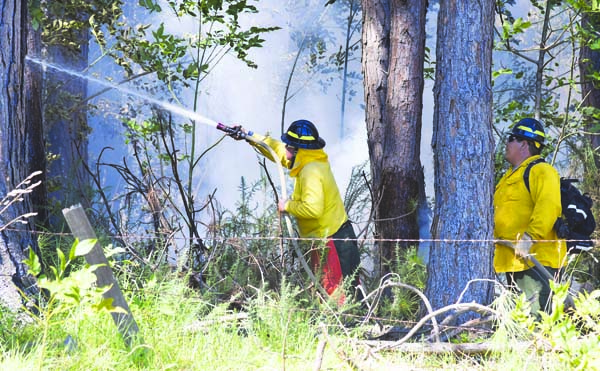
State Department of Land and Natural Resources wildland firefighters battle a blaze in a grove of pine trees near the top of Olinda Road on the morning of Aug. 8.
People walk along an EMI diversion at Twin Falls Wednesday. The Maui News / MATTHEW THAYER photos
State Department of Land and Natural Resources wildland firefighters battle a blaze in a grove of pine trees near the top of Olinda Road on the morning of Aug. 8.
Trending
Citing concerns over not having enough water to fight recent fires, the state is asking the Hawaii Supreme Court to allow more water to be allocated to Alexander & Baldwin and East Maui Irrigation, whose complex diversion system supplies farming in Central Maui as well as Maui County customers Upcountry.
But the Sierra Club, which has been challenging the state's decisions over water allocations for years, says the claims "are without merit," pointing to court documents in which the county says allocations have "been sufficient to combat fires located Upcountry" and saying the state is trying to exploit the recent tragedy.
A hearing was held virtually Wednesday afternoon before the Hawaii Supreme Court. It included arguments by the state Attorney General's Office and an attorney for A&B and EMI -- which support reinstating a previous Board of Land and Natural Resources decision that would allocate more water -- along with arguments by the Sierra Club, which opposes the request. Maui County was also represented at the hearing but has not taken a position on the matter.
The case does not involve water supply in Lahaina.
After the nearly hour-and-a-half hearing, Chief Justice Mark Recktenwald said the court would take the arguments under advisement.
In November, the BLNR approved permits that would allow up to 40.49 million gallons per day to be diverted from East Maui streams. It also denied Sierra Club a contested case hearing, board minutes show.
In June, Judge Jeffrey Crabtree, who also serves as the senior Environmental Court judge for the First Circuit, lowered the amount of water A&B and EMI can take from East Maui streams to 31.5 mgd. He also ruled that the BLNR must hold a contested case hearing upon request if it considered issuing new revocable permits for 2023.
On Aug. 9, a day after the Upcountry wildfires broke out, the state filed a petition with the Supreme Court raising concerns over the amount of water available to fight fires.
"Maui is in peril as it is ravaged by wildfires," the petition said. "Central Maui has no water for fire reserve because Respondent Judge substituted his judgment for that of the agency."
"As a result, there was not enough permitted water to battle the wildfires on Maui this morning."
State Deputy Attorney General Miranda Steed said Wednesday that more entities than just the county are battling the fire, including the state Department of Land and Natural Resources' Division of Forestry and Wildlife. The state's petition also pointed out that Mahi Pono was also involved in fighting the fire near Pulehu Road and that water levels in its reservoirs were "relatively low at the time," leaving the company unsure that the current water levels would be sufficient to support the Maui Fire Department's efforts.
The Circuit Court did grant a temporary stay on court orders for 48 hours to allow for firefighting on Aug. 9.
Steed said they appreciated the court's action, but even still, it takes about a day for the water to flow down from the diversions. Extensions of the stay were granted at the request of attorneys, but the stay has since ended.
Steed said the hurricane winds and the fires, along with issues surrounding climate change, made for a tragic set of circumstances.
"What we are experiencing is an unprecedented set of disasters that it's up to the agencies to respond to and to mitigate for public health, safety and welfare," Steed said. "So we must have a certainty of water available, otherwise it hinders on our emergency management response and that's the ultimate concern."
Maui County Deputy Corporation Counsel Mariana Lowy-Gerstmar said in a declaration that not all the data is available yet on the amount of water available in the county Department of Water Supply's reservoirs to battle the fires as well as all the sources of water used by Maui Fire Department. However, she said both the higher water allocation originally set by BLNR and the lower allocation under Crabtree's ruling "has been sufficient to combat the fires located Upcountry."
Lowy-Gerstmar said that attorneys for A&B and EMI have not renewed the request to suspend the caps imposed by Crabtree and that MFD has not made any recent requests for additional water from Mahi Pono or EMI, though Steed said during the hearing that the companies did get calls from fire captains regarding water during the fires.
But Sierra Club's attorney, David Kimo Frankel, told the court that "facts matter" and "evidence matter." He said the petition "has no basis in fact, which is dishonest, which is shameful."
Frankel said water for firefighting and reservoirs are to be drawn from the county's allocation of 7.5 mgd. Of that amount, 1.5 mgd is for the Kula Agricultural Park, but he said they "never used" that amount per day and estimated the usage could go up to 1.1 mgd at the most, as it did during the summer of 2021, according to Sierra Club's filing.
For domestic uses, the average water used by the county is 2.4 or 2.5 mgd -- over the past three years it has gone up to 4.02 mgd at the most, in February 2022, according to the filing.
Between the ag park and domestic uses, "that's more than 2 millions gallons per day" left over, Frankel said.
"In those 2 million gallons there is certainly 37,000 gallons to fight a fire over five days," he added.
Sierra Club's filed response said that the amount of water required for firefighting is in the "hundred of thousands" of gallons and not "millions of gallons" per day. It cited information from MFD in which one helicopter (using 2,400 gallons per hour of water), one tanker (7,000 gallons per hour), one type 1 engine (1,500 gallons per hour), one type 5 engine (800 gallons per hour) and one utility vehicle (300 gallons per hour) would use a total of 12,000 gallons of water per hour.
And, assuming it is only safe to fight a fire during daylight hours, a fire requiring one of each of these would use 144,000 gallons of water every day, taking into account 12 hours of firefighting time, the response said.
Frankel said the "petition was filed under false pretenses. It mischaracterizes the Environmental Court's actions and statements. It exploits a tragedy. It is without merit. It should be denied and this court should sanction the attorney general."
* Staff Writer Melissa Tanji can be reached at mtanji@mauinews.com.